TM Exclusive | Why Inter-Caste Relationships Still Invite Violence in India

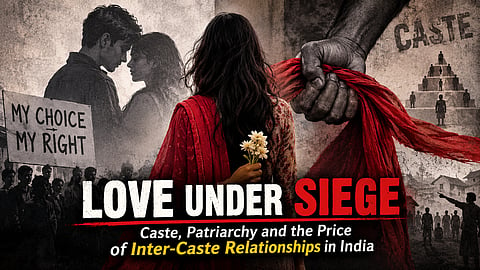
The murder of 21-year-old Saniya in Gujarat, allegedly by her father for refusing to end her relationship with a man from another caste, has once again exposed the deep-rooted hostility towards inter-caste relationships.
A society in which people need caste approval to fall in love or marry cannot claim to have fully embraced modernity. And when a family's so-called honour reaches the point of taking the life of its own daughter, it is the very definition of that honour that must be questioned.
A society in which people need caste approval to fall in love or marry cannot claim to have fully embraced modernity. And when a family's so-called honour reaches the point of taking the life of its own daughter, it is the very definition of that honour that must be questioned.AI generated symbolic image
Published on: 

A father objects to his daughter's relationship. He repeatedly asks her to end it. His opposition is rooted not merely in concerns about her future but in the fact that the young man belongs to another caste. The daughter refuses to give up the relationship. What follows is a horrifying act of violence.

In Gujarat's Anand district, 21-year-old Saniya allegedly paid with her life for exercising her choice.

Initially reported as a suicide, Saniya's death took a different turn after a post-mortem examination revealed that she had been strangled. Her father, Kaushalkumar Patel, was subsequently arrested for allegedly murdering her at their home in Metpur village of Khambhat taluka.

According to Inspector P.J. Bantva of Khambhat Town police station, the incident occurred around 3.15 am on November 9. Police said Patel allegedly used a dupatta to strangle his daughter in the kitchen while other family members were asleep.

The investigation revealed that Patel had been opposed to Saniya's relationship with a man from their village for nearly a year. His objections reportedly stemmed from two reasons: the man's caste and his monthly income, estimated at Rs 10,000 to Rs 15,000.

On the night of the incident, Patel allegedly asked his daughter once again to end the relationship. When she refused, he strangled her, police said.

The post-mortem examination established that Saniya had died of strangulation, contradicting the initial account of suicide. Police arrested her father in connection with the murder.

The murder of 21-year-old Saniya in Gujarat, allegedly by her father for refusing to end her relationship with a man from another caste, has once again exposed the deep-rooted hostility towards inter-caste relationships.

Saniya was 21 and had completed her graduation in commerce. She was pursuing further studies. Yet, her educational achievements and aspirations could not protect her from the rigid social expectations imposed on her family.

Her death is not merely a case of domestic violence or a dispute between a father and daughter. It raises a larger question about a society in which an adult woman's right to choose her partner can still be treated as a challenge to caste identity and family honour.

In another recent example, in September, Gujarat's Rajkot district had witnessed an alleged case of caste-related violence.

Dalit man Vimal Dharmendra Vania was murdered in broad daylight. Police suspected that his brother-in-law, Kamlesh alias Kano Lakha Dhandhal, along with associates, was involved.

According to The Indian Express report published on September 25, Vimal belonged to the Scheduled Caste community and had married the accused's sister despite opposition from her family.

The couple had a child and had reportedly left their homes around seven years earlier to live together.

Police said Vimal was attacked near Bhaktinagar Circle in Rajkot with sharp weapons. He was declared dead after being taken to hospital.

A case was registered under murder provisions and the SC/ST (Prevention of Atrocities) Act.

The incident once again highlighted how opposition to inter-caste relationships can persist for years, even after a couple has established a family of its own.

At a time when young Indians are increasingly exposed to higher education, technology, employment opportunities and diverse social networks, why does caste continue to determine whom they can love?

Even in the Gen Z era, caste continues to dictate relationships

Young people today interact across social boundaries through universities, workplaces, digital platforms and urban spaces. Friendships and relationships between people from different castes are increasingly visible.

However, when these relationships move towards marriage, the resistance can be intense. Family approval often becomes a formidable barrier, particularly when a relationship involves a person from a Scheduled Caste or Scheduled Tribe community.

Speaking to The Mooknayak, Mangilal Meghwal, a Rajasthan High Court lawyer associated with Dalit rights issues, says that despite educational advancement and economic development over the past two decades, patriarchal attitudes and caste hierarchies remain deeply entrenched in Indian society.

According to him, resistance to inter-caste relationships is particularly pronounced when the relationship involves a person from an SC or ST community.

While equality may be publicly acknowledged, caste-based notions of superiority continue to influence private family decisions, especially marriage.

Meghwal points out that resistance is often stronger from the woman's family because a daughter's relationships and marriage are closely associated with family honour and social prestige.

Parents frequently find it difficult to accept that their daughter can independently choose her life partner, particularly when the man belongs to a caste different from their own.

This exposes a fundamental contradiction in Indian society. Families encourage daughters to pursue education, secure jobs and become financially independent. But when the same women exercise their freedom to choose a life partner, their autonomy suddenly becomes unacceptable.

From Tamil Nadu to Karnataka, Madhya Pradesh, Haryana and Maharashtra, a disturbing pattern has emerged: despite education, economic progress and changing lifestyles, caste hierarchies and patriarchal control continue to dictate whom young people can love and marry. NCRB recorded 38 honour-killing cases in 2023, the highest number in six years.

Sociologist Dr Rajkumari, speaking to The Mooknayak, draws attention to another important dimension of the problem.

She explains that even when parents are personally willing to accept an inter-caste relationship, pressure from extended family members and the wider community can force them to reconsider their decision.

According to her, relatives and community members often intervene, turning what should be a private decision between two consenting adults into a question of collective social prestige.

Parents may fear social isolation, criticism and the loss of acceptance within their caste group.

Consequently, opposition does not remain confined to the household. It can extend to the larger community, with relatives, siblings and other members of the caste group participating in efforts to separate couples.

In several cases, such collective opposition has escalated into threats, physical violence and murder.

Honour killings, therefore, cannot always be understood as isolated incidents triggered by an individual's anger. They are frequently rooted in a larger social environment characterised by caste hierarchy, patriarchal control, restrictions on women's autonomy and the belief that family reputation must be protected at any cost.

In Saniya's case, the police have specifically identified caste differences as one of the reasons for her father's opposition. Reducing the incident to a domestic disagreement would overlook the wider social context.

A society in which people need caste approval to fall in love or marry cannot claim to have fully embraced modernity. And when a family's so-called honour reaches the point of taking the life of its own daughter, it is the very definition of that honour that must be questioned.
A Dalit Sarpanch Forced to Stand on One Leg | The Shocking Cases That Pushed Rajasthan High Court to Deliver Its Most Historic Verdict Against Khap Panchayats

Inter-caste relationships and murder: Disturbing cases from the past three years

Saniya's death is not an isolated incident. Between 2023 and 2026, several cases from different parts of India have highlighted the violence faced by young people who choose partners outside their caste.

In these cases, both women and men have been targeted. Some were killed by their own parents, while others were murdered by siblings or relatives of their partners.

Karnataka: Father allegedly kills daughter; heartbroken lover dies by suicide (June 2023)

In June 2023, 20-year-old Keerthi was allegedly murdered by her father, Krishnamurthy, in Bodagurki village of Karnataka's Kolar district.

Keerthi was reportedly in a relationship with 23-year-old Gangadhar, who belonged to the Scheduled Caste community. He worked as a daily-wage labourer and also played the traditional percussion instrument, thamate.

According to police, her family opposed the relationship. Keerthi had reportedly decided to marry Gangadhar despite their objections.

Following a dispute over the relationship, her father allegedly smothered her to death.

When Gangadhar learnt about Keerthi's death, he was devastated. While travelling on a motorcycle with his brother, he asked him to stop the vehicle, got off and jumped in front of an approaching train.

The incident resulted in the deaths of two young people whose relationship had faced opposition from the woman's family.

Police arrested Keerthi's father. The Indian Express reported the incident on June 28, 2023.

Haryana: Parents and brother accused of killing daughter over inter-caste marriage (August 2023)

In August 2023, a 22-year-old woman was allegedly strangled to death by her parents and brother in Gurugram, Haryana.

The woman had married a man from another caste against her family's wishes. According to the police investigation, her family was unhappy with the marriage.

Her father allegedly admitted that the family had opposed the relationship because she had married outside their caste.

The police arrested her father, mother and brother in connection with the murder.

The case, reported by NDTV on August 19, 2023, demonstrated how caste-based opposition can extend beyond one family member, drawing several relatives into a collective act of violence.

Madhya Pradesh: Father accused of killing daughter who refused to abandon Dalit boyfriend (August 2024)

In August 2024, 18-year-old Sanjana was allegedly murdered by her father, Radhakrishna Prajapati, in Gwalior, Madhya Pradesh.

According to the police, Sanjana had left home around six months earlier with her boyfriend, who belonged to the Jatav community.

She was traced to Udaipur in Rajasthan and brought back to her family. Her relatives reportedly tried to persuade her to end the relationship, but she remained determined to marry her boyfriend.

Her father allegedly killed her following the dispute and subsequently surrendered before the police.

Additional Superintendent of Police Gajendra Singh Vardhman said the father had confessed to the crime, according to reports.

A society in which people need caste approval to fall in love or marry cannot claim to have fully embraced modernity. And when a family's so-called honour reaches the point of taking the life of its own daughter, it is the very definition of that honour that must be questioned.
Madras HC Grants Bail to Cop in Dalit Engineer Honor Killing Case; Slams Casteism as 'Deep-Rooted Curse'

Tamil Nadu: Dalit software engineer Kavin murdered in broad daylight (July 2025)

The murder of 27-year-old Dalit software engineer Kavin Selva Ganesh in Tirunelveli, Tamil Nadu, brought the issue of caste-based violence against inter-caste relationships back into the national spotlight.

Kavin worked for an IT company in Chennai and was in a relationship with a woman named Subashini. Her family belonged to the Most Backward Classes (MBC) category, while Kavin belonged to a Scheduled Caste community.

According to The Indian Express report published on July 28, 2025, the woman's family opposed the relationship and had allegedly threatened Kavin earlier.

On July 28, 2025, Subashini's brother, 21-year-old S. Surjit, allegedly contacted Kavin, telling him that their parents wanted to speak to him.

Kavin accompanied him. Police alleged that during the journey, Surjit questioned him about how he dared to love a woman from another caste before attacking him with a sickle.

Kavin died at the spot.

The accused subsequently surrendered before the police. Subashini's parents, both police sub-inspectors, were also named as co-accused over allegations relating to their role in the alleged conspiracy and earlier threats.

Police registered a case under relevant provisions of the Bharatiya Nyaya Sanhita and the Scheduled Castes and Scheduled Tribes (Prevention of Atrocities) Act.

The case raised serious questions about caste prejudice even within families associated with the police establishment, an institution entrusted with enforcing the law and protecting citizens.

India lacks a standalone central law defining "honour killing" as a distinct offence. Police register these crimes as general murder under the Bharatiya Nyaya Sanhita (BNS) which replaced the IPC in July 2024.

Karnataka: Six-month pregnant woman allegedly killed over inter-caste marriage (December 2025)

In December 2025, 20-year-old Manya Dhoddmani was allegedly murdered in Inam Veerapur village of Karnataka's Dharwad district.

She was six months pregnant.

Manya belonged to the Lingayat community and had married Vivekananda Dhoddmani, who belonged to a Scheduled Caste community, in May 2025.

Her family opposed the marriage. Following threats, the couple had moved to Haveri district.

According to The Indian Express report published on December 22, 2025, the couple returned to their village on December 8 to obtain documents, including Aadhaar-related records, required for the delivery.

On December 21, Manya's father, Prakashgouda Patil, and other relatives allegedly attacked her and members of her husband's family.

Manya sustained serious injuries and died in hospital. Police arrested her father and two other persons.

The attack also claimed the life of her unborn child.

The incident raised another disturbing question: when couples face repeated threats and the police are aware of the danger, why do preventive measures fail to protect them?

A society in which people need caste approval to fall in love or marry cannot claim to have fully embraced modernity. And when a family's so-called honour reaches the point of taking the life of its own daughter, it is the very definition of that honour that must be questioned.
Beyond Statues - Annihilation of Caste is the Key to End Honor Killings

Karnataka: Woman allegedly poisoned by relatives after choosing to live with lover (March 2026)

In March 2026, a disturbing case emerged from Belagavi district in Karnataka involving the alleged murder of 24-year-old Satyavva Santosh Halavi.

According to reports in the media, Satyavva had been married for around four years. She subsequently developed a relationship with Krishna Sahadev Patil, who belonged to another caste.

On February 17, she reportedly left her husband's home and began living with Krishna.

Her family subsequently lodged a missing-person complaint. Police traced the couple and, after counselling, handed them over to their respective families.

On March 21, Satyavva reportedly expressed her desire to return to Krishna.

Police alleged that her brother, uncle and brother-in-law subsequently forced her to consume poison. After her death, the accused allegedly cremated her body in Maharashtra in an attempt to destroy evidence.

Three relatives were arrested.

The case demonstrates the vulnerability of women who exercise their right to choose their partners, even when they have already been married and are seeking to leave an existing relationship.

A society in which people need caste approval to fall in love or marry cannot claim to have fully embraced modernity. And when a family's so-called honour reaches the point of taking the life of its own daughter, it is the very definition of that honour that must be questioned.
Honour Killing Shocks Rajasthan: Family Allegedly Murders Daughter Over Love Marriage, Attempts Secret Cremation

Maharashtra: Father accused of killing daughter six months after inter-caste marriage (May 2026)

In May 2026, 25-year-old Gayatri was allegedly stabbed to death by her father, Vinod Vasaikar, in Kalyan, Maharashtra.

Police suspected that the murder was connected to her inter-caste marriage.

According to a Hindustan Times report published on June 1, 2026, Gayatri and her husband worked for a financial services company in Mumbai, where they had met and fallen in love.

Her family initially opposed their relationship. Her father reportedly suggested two other marriage proposals, but Gayatri rejected them.

The couple subsequently married and began living together in Mumbai.

Gayatri later visited her parental home in connection with religious and family traditions. During this visit, an argument allegedly broke out between her and her father, who reportedly attacked her with a knife.

The father was arrested after a three-day search.

Police suspected that his opposition to her inter-caste marriage was the motive behind the murder.

The National Crime Records Bureau's data provides another indication of the scale of the problem. According to the latest available official national figures, 38 cases of murder with honour killing as the reported motive were registered across India in 2023 while 36 were reported in 2024. This was the highest number recorded in six years.

Jharkhand reported the highest number of cases in 2023, followed by Haryana, Madhya Pradesh, Punjab and Uttar Pradesh.

  • Jharkhand – 9

  • Haryana – 6

  • Madhya Pradesh – 5

  • Punjab – 5

  • Uttar Pradesh – 4

Together, these five states accounted for 29 of the 38 cases registered in 2023. The Crime in India 2024 report (published on May 6–7, 2026) is the most recent edition. According to Table 2A.2 (Motives of Murder) in Volume I, 36 murder cases were officially recorded with "Honour Killing" as the motive across 13 states.

A society in which people need caste approval to fall in love or marry cannot claim to have fully embraced modernity. And when a family's so-called honour reaches the point of taking the life of its own daughter, it is the very definition of that honour that must be questioned.
When Reel Meets Real: Inter-Caste Love and Honour Killing, a Replicated Case of Dhadak-2 in Bihar

'Honour killing' or caste-hate killing? Dalit intellectuals question the terminology

Dalit intellectuals and social commentators have repeatedly questioned whether the expression 'honour killing' adequately describes the violence involved in these cases.

In an interview published by The Indian Express on September 20, 2018, Dalit scholar and writer Professor Kancha Ilaiah raised objections to the terminology following the murder of Dalit youth Pranay Kumar in Telangana.

Kancha Ilaiah argued that when Dalits are murdered because of their caste identity, the expression 'caste-hate killing' is more appropriate. He questioned how the murder of a human being could ever be associated with honour.

His argument draws attention to an important distinction: such crimes are not necessarily about protecting family honour. They may instead be about preserving caste boundaries and social dominance.

A similar argument was developed in an opinion article by researchers Khushboo Sharma and Mahesh Chaudhary, published in The Indian Express on August 25, 2025, following the murder of Kavin Selva Ganesh in Tamil Nadu.

The authors argued that violence against inter-caste relationships and marriages is a recurring reality of India's caste-based patriarchal society.

They pointed out that the expression 'honour killing' can sometimes obscure the caste power structures and patriarchal control underlying these murders.

When a woman from a socially dominant caste enters a relationship with a man from a historically oppressed community, her decision may be perceived by her family and community as a challenge to their social status.

This perspective is particularly relevant to the cases of Saniya, Manya, Gayatri and Kavin. In each instance, a relationship that should have remained a personal choice became a source of conflict because it crossed caste boundaries.

Anti-caste activist and author Shalin Maria Lawrence, questioned the class and political dynamics underlying honour crimes, pointing out that such violence is not confined to any one caste community or rural setting. She said that while honour crimes in Dalit communities are often linked to economic conditions and class, she felt deeply ashamed that members of a community fighting caste-based honour killings had themselves committed similar crimes.

Challenging the perception that such killings occur only in villages, she stressed that perpetrators may also wield considerable wealth and political influence. Lawrence further criticised the silence of political leaders on the issue, questioning the positions of Tamil Nadu Chief Minister Vijay and his predecessor M.K. Stalin. She alleged that Vijay had refrained from speaking out against honour killings before and after assuming office because he did not want to alienate voters from communities culturally inclined towards arranged marriages. “He is scared of the vote bank,” she said, arguing that the government had an opportunity to take meaningful action against honour crimes but had failed to do so.

Sociologist M. Vijayabaskar, in an interview with Rediff published on March 22, 2016, discussed the social structures underlying honour killings in Tamil Nadu. The then Associate Professor at the Madras Institute of Development Studies explained that patriarchy plays an important role in maintaining caste relations.

He argued that marriage in Indian society is not merely a union between two individuals. It is also a means of maintaining kinship networks, social relationships and economic arrangements.

He pointed out that tensions can become particularly intense when a woman from a socially backward community marries a Dalit man, because such a relationship challenges established caste boundaries.

His analysis highlighted the connection between the preference for marriage within one's caste and violence against inter-caste relationships.

This provides an important framework for understanding why women's choices are often subjected to greater scrutiny.

First, control over women's relationships and marriages becomes a means of preserving caste identity. Second, when a woman exercises her independence and chooses a partner outside these boundaries, her decision may be interpreted as an act of defiance against the entire social order.

Consequently, families may initially resort to emotional pressure, threats and social isolation before violence escalates.

Another contradiction is also visible. In many families, sons enjoy greater freedom in choosing their partners, while daughters face much stricter restrictions. This unequal treatment reflects the combined influence of patriarchy and caste hierarchy.

"I am convinced that the real remedy is inter-marriage. Fusion of blood can alone create the feeling of being kith and kin, and unless this feeling of kinship, of being kindred, becomes paramount, the separatist feeling-the feeling of being aliens-created by Caste will not vanish. Where society is already well-knit by other ties, marriage is an ordinary incident of life. But where society is cut asunder, marriage as a binding force becomes a matter of urgent necessity. The real remedy for breaking caste is inter-marriage. Nothing else will serve as the solvent of caste."
Dr. B.R. Ambedkar, Annihilation of Caste

Why is social acceptance of inter-caste marriage still so difficult?

The idea of promoting inter-caste marriage in India is not new.

Dr B.R. Ambedkar, in his 1936 work Annihilation of Caste, identified inter-caste marriage as an important means of breaking down the caste system.

Ambedkar argued that merely increasing social interaction or dining together would not be sufficient to eliminate caste divisions. Inter-caste marriages could help break down the boundaries of caste and create a sense of social belonging across communities.

Yet, nearly nine decades later, caste continues to play a decisive role in marriage decisions.

Caste-based matrimonial advertisements, dedicated caste filters on matrimonial platforms and the preference for arranging marriages within one's community reflect how deeply these social boundaries remain embedded.

Research published in 2024 in Contemporary Voice of Dalit, by Shahana Rafiq and Rukmini Sen, examined family involvement in inter-caste and inter-community marriages. The research highlighted how marriage decisions are influenced not merely by individual preferences but also by family structures, social identity, kinship networks and community expectations.

It would therefore be misleading to assume that education, urbanisation and economic independence will automatically eliminate caste prejudice.

Kavin worked in Chennai's IT sector. Manya and Vivekananda were pursuing their lives together after marriage. Gayatri and her husband worked in the financial services sector. Saniya had completed her graduation and was pursuing further studies.

Education and modern employment were part of their lives. Yet, these achievements did not guarantee social acceptance of their personal relationships.

RJD national spokesperson Priyanka Bharti, celebrating her elder brother’s forthcoming inter-caste love marriage, described such unions as a step towards breaking caste barriers and bringing families and cultures together. Drawing on the ideas of Dr B.R. Ambedkar, E.V. Ramasamy Periyar and Dr Ram Manohar Lohia, she argued that inter-caste marriages are essential to dismantling the caste system. Citing Ambedkar’s call to break restrictions on marriage within one’s own caste, Periyar’s advocacy of self-respect marriages based on the couple’s choice and Lohia’s emphasis on marriages across caste boundaries, Bharti said that the exchange of food and marital ties across caste lines could help end caste divisions.

She also referred to RJD leader Tejashwi Yadav’s interfaith marriage, saying that society was gradually moving towards relationships free from caste and religious barriers. Describing her brother’s marriage as a moment of particular happiness because it brings together two families, cultures and individuals, she expressed hope that love and personal choice would increasingly transcend caste boundaries.

Saniya's murder in Gujarat is another reminder that a country's progress cannot be measured only through literacy, economic growth, technological advancement and employment opportunities.

If a 21-year-old educated woman cannot exercise her right to choose her life partner, if a software engineer loses his life for loving a woman from another caste, and if a six-month pregnant woman is allegedly killed by her own family because of her marriage, the problem cannot be dismissed as a series of isolated family disputes.

It reflects a deeper social structure in which caste identity is placed above human relationships and women's autonomy is subordinated to the idea of family honour.

A society in which people need caste approval to fall in love or marry cannot claim to have fully embraced modernity. And when a family's so-called honour reaches the point of taking the life of its own daughter, it is the very definition of that honour that must be questioned.
Tamil Nadu Initiates Process to Identify Untouchability-Prone Areas, Move Towards Exclusive SC/ST Police Stations | TM Special
A society in which people need caste approval to fall in love or marry cannot claim to have fully embraced modernity. And when a family's so-called honour reaches the point of taking the life of its own daughter, it is the very definition of that honour that must be questioned.
After Losing Their Young Sons, Parents Sit in the Open: How Long Must Dalit Families Wait for Justice?
A society in which people need caste approval to fall in love or marry cannot claim to have fully embraced modernity. And when a family's so-called honour reaches the point of taking the life of its own daughter, it is the very definition of that honour that must be questioned.
Dhadak 2's Savarna Feminism: When 'Love' is a Privilege, Not a Feeling
A society in which people need caste approval to fall in love or marry cannot claim to have fully embraced modernity. And when a family's so-called honour reaches the point of taking the life of its own daughter, it is the very definition of that honour that must be questioned.
Dhadak 2: A Step Toward Centring Caste in Bollywood                               
A society in which people need caste approval to fall in love or marry cannot claim to have fully embraced modernity. And when a family's so-called honour reaches the point of taking the life of its own daughter, it is the very definition of that honour that must be questioned.
India's Judiciary Has a Diversity Problem: Only 2% Tribals, 3.89% Dalits 12% OBC Among 849 Judges since 2018

You can also join our WhatsApp group to get premium and selected news of The Mooknayak on WhatsApp. Click here to join the WhatsApp group.

Subscribe The Mooknayak

'The Mooknayak' practices democratic journalism. It is a media platform committed to the Constitution, democracy, and social justice. If you also want 'The Mooknayak' to always raise the voices of the marginalized and show the pain of the voiceless, please subscribe.

PLEASE SUBSCRIBE US