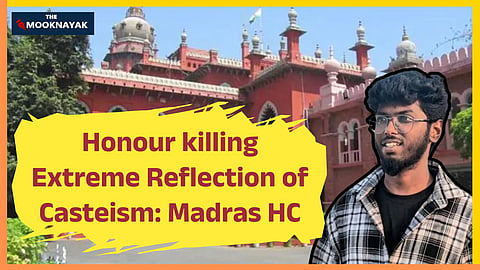
Madurai- The Madurai Bench of the Madras High Court granted bail to a Sub-Inspector of Police accused of harbouring his son, who is the prime accused in a brutal honour killing case from Tirunelveli, while delivering a sharp critique of caste-based prejudices that continue to plague Tamil Nadu society.
Justice B. Pugalendhi, while allowing the criminal appeal filed by Saravanan, accused No. 2 in the case, observed that keeping him in jail any longer "would amount to pre-trial imprisonment," and accordingly ordered his release on stringent conditions, nearly ten months after his arrest on August 11, 2025.
Delivering a strong message to society against casteism, the Court observed that the recent Tamil Nadu Legislative Assembly election results have proven that people can vote based on merit and policies rather than caste. The Court urged the state government to take responsibility for bringing 'real change' and to take concrete steps from the school level onwards to eradicate casteism.
The case stems from an incident on July 27, 2025, when Saravanan's son Surijeet (accused No. 1) allegedly lured an engineering graduate named Kavin Selvaganesh, who was in a relationship with his sister, to Lakshmipuram in Tirunelveli, attacked him with chilli powder and an aruval, and chased him down near Ambal Hospital, inflicting 19 injuries that proved fatal. Within a minute of the killing, at 2.23 pm, the son allegedly called his father Saravanan to inform him of the act. The CB-CID subsequently arrested both father and son on August 11, 2025.
Saravanan faced charges of screening evidence and facilitating his son's hideout at a relative's quarry in Pappankulam. The prosecution alleged that he instructed his son to destroy his clothes, dispose of his cell phone, and remove the number plate of his two-wheeler. He was also accused of providing wrong information about the deceased's community to police personnel at the scene. The case was registered under Sections 203(1), 238(a), 249(a) and 318(3) of the Bharatiya Nyaya Sanhita, read with Sections 3(1)(r), 3(1)(s) and 3(2)(v) of the SC/ST (Prevention of Atrocities) Amendment Act, 2015.
The appellant's counsel argued that it was Saravanan himself who informed the Head Constable at the scene that his son had committed the murder, and that he had handed over his son to the police at 4.30 pm on the day of the incident, a fact reportedly covered by several newspapers, though the CB-CID later projected it as an arrest effected by the Assistant Commissioner of Police at 9.00 pm.
Crucially, the court noted that "even according to the investigating agency, there were no calls made between the appellant and A1 prior to the occurrence," and that there were similarly no calls between Saravanan and the deceased or the victim's family before the incident, leading the court to conclude that "the available materials are not sufficient to presume that this appellant is having any active role in the commission of offence."
While granting the bail, Justice Pugalendhi used the occasion to deliver a pointed judicial commentary on the menace of casteism in society.
Noting that 59 honour killings had been reported in Tamil Nadu over the past ten years, the court said, "Though the appellant has not played any active role in the commission of the offence, he must take responsibility for having brought up his son with casteism. Honour killing is the extreme reflection of casteism." Citing the Supreme Court's observation in Lala Singh v. State of Uttar Pradesh (2006), the court reiterated that "casteism is a curse on the nation."
The Court made it clear that the time has come for every person to break free from this 'curse of caste'. The Court observed that while Saravanan's casteist mindset is a result of his upbringing, blaming a single individual is not the solution. This is a social disease that needs to be eradicated at its root, and the state government must now take concrete steps in this direction. Justice B. Pugalendhi made the following 5 historic observations while delivering the order.
In remarks that were unusually candid for a judicial order, the court acknowledged that the problem pervades all sections of society, including the judiciary itself. "No matter how powerful or privileged a person is, everyone is experiencing casteism in one form or another. Even we Judges are not spared from the same. Motives are attributed to our orders on the basis of caste, even though the cases are being decided on the basis of merit," the court stated. It also flagged political exploitation of caste identities, observing that "certain political parties are adding fuel to this social evil by using caste to mobilise votes."
The Court rejected the term 'honour killing' outright:
"Honour killing is the extreme reflection of casteism. Casteism is a curse on the nation. Nature does not recognize caste. The sun gives light to everyone, the rain falls on everyone, the air is shared by everyone. Only when society transcends the artificial barriers of caste will it truly realize that there is no 'honour' in honour killing; it is a shameful act."
In its most significant observation, the Court referred to the recent Tamil Nadu elections:
"The recent Legislative Assembly election results in the state of Tamil Nadu have shown that people can indeed be convinced to vote without considering the caste or community of the contestants. A government has been formed by largely nullifying the factors of caste. The state can claim 'real change' only when the mindset of the people is also changed. Therefore, the government shall take responsibility and initiative to eradicate caste from the minds of the people, starting from the school level."
The Court gave the example of soldiers to urge society to unite:
"Soldiers drawn from every caste, community, language, and region serve the nation at our borders. When they face enemy fire and make the ultimate sacrifice in defence of the motherland, neither their blood nor their patriotism bears the mark of caste. If those entrusted with safeguarding the nation can unite towards a common cause, every citizen should take inspiration from their example."
The Court questioned the effectiveness of existing laws and called for educational reforms:
"Legislations like the Scheduled Castes and Scheduled Tribes (Prevention of Atrocities) Act, 1989 have not yielded the expected results. The incidents being reported under this Act are increasing day by day. Reforms have to be made from the school level to change the mindset of the younger generation. The recommendations of the Justice K. Chandru (Retd.) Committee should be fully implemented. Political parties should also stop mobilizing votes on the basis of caste, as they are adding fuel to this social evil."
Saravanan has been directed to reside in Coimbatore and report to the Inspector of Police, B2 R.S. Puram Police Station, twice daily at 10.30 am and 5.00 pm. He must execute a personal bond of Rs. 1 lakh with two sureties of equivalent amounts, must not visit the scene of occurrence during the trial, and shall face bail cancellation proceedings if any condition is violated. The impugned order of the II Additional Sessions Judge (PCR), Tirunelveli, dated January 21, 2026, has been set aside.
You can also join our WhatsApp group to get premium and selected news of The Mooknayak on WhatsApp. Click here to join the WhatsApp group.
'The Mooknayak' practices democratic journalism. It is a media platform committed to the Constitution, democracy, and social justice. If you also want 'The Mooknayak' to always raise the voices of the marginalized and show the pain of the voiceless, please support us.
Please Contribute