Tamil Nadu Initiates Process to Identify Untouchability-Prone Areas, Move Towards Exclusive SC/ST Police Stations | TM Special

The move follows directions from the National Commission for Scheduled Castes on a petition by S. Venkatesan associated with the Neelam Cultural Centre, seeking dedicated policing in atrocity-prone areas.
At present, India has 145 Special Police Stations functioning under the Scheduled Castes and Scheduled Tribes (Prevention of Atrocities) Act across five states to ensure prompt investigation and effective enforcement of the law.
At present, India has 145 Special Police Stations functioning under the Scheduled Castes and Scheduled Tribes (Prevention of Atrocities) Act across five states to ensure prompt investigation and effective enforcement of the law. AI generated symbolic image
Published on

Chennai- The Tamil Nadu government has initiated administrative action to identify areas with a high incidence of untouchability-related atrocities and examine the establishment of exclusive Special Police Stations for Scheduled Castes and Scheduled Tribes (SC/ST) in such locations. The move follows directions from the National Commission for Scheduled Castes (NCSC) on a petition seeking dedicated policing in atrocity-prone areas.

At present, India has 145 Special Police Stations functioning under the Scheduled Castes and Scheduled Tribes (Prevention of Atrocities) Act across five states to ensure prompt investigation and effective enforcement of the law. Madhya Pradesh leads with 51 such police stations, followed by Bihar, Chhattisgarh, Jharkhand and Kerala.

The matter stems from a petition submitted by S. Venkatesan, a resident of Sunambedu in Chengalpattu district and associated with the Neelam Cultural Centre, to the National Commission for Scheduled Castes on June 13, 2025. In his petition, Venkatesan urged the government to officially identify areas with a high incidence of untouchability-related offences as "Areas Prone to Untouchability Atrocities" and immediately establish exclusive SC/ST police stations in such locations.

S. Venkatesan's letter to the NCSC urging government to identify areas with a high incidence of untouchability-related offences and set up special police stations.

Speaking to The Mooknayak, Venkatesan said caste-based violence in Tamil Nadu remains a complex and deeply concerning issue at social, legal and political levels. While the state is widely known for its progressive politics and the legacy of the Dravidian movement, he argued that caste discrimination and violence continue to pose serious challenges at the grassroots.

Taking cognisance of the complaint, the National Commission for Scheduled Castes issued a communication dated June 23, (Letter No. APCR/OL/TN/2025/304819) directing the Tamil Nadu government to take appropriate action.

Subsequently, the Tamil Nadu Home Department issued Letter No. 12738/Police.15/2026-1 dated July 7 signed by M. Sreenan, Deputy Secretary to Government. The letter was addressed to the Director General of Police (DGP), Tamil Nadu, and the Inspector General of Police, Social Justice and Human Rights Wing.

Letter from the Deputy Secy of TN govt to the DGP.

The Home Department enclosed a copy of the complaint forwarded by the NCSC and instructed the police authorities to take necessary action. It directed them to submit the details of the action taken directly to the National Commission for Scheduled Castes, Chennai, while also sending copies to the complainant, S. Venkatesan, and the state government.

The communication categorised the matter as "Most Urgent", asking the police to accord it priority and ensure that an appropriate response is sent to the Commission without delay.

Venkatesan's primary demand is that districts and localities witnessing recurring incidents of untouchability and caste atrocities should be officially notified as atrocity-prone areas and provided with dedicated SC/ST Special Police Stations to ensure prompt registration, investigation and monitoring of cases under the SC/ST (Prevention of Atrocities) Act.

NCRB data shows rise in SC/ST atrocity cases

According to data presented in Parliament by the Ministry of Home Affairs and the National Crime Records Bureau (NCRB), Tamil Nadu has witnessed a steady increase in cases registered under the SC/ST (Prevention of Atrocities) Act. Around 1,274 cases were registered in 2020, while the number rose to more than 1,700–1,800 cases by 2022–2023.

Compared to the national average, Tamil Nadu has also recorded a relatively low conviction rate in caste atrocity cases reported to be around 8% to 13%, while the pendency rate has remained above 80%.

Forms of caste-based violence reported in Tamil Nadu

Caste-related violence in Tamil Nadu has taken multiple forms over the years.

Honour killings remain a major concern, particularly in cases involving inter-caste relationships, especially between Dalit men and women from dominant castes. Districts such as Tirunelveli, Madurai, Thanjavur and Krishnagiri have witnessed several such incidents.

Untouchability and social exclusion continue to be reported in several rural areas, including the persistence of the "two-tumbler system" at tea shops, denial of access to cremation grounds, restrictions on temple entry, and obstruction of Dalit panchayat presidents from exercising administrative powers.

Inhuman forms of caste oppression have also drawn national attention. Incidents such as contaminating drinking water tanks serving Dalit settlements as seen in the Vengaivayal case along with social boycotts and denial of basic civic amenities have highlighted continuing caste discrimination.

Caste tensions in educational institutions have also surfaced, particularly in southern districts including Tirunelveli and Thoothukudi, where reports have emerged of students wearing caste-identifying wristbands and violent clashes linked to caste identities.

The Tamil Nadu Police's Social Justice and Human Rights (SJ&HR) Wing is tasked with monitoring caste-sensitive regions and identifying areas vulnerable to social tensions and caste-based violence.

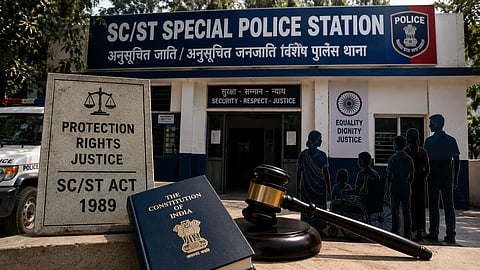
At present, India has 145 Special Police Stations functioning under the Scheduled Castes and Scheduled Tribes (Prevention of Atrocities) Act across five states to ensure prompt investigation and effective enforcement of the law.
VCK Chief Thirumavalavan Demands Immediate Law on Honour Killings After Fresh Tamil Nadu Murders

Major caste atrocity cases in recent years

Among the prominent recent incidents is the Kavin Selva Ganesh murder case in Tirunelveli (July 2025), in which a 27-year-old Dalit software engineer was allegedly murdered because of his relationship with a woman from a dominant caste.

In February 2024, a 26-year-old Dalit man, Praveen, was allegedly killed in Chennai's Pallikaranai by his wife's brother and associates following an inter-caste marriage.

In January 2024, the Aishwarya honour killing in Thanjavur drew widespread attention after a 19-year-old woman was allegedly murdered by her own family for marrying a Dalit man named Naveen.

The Uthangarai case in Krishnagiri (2023) involved the alleged killing of a young man, Sabash, by his father after he married a Dalit woman, Anusuya.

The Vengaivayal case in Pudukkottai (2023), in which human faeces were found mixed in an overhead water tank supplying drinking water to a Dalit settlement, became one of the country's most widely discussed caste atrocity cases.

Directions for SC/ST Protection Cells & Police Stations

The 27th National Review meeting of the Committee constituted for effective coordination to devise ways and means to curb offences of untouchability and atrocities against the members of SC/ST and effective implementation of the Protection of Civil Rights Act, 1955 and the Scheduled Castes and the Scheduled Tribes (Prevention of Atrocities) Act, 1989 was held at New Delhi on 21st November, 2023. Following the meeting, the States Government/ UT Administration were urged by the Ministry of Home Affairs, to set up the Exclusive Special Courts in sufficient number and set up SC/ST Protection Cells. Also Special Police Stations for registration of complaints of offences against members of SCs and STs were also advised to be set up, wherever feasible.

Only five states currently have Special SC/ST Police Stations

According to the latest data from the Ministry of Home Affairs and the Ministry of Social Justice and Empowerment, only five states currently have dedicated Special Police Stations for investigating offences under the SC/ST (Prevention of Atrocities) Act. Together, these states have 145 Special Police Stations, distributed as follows:

Madhya Pradesh: 51

Bihar: 40

Chhattisgarh: 27

Jharkhand: 24

Kerala: 3

The communication issued by the Tamil Nadu government does not announce the establishment of new police stations. Instead, it initiates the administrative process by seeking an action taken report from the police authorities in response to the NCSC's directions on the petition seeking exclusive SC/ST police stations in untouchability-prone areas.

At present, India has 145 Special Police Stations functioning under the Scheduled Castes and Scheduled Tribes (Prevention of Atrocities) Act across five states to ensure prompt investigation and effective enforcement of the law.
Madras HC Grants Bail to Cop in Dalit Engineer Honor Killing Case; Slams Casteism as 'Deep-Rooted Curse'
At present, India has 145 Special Police Stations functioning under the Scheduled Castes and Scheduled Tribes (Prevention of Atrocities) Act across five states to ensure prompt investigation and effective enforcement of the law.
Ten important things to be done in Tamil Nadu for development of SC/ST/EBC
At present, India has 145 Special Police Stations functioning under the Scheduled Castes and Scheduled Tribes (Prevention of Atrocities) Act across five states to ensure prompt investigation and effective enforcement of the law.
What the NCRB 2024 Data Says About the Lives of Dalit Women
At present, India has 145 Special Police Stations functioning under the Scheduled Castes and Scheduled Tribes (Prevention of Atrocities) Act across five states to ensure prompt investigation and effective enforcement of the law.
From 1950 to 2025: Landmark Supreme Court Report Details the Evolution of Judicial Mindset on Caste & Dalits.

You can also join our WhatsApp group to get premium and selected news of The Mooknayak on WhatsApp. Click here to join the WhatsApp group.

Support The Mooknayak

'The Mooknayak' practices democratic journalism. It is a media platform committed to the Constitution, democracy, and social justice. If you also want 'The Mooknayak' to always raise the voices of the marginalized and show the pain of the voiceless, please support us.

Please Contribute
The Mooknayak English - Voice Of The Voiceless
en.themooknayak.com