UGC Equity Regulations 2026 Spark Polarized Debate: GC Demands Rollback Amid Protests, Rajasthan Forms S-4 Coordination Committee

UGC maintains the regulations are grounded in Supreme Court directives and ensure equal opportunities for all students, but critics argue ambiguities and one-sided focus could harm the GC. In Rajasthan, a new S-4 alliance comprising Brahmin, Rajput, Vaishya, and Kayastha groups has formed a coordination committee to address GC concerns.
GC organizations contend the provisions rest on an unsubstantiated assumption of "widespread caste discrimination," lacking recent data.
GC organizations contend the provisions rest on an unsubstantiated assumption of "widespread caste discrimination," lacking recent data. Social Media
Published on

New Delhi- The University Grants Commission's (UGC) "Promotion of Equity in Higher Education Institutions Regulations, 2026," notified on January 13, has triggered intense discussions in India's higher education sector. Aimed at eliminating discrimination based on caste, gender, religion, or disability in universities and colleges, the rules have drawn sharp criticism from General Category (GC) students and organizations, who label them as "promoting caste divisions" and call for their immediate withdrawal.

The #UGCRollback hashtag is trending on social media, with student groups planning protests across several cities. UGC maintains the regulations are grounded in Supreme Court directives and ensure equal opportunities for all students, but critics argue ambiguities and one-sided focus could harm the GC. In Rajasthan, a new S-4 alliance comprising Brahmin, Rajput, Vaishya, and Kayastha groups has formed a coordination committee to address GC concerns.

Protestors at Jaipur demanded roll back of the regulations calling it divisive and discriminatory.
Protestors at Jaipur demanded roll back of the regulations calling it divisive and discriminatory. Social Media

UGC Equity Regulations 2026: A Push for Discrimination-Free Campuses But Why the Outrage?

UGC introduced these regulations to replace the 2012 guidelines, aligning with the National Education Policy (NEP) 2020's "full equity and inclusion" principles (Hindustan Times, January 15, 2026). Core mandates include establishing an Equal Opportunity Centre (EOC) in every Higher Education Institution (HEI), forming an Equity Committee, launching a 24x7 equity helpline, and deploying "Equity Squads" and "Equity Ambassadors." These mechanisms ensure complaints of discrimination trigger a committee meeting within 24 hours, a 15-day inquiry report, and action within seven days. Non-compliance could lead to penalties like exclusion from UGC schemes or halting degree programs.

According to UGC, the rules follow Supreme Court instructions from a case emphasizing the eradication of caste-based discrimination in higher education. They place responsibility on institutions to eliminate "caste-based discrimination" entirely. However, GC organizations contend the provisions rest on an unsubstantiated assumption of "widespread caste discrimination," lacking recent data. Social media fury largely targets the "Equity Squads" and "Ambassadors," derided as a "draconian monitoring system" that could create a surveillance state.

Rajasthan's S-4 Alliance Forms Coordination Committee

In a significant development, Rajasthan-based GC groups have united under the S-4 banner (Brahmin, Rajput, Vaishya, Kayastha) to form the "Savarna Samaj Samanyan Samiti" (GC Coordination Committee). Announced on January 20 in Jaipur, the panel comprising Karni Sena, Kayastha Mahasabha, Brahmin organizations, and Vaishya bodies aims to coordinate nationwide GC efforts on UGC issues and broader community concerns.

Kali Sena chief Swami Anand Swaroop, speaking to local media in Jaipur, explained: "The UGC issue, along with other Savarna society matters, prompted this coordination committee. Formed on January 20 with Karni Sena, Kayastha Mahasabha, Brahmin, and Vaishya groups, the Savarna Samaj Samyojan Samiti will work to unite all GC organizations across India for coordinated action."

General Category's Core Grievances: Ambiguous Definitions and False Accusation Fears Fuel Rollback Demands

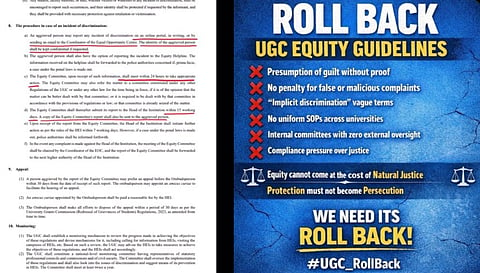
The debate hinges on the regulations' "discrimination" definition (Clause 3(e)), which encompasses "implicit" behaviors even without intent potentially turning routine interactions into violations. Critics argue this erodes procedural balance, positioning GC members as "automatic oppressors". By framing only SC/ST/OBC as primary "victims," the rules allegedly show bias against GC, overlooking discrimination they face.

A major worry is false complaints: No penalties exist for frivolous accusations, unlike the SC/ST (Atrocities) Act, enabling "patently false assumptions". Immediate action 24-hour meetings and proof burden on the accused invokes "guilty until proven innocent". UGC draws from Supreme Court inspirations, but GC students fear "targeting".

Further, civil society, NGO, and police involvement risks politicization (Clause 5(2)-(3)). Scope extension to faculty/staff allows SC/ST/OBC educators to file against GC students (Clause 3(j)). Equity Squads are slammed for fostering a "snitching culture," turning campuses into "fearful environments". Overall impacts: Perpetual anxiety, biased evaluations, weaponized personal disputes, and bureaucratic overload from institutional penalties.

Women's safety emerges as a flashpoint: Instagram reels warn the rules could empower "predator men" to misuse them against GC women for rejection or revenge. Reports stress all students need protection, but ambiguities enable exploitation. Strict non-compliance penalties like program halts could pressure institutions, compromising justice.

Social Media Storm: GC Voices Amplify Fears of 'Confidence Killer'

X user Shubham Shukla posted : "UGC's notification is truly dangerous—it's a confidence killer for GC kids. Small issues will trap them in probes; when will they study? What about their careers? This is independent India's biggest conspiracy against Savarna children. Government must act immediately."

Another post : "If UGC and Education Minister Dharmendra Pradhan don't amend the anti-GC notification by January 26, the world will see social media's injustice to students. On Republic Day, oppressed GC youth will demand justice—UGC will trend all day."

Supporters Champion 'Inclusion Revolution'

Backers view the rules as an "essential step for equity." They argue the Centre's intervention tackles caste discrimination head-on, with regulations targeting its complete elimination in colleges and universities.

Bhim Army leader Sunil Astey from Madhya Pradesh stated, "UGC's new guidelines aren't against any category but ensure equality, transparency, and student safety in campuses. Mandatory Equal Opportunity Centre, Equity Committee, and 24x7 redressal ensure timely, impartial action on discrimination, harassment, or injustice. Portraying them as 'anti-specific category' is misleading and baseless. This initiative strengthens constitutional equality, dignity, and justice, creating safe, inclusive environments for all. No fear from accountability and equal opportunity. Those believing in the Constitution and democracy should welcome UGC's effort."

BASF's Dr. Ghanshyam added, "Our movement discussed the new UGC (Promotion of Equity in HEIs) notification (2026). Discrimination definition expanded to include overt/covert acts though unlisted, creating ambiguity that could aid casteists. Clear OBC inclusion is welcome, but OBC leaders must realize only Ambedkarite constitutionalism fights for their kids' rights, not RW ideology. HEIs must establish Equity Opportunity Centres (EOC) with Equity Committee (EC) chaired by head, including SC/ST/OBC/women/PwD members. EOC reports bi-annually. Good UGC step due to Ambedkarite pressure, but we demand independent minds in committees—include BASF-like groups. Grant investigative/executive powers for expulsion/dismissal/suspension/PhD revocation to cripple offenders. National oversight via UGC committee with statutory bodies/NGOs/civil society—we'll join and demand a dashboard/fixed timelines. Casteists will sabotage, but we'll protect our children."

Senior IRS officer Netrapal remarked, "My biggest objection to UGC rules is replacing SC/ST cells with a general discrimination cell. Unsure if it'll work. What if the cell lacks SC/ST voices, who face most issues? SC/ST liaison officer is constitutionally mandatory—no change needed."

GC organizations contend the provisions rest on an unsubstantiated assumption of "widespread caste discrimination," lacking recent data.
UGC's New Regulations: How Will They Eradicate Discrimination in Higher Education? Key Provisions Here
GC organizations contend the provisions rest on an unsubstantiated assumption of "widespread caste discrimination," lacking recent data.
From the Streets of Kolkata to the White House: Meet Aloka, the Four-Legged Ambassador of Peace

You can also join our WhatsApp group to get premium and selected news of The Mooknayak on WhatsApp. Click here to join the WhatsApp group.

The Mooknayak English - Voice Of The Voiceless
en.themooknayak.com