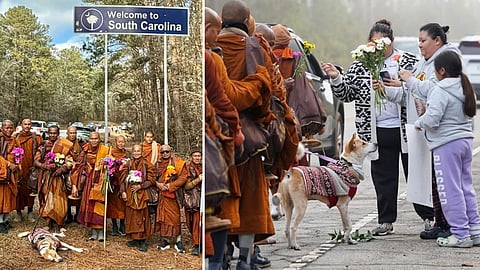
In a modern America often defined by the cacophony of political division and digital noise, a quiet revolution is unfolding on the highways. It is a movement measured not in decibels, but in footsteps. Leading this silent charge is an unlikely hero: Aloka, a resilient Indian stray dog who has journeyed from the dusty roads of Bihar to the bustling interstates of the United States.
Accompanied by 19 barefoot Buddhist monks from the Huong Dao Vipassana Bhavana temple in Texas, Aloka is currently in the final leg of a grueling 2,300-mile (3,700 km) "Walk for Peace" destined for Washington, D.C.
Aloka’s story is one of destiny. Before becoming an internet sensation with over 600,000 followers, he was an anonymous Indian Pariah dog wandering the streets near Kolkata. His life changed during a 112-day peace walk across India, where he encountered the monks.
While many strays would follow the group for a mile or two before dropping back, Aloka—whose name translates to "Divine Light"—refused to leave.
"He followed us the whole time. He’s a true hero," said Bhikkhu Pannakara, one of the monks. The depth of Aloka's loyalty was tested early on in India when, after suffering an injury, the monks placed him in a truck to rest. Refusing to be separated, Aloka leapt from the vehicle to return to the pavement alongside his companions.
"If he were left behind in Bodhgaya, he would become a stray dog again," Pannakara noted. "He deserved better."
Recognizing a "disciple of the path" in the canine, the monks navigated a labyrinth of international bureaucracy, quarantines, and veterinary checks to bring Aloka to the United States. The monks joke that the former Kolkata street dog is now fully an "American citizen."
The current trek began in October in Fort Worth, Texas. The group travels slowly, covering roughly 10 states over 110 days. They do not chant loudly or proselytize; they simply walk. They stop in town halls, parking lots, and parks, offering a rare commodity in modern life: stillness.
"We live in a time when the noise often drowns out understanding," said Texas Journalist Nicole Collier, who witnessed the march. "But this is what community and interfaith solidarity looks like."
The journey has not been without hardship. The physical toll of walking thousands of miles flared an old injury Aloka sustained in India. In January, concern for his health led to surgery at a specialist center in Charleston, South Carolina.
For weeks, the monks marched without their "noble guardian." However, scenes of pure joy erupted in Charlotte, North Carolina, this week as Aloka was briefly reunited with the group. A video shared on their Facebook page captured the heartwarming moment the dog, tail wagging furiously, greeted the monks he views as family.
While the monks continue toward the White House, Aloka is currently undergoing rehabilitation, walking only ten minutes at a time. Yet, his spirit remains the march's driving force.
For observers, particularly those from the Indian subcontinent, the walk resonates with ancient echoes. It recalls the edicts of Emperor Ashoka and the teachings of Gautama Buddha—messages of non-violence (Ahimsa) and compassion for all living beings.
In a world dominated by "tiger and monkey minds"—a Buddhist metaphor for aggression and overthinking—Aloka and the monks offer a different path.
"Life in America is very loud," noted a local observer, Chris Mulcahy, who walked a mile with the group. "But when they stop, people slow down. They breathe. It was one of the most life-changing speeches I’ve ever heard."
As the monks close in on Washington D.C. for their February arrival, they carry with them the hopes of thousands who track their progress online. And at the heart of this movement is Aloka: the street dog who proved that you don’t need a voice to speak to the world about peace.
You can also join our WhatsApp group to get premium and selected news of The Mooknayak on WhatsApp. Click here to join the WhatsApp group.