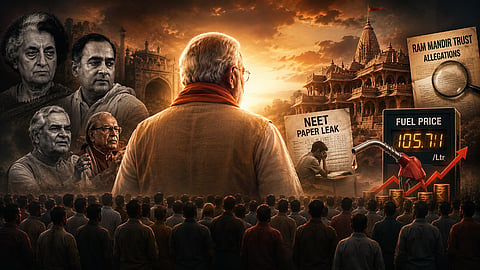
Once Atal Bihari said that "Sarkarein sab ek si hi hoti hain" (every government functions similarly). A decade later, when he was ousted from power, his party, the BJP, returned to power on the slogan and promise to correct all the mistakes of the last 67 years, which India had suffered due to wrong policies and bad governance.
After more than a decade in power, it has ascertained and echoed the same observation made by its party patriarch—that almost all governments function similarly, with a single motive: to retain themselves in power. When circumstances assure them of retaining power, they go on exploiting that power against the citizens and in favour of those in authority.
Whether it was the war-victory popularity of Indira Gandhi, who brought upon this country the Emergency; the huge mandate secured through sympathetic voting after Indira Gandhi's assassination, which enabled Rajiv Gandhi to push this country into communal tensions by amending the Shah Bano case and reigniting the Ayodhya issue to balance the Shah Bano error of judgment; or the seemingly invincible Narendra Modi, who rode the wave of anti-corruption sentiment against the UPA government and shifted from the Atal-Advani era of soft Hindutva to a severely polarised Hindutva politics, the country has gradually become immune to any kind of public outrage, even after blatant corruption and injustice.
It is hard to believe that the Hindus of this country have become so prosperous that exorbitantly high fuel prices are no longer significantly affecting them, or that the public has become so forgiving that even a NEET paper leak hardly finds their attention. Ram Mandir was such a sensitive issue for most households in this country and perhaps the principal reason for the ruling regime's political existence, invoking sentiments rooted in the trauma of Partition. Yet, even the recent allegations against the Ram Mandir Trust have not been sufficient to generate any significant resentment against the current regime.
This behaviour of India is completely new. Indira Gandhi's Emergency instantly faced one of the most inspiring demonstrations of democratic sensitivity by the masses and quickly showed how much India valued its hard-earned and heavilypriced democracy, earned after innumerable sacrifices and years of struggle against the British Raj.
Rajiv Gandhi, after his insensitivity towards Sikh rights and the Shah Bano misjudgment, lost public confidence and eventually lost power, never to regain it in the same way. His tenure also brought dynastic politics into sharper focus and made nepotism a central theme in Indian political discourse. The Gandhi surname gradually lost its magic and became counterproductive in securing large-scale acceptability and mass appeal.
But even after 12 years of failed promises, a struggling economy, a series of exposed lies, and the collapse of the sacred commitment professed towards Lord Ram following allegations regarding the misappropriation of trust donations, the present government appears completely exposed yet hardly bothered or shaken. Many people may argue that the propagandist media has protected the government and kept it popular. However, all the above-mentioned facts are in the open public domain. Even with a wholly managed media ecosystem, it is hard to believe that these issues are not sufficient to create resentment against the incumbent government.
Have we, as citizens, stopped valuing our democracy? Have we become so ignorant and politically illiterate that we no longer express our will regarding the functioning of our democratic institutions? Or are we helplessly suffering and suffocating due to the complete collapse of our political system, heading towards an era desperately searching for an accountable, honest, and fresh political alternative?
With the advent of the BJP and the downfall of the Congress during the second term of the UPA, the anti-corruption movement, popularly known as the Anna Andolan, took shape at Jantar Mantar and was followed by the success of the Aam Aadmi Party in Delhi.
Many people credited the Anna Andolan for AAP's quick rise in politics, while completely overlooking its utopian conduct in the beginning, which earned the confidence of the Delhi electorate. It promised an austere lifestyle for elected representatives, internal democracy in deciding candidates for MLA elections, accountable funding for the party, and many more such initiatives.
Many, including me, believed that a new paradigm in Indian politics was taking shape, one that would take India towards a more welfare-oriented democracy. But, to the disappointment of many and because of the lust for power of a few, this entire positive change and the prospect of a utopian democracy became subjected to the concentration of power, ensuring the totalitarian control of Arvind Kejriwal over the party.
It began with the ousting of Yogendra Yadav, Prashant Bhushan, and a few others from the party on charges of demanding decentralisation within the party— something that should have been welcomed instead of being discarded. Subsequently, this episode engulfed Kumar Vishwas and Ashutosh as well, making the Aam Aadmi Party a one-man show with made-up leaders like Raghav Chadha and the appointment of leaders instead of the election of leaders within the party.
Every dissent was answered with expulsion from the party, and this was symbolically announced and sealed by the open display of Sanjay Singh touching the feet of Sunita Kejriwal, wife of Arvind Kejriwal, after coming out of Tihar Jail.
This is the litmus test of current politics in India, where leaders cannot tolerate equals within their own party and questioning their decisions or opinions is treated as challenging their authority. Unfortunately, this has become the norm in Indian political parties.
The place where democracy has become most extinct is within the heart and soul of our present-day political parties and their leadership. Leaders have become completely intolerant of dissenting opinions, whereas party workers have become so devoid of self-respect and self-esteem that they rarely stand up for any cause or ideology.
Cowardice appears to have become the primary qualification for being an ardent party worker or cadre, while sycophancy has become the foremost virtue required to secure an MLA or MP ticket from one's party.
I am not against Sanjay Singh respecting Ms. Kejriwal or touching her feet. However, the people whom Sanjay Singh represents will completely lose confidence in his ability to stand up to Mr. Kejriwal if he displays such unquestioning devotion towards him.
We have read and heard about our first Parliament, where Congress MPs openly questioned their Prime Minister, Nehru, in Parliament and still managed to continue for a second term as Congress Party MPs. But today, it is unthinkable.
It is hard to name a party without a party supremo, and even harder to name a leader within that party who is a contender to the party supremo. There is no one in the Congress who can question Rahul Gandhi and survive without revering Sonia Gandhi and the Gandhi family. It is equally unthinkable for any leader in the Samajwadi Party, RJD, or BSP to stand up to their respective leaders.
There are some communist parties that are cadre-based and have some democracy left. They continue to fight, here and there, and on a few university campuses for the rights of students, workers, and matters of national importance. However, they are hardly a reckoning force in Indian politics to be analysed and discussed at length.
The situation is very unfortunate because a country, even after 79 years of independence, could not overcome its challenges of economic, social, and political disparity. It has fared far worse on several development parameters and indicators and has failed badly in bringing equality and egalitarianism to society. At the same time, it has before it the revealing examples of neighbouring China and Russia, which sailed through similar conditions via communism.
Communism is one of the potent answers to India's path of progress. Even many great leaders, from Baba Saheb Ambedkar to Netaji Subhas Bose, presented this idea. But the miserable failure of communism in India as a contending alternative political ideology is, again, to be blamed on the personality problem and excessive individualism of Indian leaders.
To shorten it, all communist parties in India invoke Marx and Lenin on every issue but forget the basic tenet of communism of a one-party system. Instead of respecting democratic decision-making, every faction prefers a separate party over winning on a political agenda through discourse, deliberation, and collective decision-making. Being too convinced of their own ideas and completely disregarding collective intellect makes individuals function undemocratically. If any idea is worthy of cognisance and fellow party members do not believe in it, then one should find ways to convince them or re-introspect by trusting others' opinions instead of breaking away to make one's own group and weaken the movement.
The BJP is the only party that has partially retained small bits of internal democracy, equal opportunity, and the appeal and confidence among even the lowest-level party worker that he or she can, at least theoretically, rise through the hierarchy of the party organisation. To keep a deviating BJP on the path of course correction, it has the RSS, which does not participate directly in electoral politics but firmly influences it from outside while sufficiently providing the BJP with talent, dedicated workers, and a breeding ground for political funding.
Prime Minister Modi himself is presented as the poster boy of championing democratic values, and every commoner in this country draws inspiration from him in a way they hardly do from the dynastic and nepotistic leadership of other parties. Apparently, that is the biggest mirage, where the aspiration of becoming the Prime Minister is sold in exchange for the erosion of jobs and educational opportunities.
Prime Minister Modi comes from a humble background, but his friends, who supported his rise to the office of Prime Minister, are among the capitalists of this country, and he is perceived to be working day and night for them. Apparently, this has resulted in the diversion of resources from common citizens towards these wealthy associates of the Prime Minister, but it is smartly kept away from the conscience and view of the citizens.
Appointments such as Ram Nath Kovind, Droupadi Murmu, and Nitin Nabin have made the BJP appear more inclusive and appealing to different sections of society.
To sum it all up, the BJP is doing social justice optics for masking a corrupt government in hindsight, while India's social disparities have made citizens so emotionally charged that they fail to acknowledge what they perceive as the corrupt practices of the government.
The BJP has championed the politics of hatred. It has banked upon the disgruntled emotions of every section of society. Those who harbour resentment towards Muslims are offered political polarisation. Those who question why some are more equal than others are offered campaigns against dynastic politics. Those who believe they were inadequately represented by previous governments are given symbolic representation, and the party banks upon their identity-based discontentment.
The most important feature of its politics is its far-reaching organisation, where it acknowledges widespread participation by giving notional offices within the party structure and keeps people's aspirations alive by periodically recognising their contributions.
So, the BJP is winning because others are faring far worse than it. They are offering something against nothing. Patently speaking, the BJP is a political party, whereas most others are corporate-style run political parties, where an individual or a family is running the show, and the rest who participate are paid for their association in the form of election tickets and other benefits that come from being close to the party in power.
The TMC can be taken as a suitable example, where the prospect of being ousted from power led to the flight of many of its most ardent members, who had tirelessly spoken about the leadership of Mamata Banerjee. Overnight, with the possibility of losing power, they opted for the best available option to remain close to power.
None of them are entirely to blame for this conduct because Mamata Banerjee did not have leaders in her party; she had followers, and they simply chose a different leader to secure their interests. Mamata cheated the citizens by placing dummies to appropriate total control and hijack democracy in order to run a dictatorial government. As soon as she loses power, this was the fate written by her own conduct. Like employees who desert a company as soon as it becomes unprofitable and seek better employment elsewhere, they had no political capital of their own. They were merely sycophants and opportunists who could survive best by remaining close to power.
Mamata and others like her disrespect democracy by allowing representatives who have hardly any social capital behind them to reach elected bodies and then using them as puppets. Yet, when they face political extinction, they claim to be protecting democracy from the BJP after having brutally extinguished democracy within their own functioning. This political optics does not appeal to the masses or the citizens, which, inversely and reluctantly, pushes them towards the BJP.
Occasionally, the government faces shocks in the form of protests such as the Farmers' Protest, labourers' protests in the Delhi-NCR region, and, most recently, the Cockroach Janta Party protest at Jantar Mantar. However, these protests hardly culminate in a movement capable of posing a real threat to the existence of the BJP government.
If looked at closely, these protests voice the injustice of the government, reiterate the democratic right to protest, and express opposition to government policies. However, they fall short of fulfilling their constitutional duty of sufficiently occupying the political space within the electoral system and giving rise to an alternative political force capable of doing what they demand.
During the Kisan Andolan, the farmers of our country remained on the highways leading to the national capital for more than a year and sacrificed more than 700 lives. Yet, no major political party could be seen participating in those protests except a few Left parties, which expressed solidarity and stood with them. But when elections came, every opposition party merely asked the people to vote against the BJP for bringing the farm laws, something the electorate hardly bought into, and consequently, hardly any significant electoral impact was visible.
In almost every speech these days, opposition leaders invoke Gandhi and preach others to follow him, but they themselves decline to learn even a single lesson from Gandhi's life. Gandhiji went to every part of India where Indians faced state atrocities and transformed local struggles into national movements. In contrast, today's leaders were served national movements right in the national capital, yet even that proved too cumbersome for many of them to show up and participate.
They seem to be waiting for the day when the BJP, through its corporate-friendly policies, robs and plunders the people even further, believing that when public anger eventually turns against the BJP, they will simply step in and enjoy their share of power.
So, it is very obvious and pertinent to expect a public-outraged protest to turn into an alternative political force, and the Cockroach Janta Party is one such current phenomenon to introspect, analyse, and look towards for that alternative.
Abhijeet Dipke's satirical post, which went viral, and the support he received overnight have sufficiently established that there is enough resentment at large and that the time is ripe for a tectonic shift in the paradigms of our country's political landscape. However, Abhijeet Dipke is still to be tested on his ideology, capabilities, understanding, maturity, commitment, vision, and integrity. It is too easy in a democracy to serve people with words and fall short in conduct and commitment.
A movement can stand on sloganeering and succeed on public discontent, but lasting change can only be brought through the institutionalisation of democracy and its functioning. It remains to be seen whether Abhijeet Dipke understands the magnitude of the force behind this protest and channels it into a genuine political alternative and a course correction in Indian politics, or whether he uses it merely to become a political figure and derive political mileage for himself and his associates.
The protest has started well and, till date, holds considerable potential. At the same time, however, the kind of information flowing from the platform and the clarity regarding the vision of the movement have emerged rather conservatively. The exuberance one would expect from a movement like this, where young people are participating for a cause concerning their own generation, seems to be lacking. Instead, it feels more like a calculated and carefully designed campaign. It is still early days, but this impression appears quite evident from the initial phase of the protest.
The kind of reception they are giving to political leaders creates an impression that they are more inclined towards public relations than towards building collective awareness and preparing to take this movement forward. This protest should not be viewed merely as an opportunity to acquaint itself with political leaders, but as an opportunity to become a political leadership in its own right.
One very striking feature I noticed during the protest was that those white-clad, self-created netas were given the stage and allowed to use it as a platform to promote their own politics, while space beside Sonam Wangchuk was denied to the very young students who had been on a hunger strike with him since day one. They appeared to be discriminated against, at least in comparison to these established political leaders, who themselves are part of the political apathy that has brought the students to this point.
One more important shortcoming in the protest, which is quite visible to everyone taking cognisance of it, is that while the 59-year-old Sonam Wangchuk is fasting, none of the four members of the core team of the CJP is fasting alongside him. More strikingly, there hardly appears to be any mechanism—at least in the public domain—through which people have been invited to join or become part of the core team.
However, the expectations of the participating crowd are extremely high. As has often been the case, the Indian public easily finds reasons to hope despite repeated disappointments and soon places all its trust in a single basket without much scrutiny.
The CJP should keep in mind that the conduct of the Anna Andolan and, subsequently, the Aam Aadmi Party has made the Indian public cautious about political promises and claims of higher moral standards and conduct. If the CJP meets the same fate, it will make the Indian public even more immune to public protests and even less confident about raising its voice against what it perceives as prevailing misrule and the hardships arising from government policies.
- Advocate Mukesh Kishor, Managing Partner at Audacious Law Network, is a Supreme Court lawyer championing human and labour rights with a strong focus on fair labour practices and safeguarding fundamental freedoms.
You can also join our WhatsApp group to get premium and selected news of The Mooknayak on WhatsApp. Click here to join the WhatsApp group.
'The Mooknayak' practices democratic journalism. It is a media platform committed to the Constitution, democracy, and social justice. If you also want 'The Mooknayak' to always raise the voices of the marginalized and show the pain of the voiceless, please support us.
Please Contribute