Abhijeet Dipke and the Ambedkarite Path: From Digital Protest to Democratic Responsibility

The Ambedkarite path requires a deeper transformation: from protest to political education, from anger to evidence, from personal leadership to democratic organisation, from symbolic inclusion to substantive representation, and from immediate demands to a programme for social equality.
The Ambedkarite path cannot be reduced to displaying a portrait of Babasaheb Ambedkar, raising a slogan or adopting the colour blue. It is a disciplined moral, intellectual and political commitment to liberty, equality, fraternity, dignity and reason.
Published on

— ✍️ Dr. Pankaj Tambe

The sudden emergence of Abhijeet Dipke and the Cockroach Janta Party represents an important moment in contemporary youth politics. Dipke, a political communication strategist educated in journalism and public relations, transformed an insulting description of unemployed young people as “cockroaches” into the identity of a protest movement. What began through digital satire developed into an organised campaign addressing examination irregularities, student distress and accountability within India’s education system.

In June and July 2026, Dipke and his supporters gathered at Jantar Mantar in New Delhi, demanding the resignation of Union Education Minister Dharmendra Pradhan over alleged examination failures and their consequences for students. On July 18, Dipke announced an indefinite hunger strike after Sonam Wangchuk, who had been fasting at the protest site, was moved to a hospital by the police. These developments placed Dipke at the centre of a growing, youth-led challenge to governmental authority.

The question, however, is not merely whether Dipke has attracted attention. The more serious question is whether his politics can develop along an Ambedkarite path.

What Is the Ambedkarite Path?

The Ambedkarite path cannot be reduced to displaying a portrait of Babasaheb Ambedkar, raising a slogan or adopting the colour blue. It is a disciplined moral, intellectual and political commitment to liberty, equality, fraternity, dignity and reason. Ambedkar’s thought joined personal experience with social analysis, constitutional rights with institutional reform, and political democracy with the demand for social and economic democracy.

An Ambedkarite movement must therefore do more than oppose a particular minister or government. It must ask how institutions distribute power, whose voices remain excluded, why certain communities face repeated humiliation and how democratic safeguards can make equality meaningful. Constitutionalism, in this understanding, is not simply obedience to a written document. It is the continuing effort to limit arbitrary power, protect rights, secure representation and make public institutions answerable to citizens.

Ambedkarite politics is also a politics of knowledge. It demands definitions before assertions, evidence before accusation and structured argument instead of empty rhetorical aggression. Ambedkar’s moral force came not from anger alone but from the disciplined combination of reason, historical evidence, institutional analysis and emancipatory purpose.

Dipke’s movement must be evaluated against these standards.

Turning Humiliation into Collective Assertion

One Ambedkarite feature of the Cockroach Janta Party is its attempt to transform humiliation into political assertion. Historically, systems of domination have imposed degrading names upon marginalised people in order to deny their individuality and citizenship. Anti-caste movements have often challenged such practices by exposing the violence contained in supposedly ordinary language.

By reclaiming the word “cockroach,” Dipke’s supporters appear to be saying that unemployed and frustrated young people will no longer accept invisibility. A term intended to diminish them has been converted into a symbol of collective resistance. The strategy resembles a wider democratic practice through which stigmatised groups reject shame and demand recognition.

But reclaiming an insult is only the beginning. An Ambedkarite movement must identify the structure that produces humiliation. Student distress cannot be explained merely as the failure of a few officials. It is connected to unequal schooling, expensive coaching systems, unemployment, caste and class disparities, institutional opacity and the increasing pressure placed upon competitive examinations.

The movement will acquire deeper meaning only when it connects immediate anger with these structural questions.

Education as a Democratic Right

Dipke’s focus on students and examination accountability brings his movement close to one of the central concerns of Ambedkarite thought: education as a means of emancipation.

For Ambedkar, education was not merely a ladder of private success. It was a means through which oppressed people could develop critical intelligence, challenge inherited authority and participate in public life as equals. An education system that produces anxiety, exclusion and despair while refusing institutional accountability betrays this democratic purpose.

An Ambedkarite campaign for educational justice would therefore demand more than punishment after a paper leak. It would seek transparent examination procedures, independent investigation, accessible grievance mechanisms, protection for whistle-blowers, mental-health support, affordable education and fair representation for historically excluded communities.

It would also examine the caste-based digital and economic inequalities that affect students’ ability to obtain information, training and technological access. Research has found that educational attainment and income account for a substantial part of India’s caste-based digital divide.

The slogan of educational justice must consequently include the student in an elite coaching centre, the rural student with unstable internet access, the first-generation learner, the Dalit student facing discrimination and the unemployed graduate whose qualifications have not produced dignity or security.

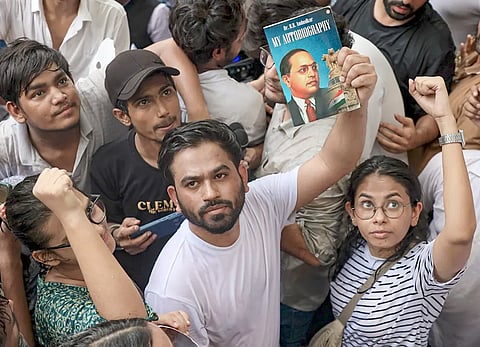
Dipke’s movement will move closer to Ambedkarism when it turns the pain of students into solidarity with all people denied dignity by unequal institutions.

Protest and Constitutional Morality

Dipke’s decision to organise public demonstrations and undertake a hunger strike places him within India’s long tradition of non-violent dissent. Peaceful protest is an essential democratic practice, particularly when institutional channels appear unresponsive.

Yet an Ambedkarite understanding of protest requires constitutional morality. This means respecting the equal citizenship of supporters and opponents, rejecting violence, presenting verifiable demands and creating internal democratic procedures. A movement cannot condemn arbitrary power in the state while concentrating unchecked power in its own leader.

The strength of a democratic movement lies not in the unquestioned authority of one charismatic individual but in the political education and organised participation of its members. Dipke’s most important task is therefore not to make himself indispensable. It is to build institutions capable of surviving disagreement, criticism and leadership change.

This requires transparent finances, publicly stated decision-making processes, accountable spokespersons, meaningful participation by women and marginalised communities, and a clear distinction between verified information and viral speculation. Without these safeguards, a digital movement can quickly become a personality cult.

The Difference Between Visibility and Representation

Social-media visibility should not be confused with democratic representation. Millions of views can reveal public dissatisfaction, but they do not automatically establish who the movement represents or how its programme has been developed.

Ambedkar understood that formally equal political systems could continue to silence socially disadvantaged groups. Representation must therefore include those whose voices are normally absent from leadership and decision-making.

If the Cockroach Janta Party wishes to follow an Ambedkarite path, it must ask difficult internal questions. Are Dalits, Adivasis, Other Backward Classes, religious minorities, women, disabled students and economically vulnerable young people represented in its leadership? Are they present only as supporters, or do they possess real authority? Does the movement address caste discrimination within universities and workplaces? Does it support constitutional safeguards and affirmative action? Does it understand unemployment as a differentiated experience shaped by caste, gender, region and disability?

Silence on these questions would reduce the movement to generalised youth anger. Engagement with them could transform it into a broader struggle for social democracy.

Reasoned Criticism, Not Permanent Outrage

Dipke’s knowledge of political communication has helped him translate frustration into powerful digital messaging. But the techniques that build a movement are not always sufficient to sustain it.

Algorithms reward speed, emotional intensity and conflict. Ambedkarite reasoning demands patience, evidence and conceptual clarity. A responsible movement must resist the temptation to treat every disagreement as betrayal or every critic as an enemy.

Ambedkar’s writing offers a valuable model. His prose could be severe, but its severity was generally attached to an argument. He defined the problem, examined evidence, anticipated objections and explained the institutional consequences of competing positions. His anger was controlled by intellectual responsibility.

Dipke’s movement will demonstrate maturity when it can produce policy documents as effectively as viral videos, conduct research as energetically as demonstrations and correct its own errors as publicly as it condemns the errors of government.

Fraternity as the Final Test

Liberty and equality cannot survive without fraternity. Ambedkar did not understand fraternity as sentimental brotherhood. It was the recognition that every person possesses equal moral worth and belongs within a shared democratic community.

His reconstruction of Buddhism placed reason, morality and social responsibility at the centre of religious life. Navayana was connected to the creation of a society in which human relationships would no longer be organised through hierarchy and inherited degradation.

This principle is especially relevant to protest politics. A movement shaped by fraternity does not reproduce caste prejudice, misogyny, religious hatred or contempt for political opponents. It opposes injustice without denying anyone’s humanity. It creates solidarity between students, workers, farmers, minorities and marginalised communities rather than presenting one group’s pain as more authentic than another’s.

Dipke’s movement will move closer to Ambedkarism when it turns the pain of students into solidarity with all people denied dignity by unequal institutions.

A Possibility, Not Yet a Conclusion

Abhijeet Dipke has shown an ability to recognise youth dissatisfaction, create a memorable political language and move people from online expression to public protest. His campaign has raised legitimate questions about student welfare, examination accountability and the democratic treatment of dissent. These achievements deserve attention.

But no leader becomes Ambedkarite merely by challenging those in power. The Ambedkarite path requires a deeper transformation: from protest to political education, from anger to evidence, from personal leadership to democratic organisation, from symbolic inclusion to substantive representation, and from immediate demands to a programme for social equality.

Dipke stands before an important choice. The Cockroach Janta Party can remain a dramatic expression of temporary frustration, dependent on viral attention and individual charisma. Or it can become a disciplined democratic movement committed to constitutional morality, anti-caste justice, educational equality, internal accountability and fraternity.

The second path is more difficult. It demands study as well as struggle, self-criticism as well as criticism of government, and organisation as well as mobilisation. But that demanding road—not spectacle alone—is the Ambedkarite path.

- Dr. Pankaj Tambe is an Ambedkarite thinker, writer, and researcher based in Nagpur, Maharashtra. His work focuses on the thought of Dr. B. R. Ambedkar, social justice, equality, democracy, constitutional values, and the struggle against caste discrimination. Through his writings, he promotes Ambedkarite philosophy and encourages critical thinking, education, and social transformation.

The Ambedkarite path cannot be reduced to displaying a portrait of Babasaheb Ambedkar, raising a slogan or adopting the colour blue. It is a disciplined moral, intellectual and political commitment to liberty, equality, fraternity, dignity and reason.
"Lost Faith in Safdarjung Hospital": Wangchuk's Wife Approaches Delhi HC Alleging Illegal Detention
The Ambedkarite path cannot be reduced to displaying a portrait of Babasaheb Ambedkar, raising a slogan or adopting the colour blue. It is a disciplined moral, intellectual and political commitment to liberty, equality, fraternity, dignity and reason.
The Mistake of Trusting Words and Ignoring Patterns
The Ambedkarite path cannot be reduced to displaying a portrait of Babasaheb Ambedkar, raising a slogan or adopting the colour blue. It is a disciplined moral, intellectual and political commitment to liberty, equality, fraternity, dignity and reason.
Can Caste Hindus Write Against Caste? Ambedkar’s Radical 1928 Experiment with 'Samata'
The Ambedkarite path cannot be reduced to displaying a portrait of Babasaheb Ambedkar, raising a slogan or adopting the colour blue. It is a disciplined moral, intellectual and political commitment to liberty, equality, fraternity, dignity and reason.
Why Was Congress Seen as Distant from Sonam Wangchuk's Protest? GPCC President Jignesh Mevani Explains the Party's Stand
The Ambedkarite path cannot be reduced to displaying a portrait of Babasaheb Ambedkar, raising a slogan or adopting the colour blue. It is a disciplined moral, intellectual and political commitment to liberty, equality, fraternity, dignity and reason.
"Youth Changes History": Chandrashekhar Azad Backs 20th July Parliament March, Slams Govt Over Sonam Wangchuk's Health

You can also join our WhatsApp group to get premium and selected news of The Mooknayak on WhatsApp. Click here to join the WhatsApp group.

Support The Mooknayak

'The Mooknayak' practices democratic journalism. It is a media platform committed to the Constitution, democracy, and social justice. If you also want 'The Mooknayak' to always raise the voices of the marginalized and show the pain of the voiceless, please support us.

Please Contribute
The Mooknayak English - Voice Of The Voiceless
en.themooknayak.com