Can Caste Hindus Write Against Caste? Ambedkar’s Radical 1928 Experiment with 'Samata'

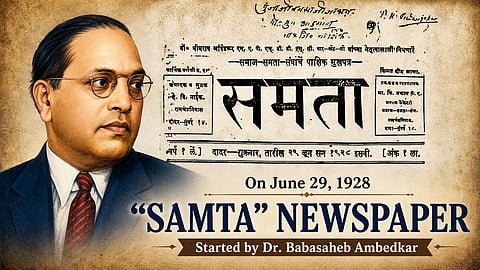
On June 29, 1928, Dr. B.R. Ambedkar launched the Marathi fortnightly newspaper Samta (Equality). Samata fell into a bottomless reading void and collapsed. It was too radical for the Savarna mainstream, which was uninterested in a study that labeled their social environment as a moral failure.
Samata was the boldest, riskiest, and essentially most radical thing Ambedkar ever did as a journalist.
Samata was the boldest, riskiest, and essentially most radical thing Ambedkar ever did as a journalist.AI Image
Published on

— ✍️ Kaleem Ullah Fasihi

Can a newspaper combat caste when its writers are members of the same castes that perpetrate the problem? This is an unanswered question in Indian media. And this was the exactly same question that B.R. Ambedkar asked on June 29, 1928, when he published Samata, or "Equality," a journal under his own name that was written and edited entirely by caste Hindus.

It had nineteen issues before it stopped publishing in March 1929, and most people have forgotten about it since then. It's a mistake to forget that. Samata was the boldest, riskiest, and essentially most radical thing Ambedkar ever did as a journalist. Even now, 98 years later, the question it raised and failed to answer is still one of the most difficult issues in Indian public life, and the reasons it failed still reveal a deep truth about our society: Can Indian Media clutched in the grip of caste Hindu society talk about the subjugations and discrimination against Dalits?

Ambedkar’s Inverted the Dalit Journalism

By 1928, Ambedkar was an experienced journalist. He launched Mooknayak in 1920 and Bahishkrit Bharat in 1927—both distinctly Dalit in perspective and audience, crafted for the populations he sought to rally. Samata was an altogether distinct entity.

The publication served as the official medium of the Samaj Samata Sangh, a cross-caste organization founded by Ambedkar in September 1927 in collaboration with progressive Savarna supporters, aimed at dismantling caste boundaries through inter-dining and inter-caste marriage. The editor was Devrao Naik, a non-Brahmin moved by the Mahad satyagraha of 1927, not a Dalit. All the compositions were authored by Naik, B.V. Pradhan, and other savarna contributors. The masthead featured Ambedkar’s name as the leader, however he contributed no written content to it.

That was the primary objective. The remaining Ambedkar newspapers were authored by Dalits for a Dalit audience. Samata inverted that model: it was a publication authored by caste Hindus, for caste Hindus, advocating for the dismantling of the system that advantaged them. It represented an unprecedented form of anti-caste journalism, unmatched in its execution.

Samata was the boldest, riskiest, and essentially most radical thing Ambedkar ever did as a journalist.
When Ambedkar Quoted Havelock Ellis Works on Homosexuality as 'Natural' in 1930s Court Proceedings!

A Newspaper Searching for Readers

The editors were considerate in their proposal. The "Golden Rule" was printed above every editorial in both traditions simultaneously. From the Anusasana Parva of the Mahabharata (Book 13), in Sanskrit:

Yadanyairvihitan nechchhed atmanah karma poorushah

Na tatpareshu kurveet jaanan apriyam atmanaha

(What we would not want others to do to us, we should not do to others if we know it will make us unhappy.)

 The texts were chosen thoughtfully and carefully. Equality is not a foreign concept imposed on Hinduism from outside. It can be found in your own faith, one of the oldest works, the Mahabharata. The fight to end untouchability is not anti-Hindu. It is, Samata emphasized, the most authentic Hindu mindset you could acquire.

It was a complex case. Apparently, no one cared to read it either.

Samata fell into a bottomless reading void and collapsed. It was too radical for the Savarna mainstream, which was uninterested in a study that labeled their social environment as a moral failure. And it was too Savarna-authored to be useful to the Dalit groups it was intended to serve. According to Ashok Gopal's biography of Ambedkar, it was "the mouthpiece of a few progressive Savarnas" and had no appeal to the majority of Savarnas or Ambedkar's own Depressed Classes supporters.

Samata sought an audience that was too small to sustain a newspaper in 1928. It assumed that people will risk social stigma to say untouchability is horrible and must end, and read, support, and spread a paper saying so. But no such reader existed. Most progressive Savarnas were Congress nationalists who opposed British rule but disliked Ambedkar's aggressive approach or left caste issue out. So, in a way, Samata wrote for a future reader, not an existing one.

Samata was the boldest, riskiest, and essentially most radical thing Ambedkar ever did as a journalist.
Acharya Prashant Receives Death Threat Over Ambedkar Remarks; Know What He Said About Hindu Religion and Baba Sahab

The Way that Led Ambedkar to Buddhism

Samata almost accidentally left behind something very valuable: an early account of where Ambedkar's mind was going.

Many scholars turn to Prabuddha Bharat and The Biddha and His Dhamma to find Ambedkar’s propensity towards Buddhism, but those materials were not the ones that ignited the fire of Buddhism into Ambedkar’s heart but it was Samata that reported Ambedkar’s famous quote in October 1928: "If there ever was a dharamveer who came into this country to kill the sin of untouchability at its root, it was Gautama Buddha". It was one of the first times Ambedkar put the Buddha at the center of the anti-caste movement in public. This was about 30 years before he became a Buddhist for real in 1956 and seven years before he said at Yeola that he would not die a Hindu.

Samata, a Success Out of Failure

In its own sense the failure of Samata was a blessing. Janata, which Ambedkar initiated in 1930 and would operate for 26 years, was constructed upon the lessons learned from previous failures. A paper was required to serve an existing community, rather than a community that was desired. Devrao Naik as an editor was competent; however, he was not Ambedkar, and the authority was evident. The energizing force had to originate from those with the most to lose, despite the fact that a cross-caste coalition could share editorial labor. Success is the product of failure.

98 years later the structural flaw Samata outlined has not disappeared. The contemporary Dalit media – Internet portals, journals, YouTube channels – has largely overcome the challenge by choosing authenticity above outreach: Dalit journalism for Dalit readers. That’s a good call, and a necessary call. But it also means that the Savarna mainstream doesn’t have to listen, because no one is talking to them about what caste costs everyone.

Samata wanted to solve a different problem: not how to empower Dalits to talk, but how to make caste Hindus listen. It didn’t work out. But it failed not because they were solving the wrong problem.

The nine-month-old journal ought to be remembered on its 98th anniversary, not as a footnote to Ambedkar’s career, but as a question he posed that we have not yet answered.

- The author is a research scholar at the department of Mass Communication, Aligarh Muslim University. His research area concerns Dalit Media.

Samata was the boldest, riskiest, and essentially most radical thing Ambedkar ever did as a journalist.
One Act of Desecration, One Extraordinary Judge, One Order That Turned a Criminal Case Into a Lesson for an Entire Nation
Samata was the boldest, riskiest, and essentially most radical thing Ambedkar ever did as a journalist.
Ambedkar Jayanti: When Babasaheb Said 'Wear White'— This Poor Beedi Worker Sold His Watch to Buy a White Sari for His Wife!
Samata was the boldest, riskiest, and essentially most radical thing Ambedkar ever did as a journalist.
Gobarha: When Dalit Wages Were Literally Scooped from Cattle Dung!

You can also join our WhatsApp group to get premium and selected news of The Mooknayak on WhatsApp. Click here to join the WhatsApp group.

Support The Mooknayak

'The Mooknayak' practices democratic journalism. It is a media platform committed to the Constitution, democracy, and social justice. If you also want 'The Mooknayak' to always raise the voices of the marginalized and show the pain of the voiceless, please support us.

Please Contribute
The Mooknayak English - Voice Of The Voiceless
en.themooknayak.com