Discussion
A Hundred Names, One Community: Where Does the Census Count Stand?
Congress raises concerns over the use of open-ended questions as the debate over data accuracy in a caste census gains political and parliamentary significance.


— ✍️ Dundra Kumara Swamy
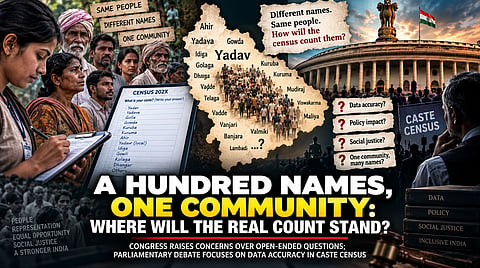
A community may be one, but its names can change from one region to another. A caste may be known by one name in one district, another name in a neighbouring State, and yet another through a sub-caste or local identity. Pronunciations may vary, spellings may differ, and individuals may describe the same social group in different ways. If all these variations enter a national caste census as separate entries, a fundamental question arises: how will the State arrive at the true numerical strength of that community?
That question is at the heart of the growing debate over the use of open-ended questions in the proposed collection of caste-related data. Congress has raised concerns over a system that allows respondents to write their caste identity freely without an immediately visible standardised list or classification framework. The concern is not merely about how a question is asked, but about what happens to the answer once it enters the national database.
India's caste structure is marked by extraordinary social, linguistic and regional complexity. The same community can be identified by different names across States, districts and even neighbouring villages. In some places, people may use the name of a broader caste group; elsewhere, they may identify themselves through a sub-caste or a local social identity. The names may be different, but the underlying social reality may still be the same.
The problem becomes more complex when variations in spelling, pronunciation and local usage are added to the process. If ten individuals belonging to the same social group describe their identity in ten different ways, how will a data system determine whether those ten entries represent ten distinct communities or one? Recording a name may be simple; recognising one community behind a hundred different names is the far more difficult task.
Every individual entry in a census eventually becomes part of a much larger national statistical picture. A small variation at the point of recording can therefore have wider consequences during classification and aggregation. If members of the same caste are recorded under multiple names and those names are not correctly reconciled, the final population figure may fail to reflect the actual strength of that community. And if the count itself is uncertain, an obvious question follows: how reliable can decisions based on that count be?
The central issue raised by Congress is not opposition to caste enumeration itself, but the method by which caste identities are recorded, classified and ultimately interpreted. How will different names referring to the same community be identified? What mechanism will distinguish a sub-caste from a broader caste category? What safeguards will prevent regional names from being treated as entirely separate social groups? These are questions of methodology, and they go to the heart of data reliability.
The issue becomes even more significant because a national caste census cannot simply collect information; it must also make sense of it. If multiple names are entered for the same community, someone—or some system—must eventually determine how those names relate to one another. What standards will govern that process? Will there be a nationally accepted classification framework? How will variations across States be reconciled? And how transparent will the exercise be?
The right of an individual to describe his or her own social identity is, of course, an important consideration. Allowing respondents to state their identity freely can be seen as an acknowledgement of India's complex social realities. But self-identification alone cannot resolve the statistical challenge. The system collecting the information must also be capable of understanding, verifying and classifying that information with consistency.
Otherwise, the respondent may provide an entirely accurate description of his or her identity, while the larger database may still treat that entry as something different. The problem, then, need not lie with the individual who answers the question. It may lie in the inability of the system to connect different expressions of the same social reality.
For the ordinary citizen, the exercise may appear straightforward: a person records the name by which his or her community is known and moves on. But that single entry does not remain an isolated response. It becomes part of a national dataset that could shape the understanding of India's social composition. If thousands of people belonging to the same community are recorded under different names, the actual size and distribution of that group could become difficult to establish.
This concern is particularly relevant to socially and educationally backward or smaller communities, for whom accurate representation in official data can be especially important. A community does not cease to exist because it is statistically fragmented. But if it is not properly recognised in official data, its social reality may become harder to measure, study and address.
The policy challenge, therefore, is not a simple choice between allowing free responses and imposing a rigid list. Should there be a standardised reference framework before enumeration begins? Or should respondents be allowed to record their identities freely, followed by a scientifically designed process to classify and consolidate the data? The answer may require consultation with statisticians, social scientists, community representatives and State governments.
A credible national exercise will require more than the collection of millions of responses. It will require a transparent and technically robust system capable of linking different names to the social realities they represent. It will also require clear safeguards to ensure that regional variations, sub-caste identities and linguistic differences do not produce an inaccurate or fragmented national picture.
The parliamentary debate, therefore, should not be reduced to a familiar contest between the government and the Opposition. The more important questions are methodological. How will caste names be recorded? How will different entries be examined? Who will determine whether multiple names belong to the same social group? What standards will guide classification? And how will the public be assured that the final data accurately represents the country's social diversity?
A caste census is not merely an exercise in filling a column on a form. It is an attempt to understand a complex social landscape through numbers. That makes the design of the process as important as the decision to undertake it.
For if one community is scattered across the census under a hundred different names, what is lost may not be just a number. What may disappear from the official record is the community's collective identity itself.
- The author is a High Court advocate, National President BC Dal and Chairman of National BC Reservation Struggle Coordination JAC.
You can also join our WhatsApp group to get premium and selected news of The Mooknayak on WhatsApp. Click here to join the WhatsApp group.
'The Mooknayak' practices democratic journalism. It is a media platform committed to the Constitution, democracy, and social justice. If you also want 'The Mooknayak' to always raise the voices of the marginalized and show the pain of the voiceless, please subscribe.
PLEASE SUBSCRIBE US