Dalit News
Gulzar Singh Death: What Happened to the Dalit Man Who Questioned Punjab Minister Harpal Cheema Over Drugs?
The National Commission for Scheduled Castes (NCSC) has sought a report from the Punjab government concerning Singh's death.

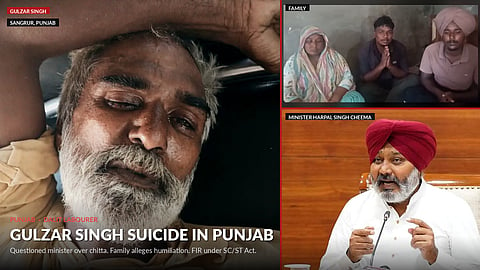

Sangrur/Punjab- A political controversy has erupted in Punjab following the death of Gulzar Singh, a Dalit agricultural labourer from Toor Banzara village in Sangrur district, after he consumed a poisonous substance days after publicly raising the issue of drug availability with Punjab Finance Minister Harpal Singh Cheema.
Singh died at Dayanand Medical College and Hospital (DMCH), Ludhiana, after being shifted between hospitals. Before his death, he recorded a video in which he alleged that he was threatened after questioning Cheema about the availability of drugs and his son's addiction.
Police have registered a case against five people under provisions relating to abetment of suicide and the Scheduled Castes and Scheduled Tribes (Prevention of Atrocities) Act. All five were arrested later.
The controversy has since expanded to the circumstances surrounding Singh's cremation. The Congress, BJP and Shiromani Akali Dal leaders have all attacked the AAP government over the death, the drug crisis and the handling of the cremation.
Congress leader Pawan Khera has alleged that Singh's body was cremated forcibly under heavy police deployment and without the family's consent, comparing the episode with the 2020 Hathras cremation controversy. However, reporting from the day of the cremation said Singh's family ultimately agreed to the cremation after negotiations with the administration and after the government agreed to compensation and a government job for a family member.
Gulzar Singh was a resident of Toor Banzara village in Sangrur district's Dirba constituency. His family had been dealing with his eldest son's drug addiction.
According to Singh's son and reports from the village, the son had been addicted to drugs and household belongings had allegedly been sold to sustain the addiction. Singh raised the issue of drug availability when Finance Minister Harpal Singh Cheema visited the village to hear public grievances.
According to media reports, Cheema visited Toor Banzara on a Sunday to meet people and hear their grievances. Singh raised the issue of the availability of “chitta”, a term commonly used in Punjab for illicit drugs, and told the minister about his son's addiction.
His central concern was not simply that his son was addicted. He wanted to know how drugs could be so easily available in the village despite the government's repeated claims of action against the drug trade.
According to the family, Singh was subsequently subjected to pressure and humiliation. The allegation is that local panchayat members and others pressured him to apologise for publicly questioning the minister.
Singh's son reportedly said that his father returned home distressed and spoke about being forced to apologise. The panchayat has denied the allegations. The sequence is particularly important because a video recorded before Singh's death has become a central piece of the controversy.
In the video, Singh reportedly speaks about the circumstances he was facing and refers to people whom he held responsible. According to the police, Singh consumed a poisonous substance on Monday. He was initially taken to Sangrur Civil Hospital and was subsequently referred to Rajindra Hospital, Patiala.
According to his family, they were unable to get a ventilator at Patiala and returned to Sangrur, where he was taken to a private hospital before being referred to DMCH, Ludhiana.
He eventually died at DMCH later that night. The police described the death as a case of suicide.
Deputy Superintendent of Police Rupinder Kaur Bajwa told media that the police would proceed on the basis of the family's statement. At the time of that report, the police had not received a statement from the family formally linking Singh's death to the incident in which he questioned the finance minister or to the alleged threats.
Cheema told the media that Singh had raised the drug issue and that he had asked the police to take appropriate action against people involved in supplying drugs. Cheema denied having any role in the circumstances leading to Singh's death.
Following the death, police booked five people: Baljit Singh alias Raj, Baljinder Kaur, the village sarpanch, Sukhraj Singh alias Sukha Conductor, Vicky, a panchayat member and Gona Singh.
According to the local media reports, the accused were booked under provisions relating to abetment of suicide and the SC/ST (Prevention of Atrocities) Act, and all five were arrested. The investigation is continuing.
The cremation became a second major flashpoint.
According to media reports, the family, police, district administration and representatives of the Zameen Prapti Sangharsh Committee (ZPSC) held negotiations.
The family eventually agreed to the cremation.
According to ZPSC general secretary Bikar Singh, the government agreed to provide a government job to one family member and compensation under the SC/ST Act.
The cremation nevertheless remained tense. According to the Indian Express ground report, some people demanded that Harpal Singh Cheema's name also be included in the FIR. Arguments broke out and logs of wood were thrown inside the cremation ground.
A heavy police presence was reported around the cremation. The cremation subsequently became the subject of a national political controversy.
Congress media chief Pawan Khera posted on X on September 9 that Gulzar Singh's body had been cremated “under heavy police deployment” and “without the family's consent”.
Khera compared the incident with the September 2020 cremation of the Hathras Dalit woman and criticised the AAP government in Punjab.
He wrote that the episode showed, in his words, that AAP was an “English medium BJP.”
A four-member Special Investigation Team (SIT) has been constituted to investigate the case. The SIT is under the supervision of ADGP Naunihal Singh. The death has triggered a major political confrontation in Punjab.
Congress leader Rahul Gandhi demanded the resignation of Finance Minister Harpal Singh Cheema and called for an independent, impartial and time-bound investigation.He also urged Punjab's Dalit community to remain vigilant and called for justice for Singh's family.
The Congress has sought greater accountability from the Punjab government over the circumstances surrounding Singh's death.
Punjab Chief Minister Bhagwant Mann responded to Rahul Gandhi's criticism by accusing him of politicising Singh's death.
Mann said Punjabis do not like politics being played over a dead person and rejected the Congress's attack on his government.
The AAP has also rejected the allegations being made by Congress leaders.
At the centre of the entire controversy is the issue that Gulzar Singh himself raised: the availability of drugs in his village and his son's addiction.
The Indian Express reported from Toor Banzara that villagers described widespread availability of “chitta” and spoke about the effect of drug addiction on families. The village has around 1,800 voters, with nearly 700 belonging to Scheduled Caste communities, according to the newspaper's ground report.
Singh's own family has said that his son's addiction had caused severe difficulties at home.
The case has also attracted the attention of national statutory bodies.
The National Human Rights Commission (NHRC) took cognisance of allegations concerning harassment and intimidation faced by Singh.
The Commission sought information from Punjab's Chief Secretary, DGP, District Magistrate and Sangrur's Senior Superintendent of Police.
The NHRC has also sought Singh's dying declaration, inquest report, post-mortem report and other relevant records and directed authorities to submit an Action Taken Report.
NHRC member Priyank Kanoongo described the allegations as a serious human-rights issue and questioned what it would mean if a citizen was pressured after raising questions about the drug problem with a minister.
The case therefore involves not merely a political dispute but allegations that have resulted in formal police action and scrutiny by a statutory commission.
The Gulzar Singh case now has several distinct questions: Why did Singh consume poison? Was it solely related to his son's addiction and personal distress, or did alleged threats and pressure after his confrontation with the minister contribute? Is it a genuine recording made before his death and does it meet the legal requirements to be treated as a dying declaration?
The five people booked by police include local panchayat members, but allegations of political affiliation and responsibility must be established through investigation.
Did the administration pressure the family over the cremation?
The family's latest allegation makes this a separate question requiring verification.
Why was such a large police presence required at the cremation?
Authorities need to explain whether the deployment was intended to prevent violence, protect the family, enforce an administrative arrangement, or respond to protesters.
You can also join our WhatsApp group to get premium and selected news of The Mooknayak on WhatsApp. Click here to join the WhatsApp group.
'The Mooknayak' practices democratic journalism. It is a media platform committed to the Constitution, democracy, and social justice. If you also want 'The Mooknayak' to always raise the voices of the marginalized and show the pain of the voiceless, please subscribe.
PLEASE SUBSCRIBE US