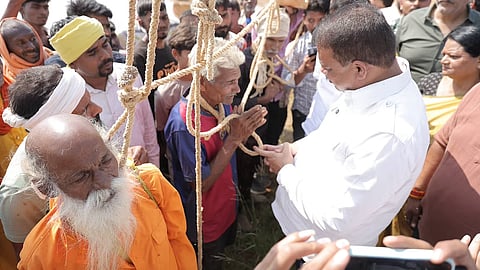
Bhopal: The controversy over the proposed nuclear power project in Rewa district of Madhya Pradesh is deepening. Villagers in Rozhauhi and Sarai Kala in the Sirmaur region are opposing the project, raising questions about the safety of their water, forests, land, and future. The situation has become more serious after the death of tribal woman Vimla Kol, who was participating in a "Jal Satyagraha" (water satyagraha) during the movement. The dispute is now no longer limited to the establishment of a power project — questions related to Gram Sabha consent, administrative permissions, environmental safety, and the rights of tribal communities have also come to the center of the matter.
Leader of Opposition in the Madhya Pradesh Legislative Assembly, Umang Singhar, met with protesting villagers and the family of Vimla Kol on October 25. Opposing the project, he said that a nuclear power plant would not be allowed to be set up in Rewa at any cost. He also announced financial assistance of Rs 1 lakh to the victim's family and said the issue would be raised in the Assembly.
The next day, on October 26, during a press conference in Bhopal, Singhar questioned the No Objection Certificate (NOC), the alleged consent letter, and safety standards related to the project. He demanded that information related to environmental studies, potential displacement, and the safety of local people be made public.
Local opposition continues over the proposed nuclear power project around Rozhauhi and Sarai Kala in the Sirmaur region of Rewa district. Amid public discussion over the project's name and nature, a clear account of its actual technical status, proposed capacity, and required approvals needs to come forward.
According to available information, the project is currently in the proposed stage, and controversy has arisen over preliminary technical investigations and drilling-related activities.
In a nuclear power plant, the heat generated by nuclear fission is used to heat water and produce steam. The steam turns a turbine, which generates electricity. A major advantage of nuclear energy is that direct carbon emissions from power generation during plant operation are relatively low.
However, setting up and operating a nuclear power plant requires strict safety standards, safe management of radioactive waste, adequate water resources, emergency preparedness, and independent regulatory monitoring.
Basic questions about the proposed Rewa project are not yet clearly answered in public. What capacity reactors are to be installed? How much land will the project require? Which villages and families could be affected? How much water will be needed? What technical and environmental approvals are necessary for the project?
Answers to these questions should come forward through official documents so that a factual assessment of the project's potential impacts can be made. But clear information has not yet been made public.
Villagers in the Rozhauhi and Sarai Kala area fear that the establishment of a nuclear power plant could affect their land, water sources, farming, environment, and health. For the villagers, this is not merely a power generation project but a matter linked to their right to live in their villages, farm, and earn a livelihood.
Along with tribal families, Scheduled Caste families, small farmers, and agricultural laborers also live in the area. Leader of Opposition Umang Singhar has claimed that more than 1,500 families and over 5,000 people live in Rozhauhi and Sarai Kala. He has demanded that the government clarify how many villages, families, agricultural land, and forest rights leases could be affected by the project.
Villagers are also concerned about what arrangements will be made for their rehabilitation and livelihood if land acquisition or displacement occurs in the future. For families dependent on farming and natural resources, land is not just property but the primary means of livelihood.
However, the conclusion on how much impact the project will have on the environment or health can only be drawn based on scientific studies and technical assessment. Along with seriously listening to villagers' concerns, it is also necessary to make project-related facts public.
A key aspect of this entire controversy is linked to Gram Sabha consent and drilling permission. According to Leader of Opposition Umang Singhar, on September 3, 2026, the Gram Sabha unanimously refused to give consent for drilling. After this, the Gram Panchayat informed the district administration of this decision through letter number 48 on September 5.
Singhar alleged that despite this, NOC number 147/2026 was issued on September 23. According to him, this NOC mentioned an alleged consent letter dated September 4.
Singhar also said that Sarpanch Komal Sanjay Singh had complained to the Divisional Commissioner and Collector on October 8, demanding an investigation into the alleged consent letter and cancellation of the NOC.
Several questions are being raised over this sequence of events. If the Gram Sabha had not given consent for drilling, on what basis did the administration issue the NOC? Was the authenticity of the alleged consent letter investigated or not? How did the concerned officials treat the Gram Sabha's decision? What action did the administration take after receiving the complaint?
Amid opposition to the project, the death of tribal woman Vimla Kol has made the movement emotionally and politically more serious.
According to media reports, Vimla Kol, a tribal woman from Rozhauhi village, had been participating in the Jal Satyagraha with villagers for about four days. On the night of October 21, information came that her health had deteriorated. She was taken to a hospital for treatment, where she died on October 22.
After her death, an atmosphere of mourning and anger prevailed in the area. Vimla Kol's husband, Jamuna Kol, expressed deep sorrow over losing his wife and questioned the administration, asking whether it could bring his wife back.
After Vimla Kol's death, Leader of Opposition Umang Singhar targeted the state government. During a meeting with villagers on October 25, he said that in the name of development, people's lives, land, and environment should not be put at risk.
He announced that the Congress would oppose the project and that the matter would be raised in the Assembly. Singhar also spoke of giving Rs 1 lakh in assistance to Vimla Kol's family. He demanded that villagers' concerns be taken seriously and that consideration be given to relocating the project elsewhere.
During a press conference in Bhopal on October 26, Singhar questioned the project's safety arrangements and administrative permissions. He asked where the proposed reactors would be installed, how many villages would fall within the safety and monitoring zone around the plant, and how many families, agricultural lands, and forest rights leases could be affected.
He demanded that studies related to environmental impact assessment, seismic risk, water availability, potential effects of radiation, and disaster management plans be made public. He also questioned how local populations would be informed about potential risks and safety measures.
Citing the Chernobyl and Fukushima nuclear accidents, Singhar said the government should take the potential risks of nuclear power projects seriously.
However, mentioning these accidents is not in itself proof of a accident risk in the Rewa project. The safety of any nuclear plant should be assessed based on its design, site, regulatory scrutiny, and safety measures.
The controversy over the proposed Rewa nuclear power project now appears to be moving forward on three levels. First, the villagers' movement and their demands related to the protection of water, forests, and land. Second, administrative questions raised over the Gram Sabha's decision and the NOC issued for drilling. Third, the Congress and Leader of Opposition Umang Singhar's opposition to the project and the announcement to raise it in the Assembly.
At present, the status of all necessary technical and regulatory approvals for the project is not clear. A detailed response from the administration on the allegations related to the Gram Sabha's disagreement and the alleged consent letter is also awaited.
The challenge before the state government and the project side is to make project-related facts public rather than merely citing the need for power generation and development. Villagers have the right to know what kind of project is proposed near their village, what changes it could bring, and what arrangements will be made for their safety and livelihood.
You can also join our WhatsApp group to get premium and selected news of The Mooknayak on WhatsApp. Click here to join the WhatsApp group.
'The Mooknayak' practices democratic journalism. It is a media platform committed to the Constitution, democracy, and social justice. If you also want 'The Mooknayak' to always raise the voices of the marginalized and show the pain of the voiceless, please subscribe.
PLEASE SUBSCRIBE US