TM Special | How Sahil Wakode’s Death Convulsed IIT Bombay: Everything That Has Happened Since 18 September

A month after IIT Bombay student Sahil Wakode’s death, his family and protesting students are demanding arrests and Director Kedare’s resignation, while police detentions on 18 and 25 October have deepened the confrontation, and no arrest has been reported so far.
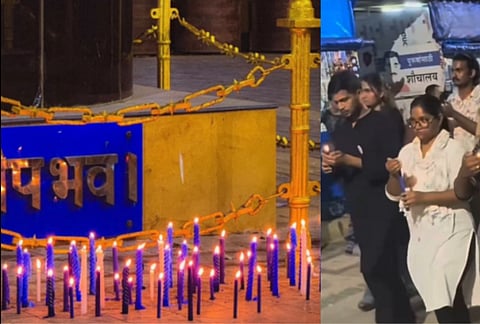
Students, activists, and community members organized a silent candlelight vigil at ChaityaBhoomi on October 25 to demand justice for Sahil Wakode.
Published on: 

Mumbai- Five weeks after the death of IIT Bombay student Sahil Wakode, the case has grown from a single campus tragedy into a wider confrontation over caste, institutional accountability and the right to protest. Wakode’s parents are demanding arrests and the resignation of the institute’s director. Students have run a month-long sit-in on campus. Police have twice moved against protesters, on 18 October inside the campus and on 25 October at Chaityabhoomi in Dadar.

Calling for a silent candle march at Chaityabhoomi in Dadar on 25 October, All India Independent Scheduled Castes Association (AIISCA) brought the Sahil Wakode protest from the IIT Bombay campus to the memorial associated with B. R. Ambedkar. The Progressive Students Union (PSU) also joined the protest. The march was meant to pay tribute to Sahil, whose family alleges caste-based harassment.

Students and activists began gathering around 5:30 pm with placards and slogans, but police detained many of them within minutes, saying the march was unauthorised. Deputy Commissioner of Police Mahendra Pandit said 20 to 25 protesters were taken to a police station and that their release was under way. A second group, including Peasants and Workers Party youth leader Samya Korde, arrived and several of them were also detained. The family’s lawyer, Siddharth Ingale, said he had repeatedly urged police to let people pay their respects peacefully.

Students protested at Chaityabhoomi over the lack of action in the IIT Bombay student Sahil Wakode’s death case. Police detained all protesters at the site.

Timeline: What happened so far

Sahil Wakode was found dead in his hostel room on 18 September, hours after the exam incident in which he was allegedly caught with a phone during a mid-semester paper.

The next day, 19 September, Mumbai Police registered an FIR on his father’s complaint under abetment and SC/ST Act provisions, and the case was moved to the Crime Branch.

On 20 and 21 September, IIT Bombay suspended Professor Suryanarayana Doolla as Dean of Administrative Affairs and apologised for its earlier account of the events before his death.

Around 23 September, Organiser, citing police sources, reported that the Crime Branch’s early inquiry had found no concrete evidence of Doolla’s role in abetment.

From late September, Wakode’s parents began a hunger strike at Azad Maidan, demanding the arrest of Doolla and Director Shireesh Kedare. In early October, students announced a hunger strike on campus, demanding Kedare’s resignation.

On 18 October, one month after the death, police entered the campus, the Justice Corner protest site was dismantled, and students were detained. Student bodies counted 22 detained, eight of them twice in one day.

On 19 October, IIT Bombay faculty sent an open letter to Kedare with seven questions on the police action and the students’ belongings.

On 24 October, the Justice for Sahil / Justice Corner 2.0 group published its open letter to the IIT Bombay community.

On 25 October, a silent candle march was held at Chaityabhoomi in Dadar. Police called it unauthorised and detained participants, and DCP Mahendra Pandit said 20 to 25 were taken to a police station. The Wire reported dozens detained, including Wakode’s parents, and about 84 organisations backing a call for Kedare’s resignation.

Police have taken the CCTV footage into custody as part of their investigation.
The footage appears to show Prof Doolla taking Wakode away from the other students before an exchange between them.Social Media

Wakode, a second-year BTech student in the Department of Energy Science and Engineering from Yavatmal, was found dead in his hostel room on the evening of 18 September. His was the third student suicide at IIT Bombay this year and the tenth at an IIT nationwide in 2026.

Sahil died hours after he was allegedly caught with a phone during a mid-semester examination and accused of uploading the question paper to ChatGPT. Professor Suryanarayana Doolla was on examination duty that day, who asked Wakode to step outside, and took him to the Head of Department.

The institute’s first public account of the circumstances became a flashpoint. IIT Bombay later apologised for having described the events preceding his death before any investigation had established them. The original statement had said Wakode was counselled and assured the incident would not harm his academic career. The institute has denied that caste discrimination was involved and said no disciplinary action had been started against him before his death.

Students, activists, and community members organized a silent candlelight vigil at ChaityaBhoomi on October 25 to demand justice for Sahil Wakode.
Sahil Wakode Suicide: IIT Bombay Faculty Forum Says Prof Doolla Not Suspended, Only ‘Temporarily Relieved’; Sociology Professor Questions Its Legal Status

The family’s allegations and the criminal case

Wakode’s parents, Ravindra and Sonali Wakode, allege that he faced caste-based abuse. His father has said Professor Doolla subjected him to casteist slurs over about three months. A day after the death, Mumbai Police registered an FIR on the father’s complaint, invoking abetment of suicide and Scheduled Castes and Scheduled Tribes (Prevention of Atrocities) Act provisions. The FIR names Doolla and other officials. The case was then moved to the Mumbai Crime Branch.

IIT Bombay suspended Doolla from his post as Dean of Administrative Affairs, and he was summoned for questioning. Organiser, citing police sources, reported around 23 September that the Crime Branch’s preliminary inquiry had not so far found concrete evidence of Doolla’s role in abetment. The institute also formed a 10-member committee to inquire into the circumstances of the death.

The case sits against a long-running debate about caste at the IITs. In 2023, the death of first-year student Darshan Solanki at IIT Bombay led to a Maharashtra government SIT and the arrest of a batchmate for alleged abetment, even though an institute committee had earlier ruled out caste discrimination. Student groups also point to the 2014 death of Aniket Ambhore, whom they described as a Scheduled Caste student.
Maha police detained the people including those who were heading to Chaityabhoomi, who were holding peaceful candle march.

A month of protest

Students gathered on campus after the death and marched to the main gate, setting up a protest site they named Justice Corner. Their demands, include Doolla’s suspension until the criminal investigation concludes, Director Shireesh Kedare’s resignation, and safe access to the campus for Wakode’s parents. Students put a list of 18 demands to the institute. The institute has also reversed stricter cheating rules it had introduced, restoring the original norms.

Students later announced a hunger strike on campus. Separately, Wakode’s parents began a hunger strike at Azad Maidan, where they were reportedly not permitted inside the institute. They have demanded the arrest of Doolla and Kedare, and the family’s lawyer said the government had not responded to the demands. Mumbai Congress chief and MP Varsha Gaikwad met the family. Reports at that stage said police were reviewing CCTV footage and speaking to witnesses.

Bhim Army chief and Nagina MP Chandrashekhar Azad has written to Union Home Minister Amit Shah seeking a CBI investigation, and also flagged what he described as harsh treatment of protesting students by police.

Students, activists, and community members organized a silent candlelight vigil at ChaityaBhoomi on October 25 to demand justice for Sahil Wakode.
IIT Bombay Academic Malpractice Rules: Sahil Wakode Case Raises Questions Over What Should Have Happened Inside Exam Hall

18 October: police on campus

Sunday 18 October marked one month since Wakode’s death. Students had planned a memorial and a torchlight procession, and his parents came to the campus to pay tribute.

A large police presence entered the campus, the Justice Corner site was dismantled, and students were detained. Student bodies said 22 students were detained, eight of them twice in one day. The parents, students and activists were detained, with people inside the campus held within the premises and others at the gate taken to Azad Maidan police station. Other outlets reported students being taken to Powai police station, and the Justice Corner letter names Rambaug.

Protesters alleged that police tore clothes, kicked and choked them, and that women students faced inappropriate touching and assault. Students and faculty asked who had authorised police to enter the campus.

Protestors holding a candle march demanding justice for Sahil.

What the Justice for Sahil letter says

In an open letter dated 24 October, the Justice for Sahil / Justice Corner 2.0 group explained what had happened on October 18. The six-page letter, titled “What Really Happened on 18th October and Why the IIT Administration is Whitewashing its Complicity with Mumbai Police”, is signed “Justice For Sahil, Justice Corner 2.0”.

Opening claims and two questions

The students say 22 of them were “brutally detained” from inside the campus with the visible complicity of the administration, after a month of peaceful protest at Justice Corner, and that videos of the events have spread across India. They pose two questions: why students who questioned police aggression on their own campus were brutalised while the administration stayed silent, and whether the violence can be called “administration sponsored”.

They say they invited the administration to dialogue several times. In their account the administration only forwarded their demands to the Chairman of the Board of Governors and gave no genuine response, which they say contributed directly to the events of 18 October.

Why the day was unusual

The students say they found an unusually large police presence that morning, including several buses of the kind used for detentions, vans and police cars, and call the deployment “an act of aggression” in itself. They say that in a month of protest at the main gate there was no security incident, blockage or disruption attributed to them, and that security never told them the protest was an obstruction.

They point out that when Union minister Ramdas Athawale visited on 25 September to meet the Director and briefly spoke to protesters, there was no comparable police deployment. They say their questions to police and campus security on 18 October went unanswered.

The institute later told staff and faculty by email that the police were there for a scheduled visit by MP Varsha Gaikwad, which coincided with a planned visit by Ravindra and Sonali Wakode to meet the Board chairman. The students say they were never told of either visit and that advance notice would have won their cooperation.

Their timeline of 18 October

  • 12:00 pm: Protesters ask why police are inside the campus. Police do not explain.

  • 12:15 to 12:30 pm: Eight students are detained. The letter alleges hair-pulling, dragging and serious injuries, and says students asked for the Chief Security Officer or any administrator, citing their status as IITB students. It says the Director and the CSO were present and did not intervene, and describes the detention as a “day-light kidnapping” that campus security witnessed.

  • 12:30 to 1:30 pm: The eight are driven around in a bus, taken to a police station for 10 to 15 minutes, and returned to Justice Corner through Gate 3.

  • 1:30 to 3:00 pm: On return, the students find Wakode’s parents, their lawyer, MP Gaikwad and some media at the site. They report the earlier detention formally to the CSO. The letter says campus security barricaded the route to the main gate from inside, keeping many students from joining, though some got through. The parents perform “Shradhanjali” rituals, hand a letter to the Registrar (the Chairman being unavailable), and sit with students after media and others leave. The students say the administration told them nothing of the parents’, the MP’s or the media’s arrival.

  • 3:00 pm: A second round of detentions begins. The letter alleges students sitting peacefully were pulled, dragged and thrown, posters and banners torn down, and portraits of Ambedkar, Jotiba Phule, Savitribai Phule, Gandhi and Bhagat Singh removed, with a statue of Ambedkar handled roughly. It alleges cuts, bruises, torn clothes and sexual assault, all with the assistance of IIT security.

  • 3:00 to 7:00 pm: Students are held at a police station until about 6:30 pm, then driven back to the campus and kept on the bus for another half hour as it circled the grounds. The protest site was by then “completely erased and destroyed”.

Six points on what the administration could have done

The letter rejects the administration’s reported line that students “behaved aggressively” and lists missed chances to prevent the events:

  1. Tell students why police were on campus and about the parents’ visit, so they could cooperate.

  2. Step in when the first detentions began, speak to students and discourage police violence. The letter also accuses the administration of earlier conduct it calls hostile: setting a narrative that Wakode had cheated through the institute’s official X account, encouraging selected faculty and students to speak to media against guidelines, and backing a faculty march while a criminal investigation was open.

  3. Attend to students who were calling for the administration while being dragged. The Director, the letter says, was only a few feet away.

  4. Open a dialogue when the first group was released and sitting with the parents, rather than “giving a free hand” to police.

  5. Recognise that the “aggression” claim collapses because, in the second round, students were detained in larger numbers merely for being present. The letter says police chased some students inside the campus, and that campus security told police that some professors caught up in the detentions were not students and they were let go, which the authors say shows security intervention could have prevented the detentions.

  6. Correct the line in the administration’s email that the police “detained the students involved and released them by evening”. The students call this a “blatant lie” because it implies a single round of detention of only the morning group.

The students say the dismantled site’s contents were seized by campus security, including laptops, books, room keys and medication, and that five days later they had received only “bureaucratic” excuses, among them that the property was with Powai police. They dispute that, saying their MacBooks have shown within a kilometre of the campus. They read the “lost property” label as an attempt to deny that a protest site ever existed, after more than 30 days in which they say they slept in the open and held hunger strikes there.

The letter says the administration shifts blame to students whenever it is under scrutiny, citing what it calls past responses to student suicides that pointed to personal reasons or academic weakness. It says many see this as an “institutional form of casteism” aimed at students from marginalised communities, and that hours after Wakode’s death an unverified statement called him a cheater and set off a media trial against him and his family. The authors say the same method is now being used against the protesters. The name list it closes with is “Sahil, Sohil, Naman, Rohit, Darshan, Aniket and many more”.

The letter closes by opposing what it calls the administration’s attempt to defame students and deny accountability questions raised by professors and staff. It asks the community to stand in solidarity, to press for a fair dialogue between students and the administration, to secure the immediate return of their belongings, and to open talks on their demands.

25 October Candle March

On Sunday 25 October, students and activists gathered for a silent candle march at Chaityabhoomi, the memorial at Dadar associated with B. R. Ambedkar, to pay tribute to Wakode. Police detained more than 140 participants, saying the march was unauthorised.

Deputy Commissioner of Police Mahendra Pandit said roughly 20 to 25 protesters were taken to a police station and that their release was under way. Police had been deployed in the area hours earlier to prevent law-and-order problems. As students and activists gathered around 5:30 pm with placards and slogans, police began detaining them and moving them to different stations. A second group, including Peasants and Workers Party youth leader Samya Korde, arrived and several were detained as well. The family’s lawyer, Siddharth Ingale, said he had repeatedly asked police to let people pay their respects peacefully. Stand-up comedian Masoom Rajwani was among those detained.

The candlelight protest demanded Director Kedare’s resignation and that Wakode’s parents were also detained, with a post circulated on social media alleging they were held at an unknown location. The family’s lawyer said they could not be contacted after 5 pm. Around 84 organisations also backed the demand through an open letter calling for justice for Wakode and resignation as a form of institutional accountability. The police position is that permission had not been obtained.

“Take Accountability and Resign”: 84 Organisations Accuse IIT Bombay Director of Smear Campaign, Police Repression

In an open letter addressed to IIT Bombay Director Prof. Shireesh Kedare, 84 organisations (joined by 40 distinguished individuals) have accused the institute's administration of being "spectacularly callous at best or maliciously repressive towards complaints of caste discrimination" following the death of student Sahil Wakode.

The letter makes four allegations: that the institute issued a press statement defaming Sahil as a cheater within hours of his death, possibly without any enquiry, and before his family had even complained to the Mumbai police; that after Sahil's parents filed a complaint against Dean Suryanarayana Doolla, the institute's official faculty body publicly stood in solidarity with the accused professor, prejudicing public opinion while the matter is under investigation; that selectively chosen CCTV footage from the examination hall was leaked to the media to malign Sahil even after his death, while his subsequent interaction with the Dean remains confidential and no action has been taken against anyone for the leak; and that police "brutality" was unleashed on students standing in solidarity with Sahil, with his parents and protesters outside the IIT Bombay gate also manhandled.

Holding the Director responsible and saying he "must be held accountable," the signatories demand that he step up, take accountability for the "entire debacle of administrative failures," and resign from his position, urging him not to become "a mascot of repression and casteism."

Students, activists, and community members organized a silent candlelight vigil at ChaityaBhoomi on October 25 to demand justice for Sahil Wakode.
"Conclusion Already Decided": IITB Students' Collective Says Inquiries into Aniket Ambhore, Darshan Solanki Deaths Found No Caste Discrimination By Design, Sahil Wakode Probe Will Be No Different
Students, activists, and community members organized a silent candlelight vigil at ChaityaBhoomi on October 25 to demand justice for Sahil Wakode.
“We Will Not Be Silenced”: APPSC IIT-B Says Its Instagram Page Was Hacked After Raising Its Voice Over Sahil Wakode’s Death
Students, activists, and community members organized a silent candlelight vigil at ChaityaBhoomi on October 25 to demand justice for Sahil Wakode.
After IIT-Bombay Suicides & Medical College Cases, MP Varsha Gaikwad Urges CM to Activate SC/ST Protection Cells & Vigilance Panels

You can also join our WhatsApp group to get premium and selected news of The Mooknayak on WhatsApp. Click here to join the WhatsApp group.

Subscribe The Mooknayak

'The Mooknayak' practices democratic journalism. It is a media platform committed to the Constitution, democracy, and social justice. If you also want 'The Mooknayak' to always raise the voices of the marginalized and show the pain of the voiceless, please subscribe.

PLEASE SUBSCRIBE US
The Mooknayak English - Voice Of The Voiceless
en.themooknayak.com