India
TM Exclusive | Periyar Gets First Formal Recognition by a Parliament Outside India; Australia’s NSW Council Passes Motion
PATCA President Devibala Palanivel tells The Mooknayak how it came about

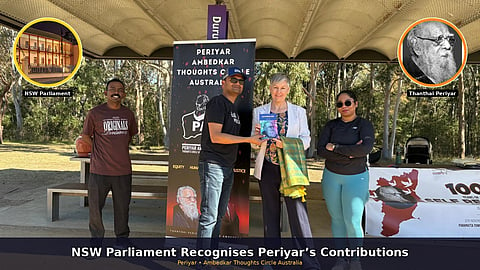

New Delhi- Periyar E. V. Ramasamy’s contributions have been formally recognised for the first time by a parliament outside India. The Legislative Council of New South Wales (NSW), Australia, has passed a motion commemorating Periyar’s contributions to social justice and equality. The motion also congratulates the Periyar Ambedkar Thoughts Circle of Australia (PATCA) on its work advocating for marginalised communities. It was agreed to without objection. PATCA is a grassroots advocacy organization in Australia dedicated to ending caste-based discrimination, promoting social justice, and advancing rationalism
The motion was moved by Greens MLC Cate Faehrmann. PATCA says it is the first formal recognition of Periyar by a parliament outside India.
According to the Hansard record, Faehrmann moved the motion on October 13. Its key points:
The Equality Walk: On 20 September 2026, PATCA held its inaugural Equality Walk in Parramatta Park, commemorating the 148th anniversary of Periyar E. V. Ramasami’s birthday. The motion says the walk united people from different communities and backgrounds who identify with Periyar’s Self-Respect Movement and anti-caste teachings.
The Self-Respect Movement: The motion records that in 1925, following Periyar’s involvement in the Vaikom Satyagraha against caste-based exclusion in present-day Kerala, he founded the Self-Respect Movement to challenge caste hierarchy and promote social equality and dignity.
Class, race and gender: According to the motion, Periyar’s ideas sit at the intersection of class, race and gender discrimination. He argued that all humans should be born equal and free of the restrictions society has placed around these elements of identity.
Reach of the movement: The motion notes that the movement was concentrated mainly in Tamil-speaking regions but has amassed a large following in many communities with diverse Hindu populations experiencing hierarchical tensions.
Education reform and the First Amendment: The motion states that Periyar’s leadership in education reform helped bring about India’s First Constitutional Amendment in 1951, which inserted Article 15(4), enabling educational reservations for socially and educationally disadvantaged communities.
Gender equality and reproductive rights: The motion records that Periyar taught that men are equally responsible for child rearing, and that he supported reproductive rights and women’s autonomy, viewing these as core tenets of accessing self-respect.
Caste discrimination in Australia: The motion states that PATCA has advocated for recognition of the reality of caste discrimination in Australia and that, as a result, the Australian Human Rights Commission acknowledged it as a form of racism in 2022. In 2024, the Commission included investigation of legal protections against caste discrimination in its National Anti-Racism Framework.
Congratulations and values: The House congratulated PATCA on its work advocating for marginalised communities and acknowledged the values of self-determination, equality and respect.
The record ends with the words “Motion agreed to.”
On 20 September, PATCA held its inaugural Equality Walk in Parramatta Park, commemorating the 148th anniversary of Periyar E. V. Ramasami’s birthday. Speaking to The Mooknayak, PATCA President Devibala Palanivel said the organisation has a long-standing relationship with the Greens.
“The Greens were the first political party in Australia to recognise caste, and they have actively supported advocacy on this issue,” she said. Because Faehrmann holds the Greens’ multicultural portfolio, PATCA felt it was appropriate to invite her. As PATCA President, Devibala invited her to inaugurate the walk.
Devibala said that after accepting the invitation, Faehrmann read about Periyar to prepare her speech and was impressed by his work and the Self-Respect Movement. During the walk, Devibala said, Faehrmann told them she wanted to move a motion recognising his contribution to the Tamil community. Devibala added that the wording of the motion was entirely Faehrmann’s own, except for the reference to the First Amendment to the Indian Constitution.
Asked whether there was any resistance or hesitation from within parliament or from community groups, she said: “No. There was no resistance or hesitation, and the motion passed without opposition.”
On PATCA’s next plans, Devibala said the organisation’s goal is to make Periyar’s ideas part of everyday conversation in the Indian diaspora. PATCA wants to use his frameworks to empower migrant communities in Australia and to address the many forms of oppression they may face, from caste discrimination to barriers in employment, healthcare and other areas.
“This is about much more than recognition of an organisation.”
Devibala said the milestone is about much more than the recognition of an organisation or an event. In her view, it brings Periyar’s ideas and legacy into an international parliamentary institution and affirms their continuing relevance in the struggle for equality and social justice.
She also called it deeply personal. “As a caste-oppressed woman who grew up in a rural part of India, I have been able to come this far in large part because of the ideas of Periyar and the transformative contributions of the Dravidian movement,” she said. Her journey, including her advocacy as PATCA President, she said, reflects the power of these ideas to challenge entrenched social hierarchies and create opportunities for marginalised people.
She described it as particularly meaningful that a woman parliamentarian, Cate Faehrmann, moved a motion recognising Periyar’s contributions to equality, dignity and social justice. For her, it is a powerful moment when the ideas that shaped her own journey are recognised by a parliament on the other side of the world.
Devibala said PATCA is proud to have played a role in the milestone, and the organisation believes the recognition deserves wider attention, particularly within the global anti-caste movement and among those working to advance the ideas of Periyar and Ambedkar beyond geographical and cultural boundaries.
You can also join our WhatsApp group to get premium and selected news of The Mooknayak on WhatsApp. Click here to join the WhatsApp group.
'The Mooknayak' practices democratic journalism. It is a media platform committed to the Constitution, democracy, and social justice. If you also want 'The Mooknayak' to always raise the voices of the marginalized and show the pain of the voiceless, please subscribe.
PLEASE SUBSCRIBE US