India
SC Closes NCERT Textbook Case After Chapter on ‘Corruption in Judiciary’ Is Rewritten: What the Court Said About Criticism
Supreme Court reiterates: Judiciary is not averse to criticism

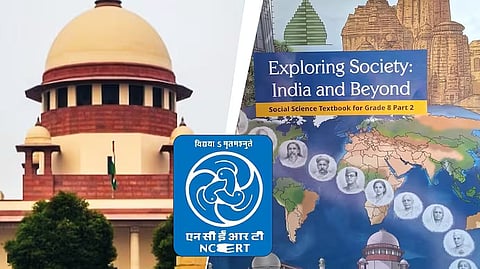

New Delhi: The Supreme Court has closed its suo motu proceedings concerning the Class 8 Social Science textbook published by the National Council of Educational Research and Training (NCERT), after noting that the controversial chapter on the judiciary had been withdrawn and replaced with a revised and balanced text.
A three-judge Bench comprising Chief Justice of India Surya Kant, Justice Joymalya Bagchi and Justice V. Mohana passed the final order on September 1, in Suo Motu Writ Petition (Civil) No. 1 of 2026- In Re: Social Science Textbook for Grade 8 (Part-2) Published by NCERT and Ancillary Issues.
The proceedings had originated from a report published in The Indian Express on February 24, 2026, concerning NCERT’s Class 8 Social Science textbook, “Exploring Society: India and Beyond”, First Edition.
Chapter 4 of the textbook was titled “The Role of the Judiciary in our Society” and contained a sub-topic specifically titled “Corruption in the Judiciary.”
According to the final order, the Court’s preliminary examination of the chapter, along with the response submitted by the NCERT Director, disclosed a prima facie attempt to undermine the institutional authority and dignity of the judiciary.
The Court particularly noted that the chapter did not contain a corresponding reference to the constitutional role of the Supreme Court, High Courts and District Courts or to the reformative measures undertaken by the judiciary across the country.
Against this backdrop, the Supreme Court took suo motu cognisance of the matter on February 26, 2026.
The Court observed that allowing the chapter to remain in circulation and be taught to students of an impressionable age was likely to erode public faith in the judicial institution.
The Supreme Court issued notices to the Secretary, Department of School Education and Literacy, Ministry of Education, Government of India, and NCERT Director Professor Dr Dinesh Prasad Saklani.
It also directed the seizure and withdrawal of all copies of the textbook from circulation and prohibited any further publication or digital dissemination of the book.
The NCERT Director was further directed to disclose the composition of the National Syllabus and Teaching Learning Material Committee (NSTC) and details of the Textbook Development Team (TDT) that had prepared Chapter 4.
However, the Court made an important distinction regarding criticism of the judiciary.
It clarified that its intervention was not intended to stifle legitimate criticism of the judiciary. The Court recognised dissent, deliberation and rigorous discourse as essential elements of a living democracy.
The Court said its intervention was prompted by concerns relating to the pedagogical integrity of material intended for young and impressionable minds, rather than an objection to scrutiny or criticism of the judiciary.
Following the Court’s directions, NCERT Director Professor Dr Dinesh Prasad Saklani filed an affidavit tendering an unconditional and unqualified apology, both personally and on behalf of NCERT.
The Court was also informed that the Government of India had directed the recall of 82,440 copies of the textbook that had already entered circulation.
A separate affidavit was filed by Sanjay Kumar, IAS, Secretary, Department of School Education and Literacy. He too tendered an unconditional apology and informed the Court that necessary systemic corrective measures had been initiated.
The Government subsequently constituted a three-member committee through an order dated March 16, 2026, issued by the Ministry of Education’s Department of School Education and Literacy.
The committee comprised:
Justice Indu Malhotra, former Judge of the Supreme Court;
K.K. Venugopal, Senior Advocate and former Attorney General for India; and
Professor Prakash Singh, Vice-Chancellor of Hemwati Nandan Bahuguna Garhwal University.
The committee was tasked with associating and collaborating with the National Judicial Academy, Bhopal, to finalise curricula relating to legal studies for Class VIII and other grades.
The NSTC was also reconstituted through a notification dated April 2, 2026.
It was converted into a 20-member High-Powered Committee. M.C. Pant, former Chancellor of the National Institute of Educational Planning and Administration, was appointed Chairperson, while Professor Manjul Bhargava of Princeton University was appointed Co-Chairperson.
During the proceedings, the Solicitor General also brought to the Court’s attention certain other objectionable material, including cartoons, appearing in other NCERT publications.
The Supreme Court directed that this material be placed before the expert committee for review.
The Supreme Court recorded that the committee headed by Justice Indu Malhotra, K.K. Venugopal and Professor Prakash Singh had completed the task assigned to it.
Working with the National Judicial Academy, Bhopal, and the reconstituted NSTC, the committee reviewed Chapter 4 and other material brought before it.
It subsequently submitted its report along with a revised and balanced text dealing with the role and functioning of the judiciary.
The Court was informed that after due approval by the committee, the revised chapter had already been circulated to students and was in classroom use.
After examining the report and the revised chapter, the Supreme Court found that the new text presented an objective, factually accurate and balanced account of the judiciary.
According to the Court, the revised chapter sets out the constitutional role of the judiciary as well as the safeguards relating to judicial independence and accountability.
Importantly, the Court said that the revised text neither glorifies the judiciary nor unfairly disparages the institution.
The Supreme Court took into account the unconditional apologies tendered by the NCERT Director and the Secretary of the Department of School Education and Literacy.
It also considered the subsequent remedial measures, including:
recall of the offending publication;
reconstitution of the NSTC;
review by the expert committee; and
preparation and implementation of a revised and balanced chapter.
The Court held that the object underlying the suo motu proceedings had been substantially achieved.
It therefore concluded that there was no useful purpose in keeping the matter pending any further.
The Court accordingly discharged the show-cause notices issued on February 26, to the Secretary, Department of School Education and Literacy, and the Director of NCERT.
At the same time, the Union of India, NCERT and the concerned authorities were directed to remain bound by the assurances given before the Court concerning the content and vetting of educational material relating to public institutions, including the judiciary, in future editions and curricula.
The Bench placed on record its appreciation for Justice Indu Malhotra, K.K. Venugopal and Professor Prakash Singh for the manner in which they completed the task assigned to them.
The Court also commended the reconstituted NSTC, headed by M.C. Pant and co-chaired by Professor Manjul Bhargava, for re-examining the curriculum within a limited timeframe.
The Supreme Court said the response of the Government of India, NCERT and the committees reflected “a healthy institutional collaboration between the Judiciary and the Executive” on matters concerning the integrity of public education.
In a significant observation before closing the proceedings, the Supreme Court reiterated that the judiciary, as an institution, “is not, and cannot be, averse to criticism.”
The Court said that fair, informed and constructive criticism of judicial functioning is a legitimate and necessary feature of a vibrant constitutional democracy. Such criticism, it said, contributes to institutional accountability and self-correction.
At the same time, the Court said that criticism must be voiced through an appropriate forum and a fair and rational mechanism.
The Court specifically cautioned against unverified assertions finding their way into a school curriculum meant for impressionable minds.
The distinction, the Court said, is not between criticism and silence, but between “responsible discourse and uninformed assertion.”
In view of the developments, the Supreme Court disposed of and closed the suo motu writ petition. Any pending applications were also ordered to stand disposed of.
You can also join our WhatsApp group to get premium and selected news of The Mooknayak on WhatsApp. Click here to join the WhatsApp group.
'The Mooknayak' practices democratic journalism. It is a media platform committed to the Constitution, democracy, and social justice. If you also want 'The Mooknayak' to always raise the voices of the marginalized and show the pain of the voiceless, please subscribe.
PLEASE SUBSCRIBE US