TM Special | From a Dream Outside BBAU to a Gold Medal: Amay Sonker’s Journey of Education, Law and Social Change

Sonker's decision to study law, he has said, was shaped less by career considerations than by personal experience. During his school years, he faced incidents of caste-based discrimination at the hands of a teacher, an experience he has described as formative in pushing him toward a legal education as a means of understanding and challenging injustice.
Amay Sonker, a final-year BBA LL.B. (Hons.) student, was awarded the Gold Medal in the Scheduled Caste category at the 11th Convocation of Babasaheb Bhimrao Ambedkar University (BBAU), Lucknow, held on August 29.
Published on

Lucknow: As a school student in Lucknow, Amay Sonker would pass by Babasaheb Bhimrao Ambedkar University (BBAU) every day. His school stood directly opposite the university, and over time, the institution carrying Dr. B. R. Ambedkar’s name became more than just a university to him. It became a dream.

Years later, that childhood dream came full circle.

On August 29, Sonker was awarded the Gold Medal in the Scheduled Caste category at BBAU’s 11th Convocation after completing his BBA LL.B. (Hons.) with 82.5 per cent marks during the 2021–2026 session.

For Sonker, the honour marks the culmination of a journey that began years before he ever enrolled at the university. Born in 2001 into a Scheduled Caste family in Rasra, Ballia, Uttar Pradesh, he grew up in a household shaped by the Ambedkarite movement. His father, a postgraduate in Human Rights, served as Convener of the Backwards and Minorities Communities Employees Federation (BAMCEF), founded by Kanshi Ram, and organised meetings for the Bahujan movement across Ballia district between 1986 and 2001.

For Sonker, his father became his first teacher.

From childhood, he listened to his father speak about the struggles, vision and philosophy of Dr. B. R. Ambedkar. The ideas of dignity, equality and social justice gradually became part of his understanding of society.

Sonker says Babasaheb was not merely a historical figure in his household. His father revered and respected Ambedkar deeply, and that influence eventually became central to Sonker’s own understanding of education and social responsibility.

Today, Amay's academic journey has already moved beyond BBAU. He has secured All India SC Rank 84 and Uttar Pradesh SC Rank 18 in CLAT PG 2026, secured admission to the LL.M. programme at Dr. Ram Manohar Lohiya National Law University (RMLNLU), Lucknow, cleared the All India Bar Examination in his first attempt, and qualified UGC-NET for Ph.D. admission.
Sonker began viewing the university not simply as a place to obtain a degree but as a space where he could contribute to students and communities that had historically been denied equal opportunities.

Sonker began his schooling at St. Mary’s School in Rasra. After his father was transferred to Azamgarh district, he continued his studies at St. Xavier’s School. The family later shifted permanently to Lucknow, where he joined The Millennium School.

He secured more than 75 per cent marks in both Class 10 and Class 12.

His school in Lucknow was situated directly opposite BBAU.

Every day, he saw the university while travelling to school. Growing up in a family where Ambedkar’s ideas were frequently discussed, the sight of a university bearing his name had a particular meaning for him.

Sonker says he gradually developed a strong desire to study there. As a child, he could not completely explain the emotional connection, but he knew that he wanted to become a student of BBAU someday.

In 2021, he appeared for the BBAU entrance examination and secured admission to the BBA LL.B. programme.

For him, entering the university was an emotional moment: the institution he had watched from outside his school had finally become the place where he would spend the next five years.

Sonker’s decision to study law was also shaped by his own experiences.

During his school years, he says he encountered incidents of caste discrimination that deeply affected him. He was around 16 or 17 at the time.

Until then, caste discrimination had largely been something he understood in an abstract sense. Experiencing it personally, however, made its reality and consequences much more immediate.

What troubled him particularly was the fact that such experiences came within educational settings, where a student expects guidance, fairness and protection. He was left with questions about why a student should be treated differently because of caste and how such injustice could be challenged.

Those experiences eventually influenced his decision to pursue law.

Sonker says he wanted to understand what had happened to him, find answers and develop the legal understanding necessary to question injustice and stand up for the rights of Bahujans.

For him, law was therefore not simply a career choice. It emerged from his desire to understand discrimination and find a meaningful framework through which injustice could be challenged.

Sonker became involved in student welfare and student politics through the National Students’ Union of India (NSUI).

BBAU Became More Than a Place to Earn a Degree

After joining BBAU, Sonker says he gradually came to understand the university’s distinctive social-justice-oriented character. He learned that BBAU had been established through a special Act and had 50 per cent reservation for SC/ST students. He also observed that a majority of the student community came from SC/ST backgrounds.

This strengthened his sense of responsibility towards the student community.

He began viewing the university not simply as a place to obtain a degree but as a space where he could contribute to students and communities that had historically been denied equal opportunities.

According to Sonker, he wanted to use his time at the university to contribute to the educational and social empowerment of Bahujans and stand with students who needed support.

Despite his involvement in student politics and other activities, Sonker says he remained academically focused from his first semester.

During his BBA LL.B., he participated in and won several academic and co-curricular competitions. He became involved with various legal committees and served first as Co-Convenor and later as Convenor of the BBAU Moot Court Committee.

He organised the 1st and 2nd Babasaheb Bhimrao Ambedkar National Moot Court Competitions.

He also participated in and organised several national- and state-level seminars and academic programmes in different capacities.

For Sonker, these activities were an opportunity to connect legal education with the legacy of Babasaheb. He wanted legal education to extend beyond classrooms, examinations and competitions.

During his undergraduate years, Sonker developed a strong interest in legal research.

He authored and published research papers dealing with issues including food security and caste-based discrimination in prisons, examining these questions through the frameworks of law, human rights and social justice.

Some of his other research papers are currently under review.

He says research gave him another way of examining structural inequalities and understanding them through constitutional values and the law.

Alongside research, Sonker gained practical exposure through several government and legal internships. These included internships under High Court judges, state and government authorities, and private advocates practising before High Courts and District Courts.

These experiences, according to him, helped connect his academic learning with courts, legal institutions and the justice-delivery system.

Sonker also became involved in legal-aid initiatives in slum areas.

Through these initiatives, he interacted with people from economically and socially marginalised communities, helped provide basic legal awareness and explained rights and available legal remedies.

These experiences shaped his understanding of the barriers that ordinary people face in accessing justice.

Sonker says the law can remain inaccessible not only because it is complex, but also because many people lack information, guidance and resources.

That experience strengthened his belief that legal education ultimately has to serve society and that knowledge becomes meaningful when it is used to empower people who need it most.

Amay took part in numerous national and state-level seminars and academic programmes.

When Sonker decided to enter student politics, he says his father supported the decision.

Rather than discouraging him from engaging with protests, public issues and institutions, his father encouraged him to stand up for Bahujan rights and help people.

Sonker recalls one line his father would often tell him:

“Hum log nahi bolenge toh kaun bolega? Babasaheb ne jo kara hai, humein kisi tarah aage badhana hai.”

The words, he says, gave him courage to enter student politics and continue standing for what he believed in.

Sonker became involved in student welfare and student politics through the National Students’ Union of India (NSUI).

At BBAU, he says he constituted what, to his knowledge, was the first formal student unit at the university, with a structured 15-member committee and office-bearers.

Through the platform, he worked on student welfare issues, discrimination, violence against SC/ST students and other concerns affecting students.

During a membership drive, he says the organisation connected with more than 500 students in 15 days.

His work at the university subsequently led to his appointment as State Secretary of NSUI, Uttar Pradesh, with organisational responsibility for Shravasti and Kanpur University.

He later served as Election In-charge in Raebareli, the Lok Sabha constituency from which Rahul Gandhi contested, and subsequently became National Coordinator of NSUI, with responsibility for Gujarat, Dadra and Nagar Haveli, and Daman and Diu.

Another significant episode in Sonker’s university journey came after remarks by Amit Shah concerning Dr. B. R. Ambedkar.

Sonker says he was deeply hurt by the remarks because Babasaheb had by then become central to his understanding of education, dignity and equality.

He organised a protest at BBAU in which an effigy of Amit Shah was burnt. Sonker says the protest subsequently brought repercussions for him within the university.

Looking back, he says the episode taught him that standing by one’s beliefs can sometimes come with a personal cost.

His activism also brought difficult periods during his university years. He says he faced several instances of administrative action, including formal notices from the university administration.

On one occasion, he says he was locked inside the university premises for more than eight hours by the Proctor without an explanation for the action.

During those difficult periods, Sonker says his Law Department became a source of strength.

He remains grateful to the professors who stood by him, guided him and encouraged him during challenging periods.

He is particularly thankful to his Head of Department, whose support, guidance and blessings, he says, helped him continue concentrating on his academic and legal career despite difficult circumstances.

Sonker organised a protest at BBAU in which an effigy of Amit Shah was burnt. Sonker says the protest subsequently brought repercussions for him within the university.

As he reached the ninth semester of his BBA LL.B., Sonker began preparing seriously for postgraduate education.

He had wanted to study at a National Law University and therefore prepared for CLAT PG 2026.

His result brought another significant achievement: All India SC Rank 84 and Uttar Pradesh SC Rank 18.

He subsequently secured admission to the LL.M. programme at Dr. Ram Manohar Lohiya National Law University, Lucknow.

He also appeared for the All India Bar Examination and cleared it in his first attempt.

In June, he appeared for UGC-NET. Sonker says he initially approached the examination as a trial attempt because he was still an undergraduate student. He nevertheless qualified UGC-NET for Ph.D. admission.

The biggest academic milestone came on August 29.

At BBAU’s 11th Convocation, Sonker received the Gold Medal in the Scheduled Caste category after scoring 82.5 per cent in his BBA LL.B. programme.

The significance of the moment lay in the journey behind it.

As a child, Sonker had seen BBAU from outside his school and dreamed of studying there. Years later, he stood inside the same university as a graduate receiving its Gold Medal.

The institution he once viewed from outside had become the place where he studied law, participated in academic activities, organised moot court competitions and seminars, worked on legal awareness and student welfare, became involved in student politics, faced difficult circumstances and received support from his teachers.

Ultimately, he completed his BBA LL.B. with a Gold Medal from the same university.

For Sonker, the fact that the university carries the name of Babasaheb makes the achievement even more meaningful.

Sonker describes Dr. B. R. Ambedkar as his idol.

The influence began at home through his father’s teachings and deepened during his years at BBAU. What inspires him most, he says, is Ambedkar’s belief in education, equality, dignity, constitutionalism and social transformation.

That is why he does not view the Gold Medal merely as recognition for academic performance.

For him, education also brings responsibility.

His next destination is already clear. He has begun his LL.M. at RMLNLU and intends to pursue a Ph.D. and enter academia. He wants to dedicate himself to legal research and teaching while continuing to contribute to the Ambedkarite movement and work towards the empowerment of Bahujan communities.

His long-term aspiration is to contribute to a stronger Ambedkarite movement through education, legal awareness, research and social engagement.

He wants to use the knowledge and opportunities he receives to support people facing discrimination and inequality, as well as those who lack access to knowledge about their rights.

Looking back, Sonker describes his journey as a continuous process of learning. His next goals lie in postgraduate education, research and academia, alongside his commitment to education, legal awareness and social engagement.

For him, the central lesson of his journey is simple: education is not only an opportunity; it is a responsibility. And after the Gold Medal, he says, the journey continues.

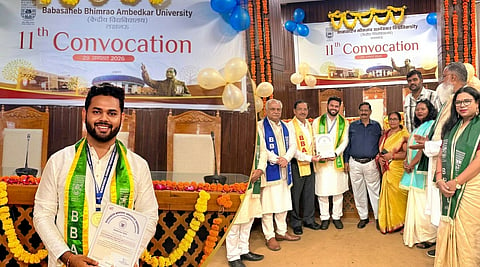
Amay Sonker, a final-year BBA LL.B. (Hons.) student, was awarded the Gold Medal in the Scheduled Caste category at the 11th Convocation of Babasaheb Bhimrao Ambedkar University (BBAU), Lucknow, held on August 29.
How a Dalit Farmer's Son Who Reached the Global Stage Says He Is Now Fighting for His Reputation
Amay Sonker, a final-year BBA LL.B. (Hons.) student, was awarded the Gold Medal in the Scheduled Caste category at the 11th Convocation of Babasaheb Bhimrao Ambedkar University (BBAU), Lucknow, held on August 29.
TM Special | Why Tamil Nadu Government Refused to Remove Iron Bars Around Ambedkar Statues?
Amay Sonker, a final-year BBA LL.B. (Hons.) student, was awarded the Gold Medal in the Scheduled Caste category at the 11th Convocation of Babasaheb Bhimrao Ambedkar University (BBAU), Lucknow, held on August 29.
TM Special | 70% SC/ST Seats Under Threat in Four UP Medical Colleges: Students Fear Seat Loss Ahead of August 13 NEET-UG Counselling
Amay Sonker, a final-year BBA LL.B. (Hons.) student, was awarded the Gold Medal in the Scheduled Caste category at the 11th Convocation of Babasaheb Bhimrao Ambedkar University (BBAU), Lucknow, held on August 29.
Tamil Nadu Initiates Process to Identify Untouchability-Prone Areas, Move Towards Exclusive SC/ST Police Stations | TM Special
Amay Sonker, a final-year BBA LL.B. (Hons.) student, was awarded the Gold Medal in the Scheduled Caste category at the 11th Convocation of Babasaheb Bhimrao Ambedkar University (BBAU), Lucknow, held on August 29.
TM Special Report | Rajasthan Police Circular Replaces 'Dalit' with 'Scheduled Caste' in Official Records, Triggering Identity Debate

You can also join our WhatsApp group to get premium and selected news of The Mooknayak on WhatsApp. Click here to join the WhatsApp group.

Subscribe The Mooknayak

'The Mooknayak' practices democratic journalism. It is a media platform committed to the Constitution, democracy, and social justice. If you also want 'The Mooknayak' to always raise the voices of the marginalized and show the pain of the voiceless, please subscribe.

PLEASE SUBSCRIBE US
The Mooknayak English - Voice Of The Voiceless
en.themooknayak.com