India
“Killed by a Bullet Named NIA”: CASR Meeting Slams Judicial System on Fr. Stan Swamy Anniversary
Human Rights Defenders Remember Fr. Stan Swamy’s Custodial Death

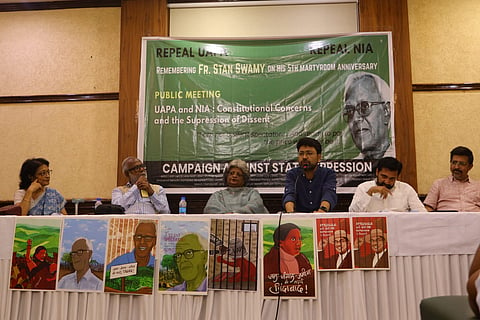

New Delhi- On the fifth martyrdom anniversary of Jesuit priest and human rights defender Fr. Stan Swamy, the Campaign Against State Repression (CASR) organised a public meeting in New Delhi. The event, themed "NIA and UAPA: Constitutional Concerns and the Suppression of Dissent", brought together lawyers, academics, journalists, human rights defenders, and activists to reflect on his legacy and critique the use of draconian laws against democratic voices.
Fr. Stan Swamy, who dedicated his life to defending the rights of Adivasi communities in Jharkhand and advocating for the implementation of the Panchayats (Extension to Scheduled Areas) Act (PESA), died in custody in 2021 while incarcerated under the Unlawful Activities (Prevention) Act (UAPA) in the Bhima Koregaon case. Speakers at the meeting described his death as a custodial killing and a stark example of state repression.
Senior Advocate Rebecca Mammen John traced the expansion of the Unlawful Activities (Prevention) Act (UAPA), arguing that its judicial interpretation has steadily eroded constitutional guarantees of liberty, free speech and democratic dissent. Referring to the Supreme Court's recent judgment in the Gulfisha Fatima case, she observed that the expanded interpretation of Section 15 effectively brings speech within the ambit of a "terrorist act," creating a dangerous precedent that risks criminalising political dissent.
Criticising the stringent bail regime under Section 43D(5), she said the UAPA has turned accusation into punishment by enabling years of incarceration without trial, while subsequent judicial developments have weakened the safeguards recognised in K.A. Najeeb. She also criticised the increasing reliance on anonymous protected witnesses and redacted witness statements in NIA cases, arguing that these undermine fair trial rights and due process. Recalling the COVID-19 pandemic, she noted that despite recommendations to decongest prisons, UAPA prisoners, including the ailing Fr. Stan Swamy, were denied humanitarian relief. She further criticised the NIA's recent plea seeking cancellation of bail granted to four Bhima Koregaon accused merely for attending a public event together, saying it reflected a state more committed to maximising the punitive potential of the criminal process than ensuring fair and expeditious trials. Paying tribute to Fr. Stan Swamy, she concluded, "I did not know Stan personally, but I know of the injustice of his incarceration, and ultimately, the injustice of his death."
Journalist John Dayal sharply criticised the judicial denial of bail to Fr. Stan Swamy, stating that the order reflected a disturbing degree of hostility towards an 84-year-old Jesuit priest who had dedicated his life to defending the rights of Adivasi communities and advocating for the implementation of the PESA Act. He recalled how Fr. Stan transcended institutional boundaries to become one with the struggles of Adivasi people and described him as a guiding light of commitment and courage.
Human rights activist Nadeem Khan described Fr. Stan Swamy as a martyr who was "killed by a bullet named the NIA, fired by the Indian judicial system." He criticised the selective functioning of the NIA, pointing out that while it continues to arrest, raid and summon activists in cases such as Bhima Koregaon and other conspiracy cases, it has never summoned Sambhaji Bhide despite repeated allegations against him. Referring to the recent arrests in Gujarat over the alleged possession of a letter linked to Jaish-e-Mohammad, he questioned the credibility of such investigations, drawing parallels with allegations of fabricated evidence in the Bhima Koregaon case. He also highlighted the continued incarceration of Advocate Surendra Gadling, who spent decades defending Adivasis and other marginalised communities in Gadchiroli, and held the Indian judicial system responsible for Fr. Stan Swamy's custodial death.
Advocate Nizam Pasha examined constitutional concerns arising from the UAPA's provisions relating to unlawful associations and restrictions on democratic organising. He discussed the litigation concerning the ban on the Students Islamic Movement of India (SIMI), recalling judicial observations that the reasons for banning an organisation cannot simply be replaced by executive opinion. He also referred to the continuing proceedings concerning the ban on Jamaat-e-Islami noting that despite the expiry of the initial notification, the state has continued extending the ban while registering numerous additional cases alleging membership or support. He argued that bans on organisations must be subjected to meaningful judicial review rather than being sustained through repeated prosecutions.
Delhi University Professor Saroj Giri paid tribute to Fr. Stan Swamy and reflected on his writings and political vision. He drew attention to Adivasi leader Sarju Tekam, who mobilised thousands of Adivasis against state repression. He stated that Fr. Stan's vision continues through activists such as Sarju Tekam, Raghu Midiyami and Suneeta Pottam. Calling for the release of imprisoned activists associated with Moolwasi Bachao Manch, he emphasised that they have been incarcerated for demanding implementation of the PESA Act and opposing the expansion of paramilitary camps. He also highlighted Fr. Stan Swamy's support for the Pathalgadi movement and its demand for the implementation of constitutional rights guaranteed under PESA.
Professor Nandita Narain reflected on the values of critical thinking and moral courage that she learned during her school years, saying that these ideals made Fr. Stan Swamy's loss feel deeply personal. She observed that a person's life is defined not by death but by the principles they live for. Describing the Bhima Koregaon prisoners as selfless individuals who dedicated themselves to the oppressed, she called them role models. She argued that successive political projects—including the "war on terror," the "war on intellect" after the 2008 financial crisis, and the present "war on empathy" that discourages solidarity with victims of atrocities such as those in Gaza—have sought to weaken democratic resistance. She concluded by reading Fr. Stan Swamy's poem "I Am Not a Silent Spectator" and drew parallels between the judicial orders denying relief to Fr. Stan Swamy and convicting Prof. G. N. Saibaba, arguing that both reflected institutional hostility towards those who defend people's lives, dignity and natural resources.
Deepak Kumar from the Campaign Against State Repression read messages sent from prison by Advocate Surendra Gadling and Dinkar Gota, who are observing a hunger strike in jail to commemorate Fr. Stan Swamy. Their message stated that Fr. Stan Swamy's legacy continues to inspire everyone who fights for justice and appealed to civil society to carry forward his commitment to the rights of oppressed people. Deepak also highlighted what CASR described as the arbitrary use of the NIA to fabricate conspiracy cases, referring to the incarceration of Vishal Singh, Priyanshu Kashyap and Advocate Ajay Kumar in the alleged Lucknow conspiracy case. He called upon democratic forces to unite against the misuse of the UAPA and the NIA, defend constitutional rights, and protect the democratic space for dissent.
The meeting concluded with a collective pledge to continue the struggle for the repeal of draconian laws such as the UAPA, to resist the misuse of investigative agencies against democratic movements, and to uphold Fr. Stan Swamy's lifelong commitment to justice, constitutional rights, and the struggles of Adivasis, workers and all oppressed communities.
You can also join our WhatsApp group to get premium and selected news of The Mooknayak on WhatsApp. Click here to join the WhatsApp group.
'The Mooknayak' practices democratic journalism. It is a media platform committed to the Constitution, democracy, and social justice. If you also want 'The Mooknayak' to always raise the voices of the marginalized and show the pain of the voiceless, please subscribe.
PLEASE SUBSCRIBE US