Pune - As the clock strikes midnight tonight, millions across India will usher in 2026 not just with fireworks and celebrations, but with a profound act of remembrance and resistance. For the Bahujan community, encompassing Dalits, Adivasis, and other marginalized groups, January 1 is no ordinary New Year's Day. It is Shaurya Diwas, or Valour Day, commemorating the 1818 Battle of Bhima Koregaon and the transformative legacy of Dr. B.R. Ambedkar.
Tomorrow marks the 208th anniversary of that historic clash, drawing lakhs to the Vijay Stambh (Victory Pillar) in Koregaon Bhima village near Pune. But the true pivot came nearly a century later, in 1927, when Ambedkar's visit redefined the date as a symbol of Dalit pride and anti-caste defiance. Drawing from authentic sources like Dr. Babasaheb Ambedkar: Writings and Speeches (BAWS) Volume 17, Part 3, and historical records, this report explores that seismic shift.
The story begins on January 1, 1818, amid the Third Anglo-Maratha War. A small British East India Company contingent of 834 troops led by Captain Francis Staunton and including around 500 infantry from the 2nd Battalion, 1st Regiment Bombay Native Infantry (predominantly Mahar soldiers), 300 cavalry, and 24 artillerymen with two 6-pounder cannons was marching to reinforce Pune. They were ambushed by approximately 2,000 Peshwa soldiers under Baji Rao II's commanders, part of a larger 28,000-strong Maratha force. The British troops fortified Koregaon village, holding off waves of attacks across the Bhima River for nearly 12 hours, repelling assaults despite cannon and rocket fire from the Peshwas, who included Arab mercenaries, Gosains, and Marathas.
The battle was brutal and inconclusive, but it delayed the Peshwa advance, paving the way for British reinforcements under General Joseph Smith to arrive. By 9 p.m., the Peshwas withdrew, allowing the Company forces to retreat to Shirur under cover of night. Casualties were heavy: 275 British troops killed, wounded, or missing (50 infantry dead, including 22 Mahars; 105 wounded; 12 artillery dead). Peshwa losses were estimated at 500–600. While militarily a stalemate, the battle accelerated the Peshwa Empire's collapse, leading to Baji Rao II's surrender in June 1818 and British dominance over much of India.
For the Mahars, an untouchable caste, the fight held deeper meaning. Under Peshwa rule, centered in Brahmin-dominated Pune, they endured unimaginable humiliation. As Ambedkar documented in his writings, untouchables were barred from streets, forced to wear black threads for identification, and required to carry earthen pots around their necks to catch spit, lest it "pollute" upper-caste Hindus. Temples, water sources, and basic dignity were off-limits; they were treated worse than animals. Joining the British army was often economic desperation, but for Mahars, it became a chance for retribution against centuries of Brahminical oppression.
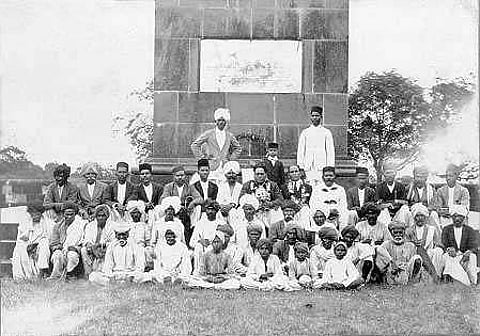
Decades later, the British erected the Vijay Stambh, a 65-foot obelisk at the site, inscribed with the names of 49 fallen soldiers, prominently featuring the 22 Mahars. Initially a colonial monument, it quietly preserved evidence of Mahar valor amid systemic erasure.
By 1927, Dr. Bhimrao Ramji Ambedkar, the architect of India's Constitution and a fierce crusader against untouchability, had launched the Dalit movement in earnest. On January 1, the 109th anniversary of the battle, Ambedkar led a group of followers to the Vijay Stambh. This was no casual pilgrimage; it was a deliberate reclamation of history. In his speech, recorded in BAWS Volume 17, Part 3, Ambedkar addressed a gathering of the Depressed Classes, weaving the battle into a narrative of Dalit agency.
He recounted the Mahars' plight: "Hundreds of warriors from our community fought on the British side... Caste Hindus regarded them as untouchables, so they had no means of livelihood and ultimately joined the British army." Detailing the 1818 heroism, how the outnumbered Mahars held the line against a "Brahmin Peshwa" force, Ambedkar highlighted the 22 martyrs immortalized on the pillar. He lambasted Peshwa atrocities, from the black threads to the spit-pots, and called for action: Lift military recruitment bans on untouchables to shatter stereotypes of inferiority. "Compel the government to remove the ban," he urged, "so that the evidence of valor breaks the stereotype."
This visit, as noted in historical accounts, was a masterstroke. Ambedkar reframed the British-built pillar not as imperial glory, but as a testament to Mahar "unparalleled bravery and tenacity." It galvanized Dalits, turning a forgotten colonial footnote into a rallying cry for self-respect and equality.
Ambedkar's intervention was catalytic. What was once a marginal British commemoration morphed into an annual Dalit-Bahujan ritual. Followers began gathering at the Vijay Stambh every January 1, honoring the fallen with floral tributes, "Jai Bhim" chants, and recitations of the Constitution's Preamble. The day evolved into Shaurya Diwas, Day of Valour, a counter-narrative to caste hierarchies. For the Bahujan community, it symbolizes not just military triumph, but victory over Brahminical tyranny: the Mahars, treated as subhuman, toppled an "evil empire" through indomitable spirit.
Today, the site draws over 2 million pilgrims annually, blending solemnity with festivity: Blue flags flutter, Ambedkar statues are garlanded, and vows for education and justice echo. Political figures, from Union Minister Ramdas Athawale demanding a ₹200 crore memorial to local leaders, vie for its symbolism, but the core remains grassroots pride.
You can also join our WhatsApp group to get premium and selected news of The Mooknayak on WhatsApp. Click here to join the WhatsApp group.