Will the 'Public View' Clause Become a New Barrier to Dalit Justice? The SC Ruling That Has Left the Bahujan Community Worried

The CPI(M) demanded that the Union Government immediately intervene and appeal to the Supreme Court to revisit the judgment.
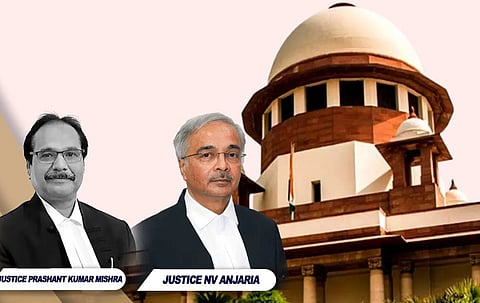
The judgment, delivered by a Division Bench of Justice N.V. Anjaria and Justice Prashant Kumar Mishra has triggered sharp criticism from the Communist Party of India (CPI) and (Marxist) and widespread anxiety across Bahujan communities nationwide.
Published on

New Delhi- In a significant but deeply contested ruling, the Supreme Court of India on May 11, held that caste-based abuses or humiliation inflicted inside a private residence, beyond public view, cannot attract penal provisions under the Scheduled Castes and Scheduled Tribes (Prevention of Atrocities) Act, 1989.

The judgment, delivered by a Division Bench of Justice N.V. Anjaria and Justice Prashant Kumar Mishra in Gunjan @ Girija Kumari and Others v. State (NCT of Delhi) and Another (Criminal Appeal No. 2446 of 2026), has triggered sharp criticism from the Communist Party of India (Marxist) and widespread anxiety across Bahujan communities nationwide.

The case arose from a property dispute among family members in Delhi's Ramesh Nagar locality. The complainant, a member of a Scheduled Caste, alleged that on January 28, 2021, appellant No. 1 Gunjan @ Girija Kumari, who belongs to an upper-caste community, hurled casteist slurs including words such as chura, chamar and harijan at him and his wife, while the other accused persons issued threats. FIR No. 42/2021 was registered at Kirti Nagar Police Station. The Trial Court framed charges under Sections 3(1)(r) and 3(1)(s) of the SC/ST Act against the primary accused and under Section 506 read with Section 34 of the IPC against all accused. The Delhi High Court upheld the charges. The matter then reached the Supreme Court.

The judgment, delivered by a Division Bench of Justice N.V. Anjaria and Justice Prashant Kumar Mishra has triggered sharp criticism from the Communist Party of India (CPI) and (Marxist) and widespread anxiety across Bahujan communities nationwide.
'Locked In, Starved, and Beaten': Kuki Nanny Alleges Years of Torture at IIM Bangalore Professor's Home | TM Exclusive

The Supreme Court's Reasoning: 'Public View' is Non-Negotiable

The apex court quashed the FIR and chargesheet in their entirety, holding that the essential statutory ingredient, that the caste-based abuse must occur "in any place within public view" was simply not established on the face of the FIR. The Court held that the place of occurrence was plainly a private residential house, that the FIR itself mentioned the residential address at multiple points as the site of the incident, and that no independent member of the public was present to witness the alleged abuse.

Relying on a line of its own precedents , Swaran Singh v. State (2008), Hitesh Verma v. State of Uttarakhand (2020), and Karuppudayar v. State (2025) , the bench articulated the legal position as follows: a place is "within public view" only when members of the public can witness or hear the utterance made by the accused to the victim. If the alleged offence takes place within four walls where members of the public are not present, the essential ingredient is not satisfied. The Court further held that the charge under Section 506 IPC (criminal intimidation) also failed because the element of "intent to cause alarm" was absent, and Section 34 IPC (common intention) was not established either.

In 2018, the Supreme Court's dilution of arrest provisions under the same Act triggered nationwide protests, a Bharat Bandh, and the deaths of several demonstrators, before Parliament intervened to restore the original provisions through amendment.

CPI(M) Hits Out: 'Narrow, Legalistic View Will Embolden Perpetrators'

The Polit Bureau of the Communist Party of India (Marxist) issued a strong statement expressing grave concern over the ruling. The party said the Supreme Court "adopted a narrow, legalistic view" in ordering that the FIR and chargesheet be quashed. In its statement, the CPI(M) Polit Bureau said the ruling is a matter of concern for several reasons: "For one, it comes at a time when atrocities against people belonging to the SC and ST communities are seeing an exponential rise in most parts of the country. Secondly, the judgment is the latest in a series of SC judgments and pronouncements which adversely impact the rights of members of these communities."

The party further warned: "It would be tragic if this latest judgment increases incidents of humiliation and abuse of SC and ST persons in the privacy of homes, offices, schools, colleges and such other public spaces because perpetrators believe that it confers them with impunity before the law." The CPI(M) demanded that the Union Government immediately intervene and appeal to the Supreme Court to revisit the judgment.

On the other hand, CPI too condemned the order. The party General Secretary, D.Raja in a statement said, " The Communist Party of India takes a very critical view of the recent Supreme Court judgment restricting the applicability of the SC/ST (Prevention of Atrocities) Act to instances where casteist abuse takes place “within public view”. Such an interpretation risks invisiblising the lived realities of caste oppression in India. Caste discrimination and violence do not occur only in public spaces. Verbal humiliation, social exclusion, untouchability practices and even physical violence often take place within homes, workplaces and other private spaces shaped by entrenched caste hierarchies. A crime does not cease to be a crime merely because it occurred away from public gaze."

" The judgment appears to overlook the spirit of the Protection of Civil Rights Act, 1955, which criminalised untouchability and all forms of disabilities and discrimination arising out of casteist practices. The struggle against caste oppression requires recognition of how caste power operates in everyday life, including in private domains where victims are most vulnerable and isolated. At a time when atrocities against Dalits and tribals are increasing across the country, legal interpretations must strengthen constitutional protections and the fight for dignity, equality and social justice, not narrow them."

The judgment, delivered by a Division Bench of Justice N.V. Anjaria and Justice Prashant Kumar Mishra has triggered sharp criticism from the Communist Party of India (CPI) and (Marxist) and widespread anxiety across Bahujan communities nationwide.
Rahul Gandhi to PM: Withdraw Cases Against Dalit-Adivasi Youth Arrested During 2018 Protests | Dalit History Month

Why the Bahujan Community Is Alarmed

This is not the first time a Supreme Court ruling on the SC/ST Act has drawn political and social backlash. In 2018, the Court's dilution of arrest provisions under the same Act triggered nationwide protests, a Bharat Bandh, and the deaths of several demonstrators, before Parliament intervened to restore the original provisions through amendment. The CPI(M) had on that occasion too called the judgment "retrograde" and demanded an immediate review petition from the Central Government. The 2026 ruling is now being seen by critics as part of a continuing judicial trend of reading down the protective provisions of the Act.

Dalit and Bahujan rights groups have pointed out a ground reality that the judgment appears to overlook: caste-based humiliation most frequently occurs in precisely those spaces that are beyond public view, inside homes, at workplaces, in schools, and within families. The demand that an independent public witness must be present for the SC/ST Act to apply is seen as an almost impossible standard to meet in the context of everyday casteism. Activists argue that the judgment, despite its technical legal correctness, risks creating a zone of impunity for perpetrators operating in private settings.

Expressing his dissent, Ambedkarite activist Ravi Parmar stated, "Does the dignity of Dalits and Adivasis mean nothing Milord? If tomorrow some Manuvadi forcibly kidnaps a Dalit person, takes him to his private house, and insults him by using casteist slurs, then it will not be considered an offence under the SC/ST Act. This is astonishing! As long as the Collegium system continues, attacks on the rights of Dalits and Adivasis will keep happening. This is certain."

Anti caste activist Rehna Raveendran asserted, " Read it like: No offence if murder occurred inside private house. No offence if rape occurred inside private house. No offence if husband beats his wife inside private house. So, do you understand the idiocy that underlines these statements? Prejudiced casteist minds can go to any extent to weaken legal protection given to Schedules Castes and Scheduled Tribes." She further added, " Parliament must amend atrocities act to include 'private' to prevent other institutions from legitimising humiliation and violence against Dalits and tribals in private spheres. Matters related to social justice must be dealt with utmost seriousness, responsibility, and accountability. Callous observations on caste violence without any proper study and research are a disturbing trend."

Another activist Ravi Ratan remarked, " Khairlanji atrocity happened in full public view. The victim and and her daughter were raped, paraded naked with castiest abuse and killed, Her’s blind son and another youth were killed in broad daylight. But court ruled that murders resulted from an act of revenge and not caste related so no SC ST act applied."

Summary

The Supreme Court set aside the Delhi High Court's order dated August 22, 2024, as well as the Trial Court's orders dated November 26 and 30, 2022. FIR No. 42/2021 registered with Kirti Nagar Police Station, along with the chargesheet filed against all accused under the SC/ST Act and IPC, stands quashed. The appeal was allowed in full.

The judgment, delivered by a Division Bench of Justice N.V. Anjaria and Justice Prashant Kumar Mishra has triggered sharp criticism from the Communist Party of India (CPI) and (Marxist) and widespread anxiety across Bahujan communities nationwide.
One Act of Desecration, One Extraordinary Judge, One Order That Turned a Criminal Case Into a Lesson for an Entire Nation
The judgment, delivered by a Division Bench of Justice N.V. Anjaria and Justice Prashant Kumar Mishra has triggered sharp criticism from the Communist Party of India (CPI) and (Marxist) and widespread anxiety across Bahujan communities nationwide.
A Dalit Sarpanch Forced to Stand on One Leg | The Shocking Cases That Pushed Rajasthan High Court to Deliver Its Most Historic Verdict Against Khap Panchayats

You can also join our WhatsApp group to get premium and selected news of The Mooknayak on WhatsApp. Click here to join the WhatsApp group.

Support The Mooknayak

'The Mooknayak' practices democratic journalism. It is a media platform committed to the Constitution, democracy, and social justice. If you also want 'The Mooknayak' to always raise the voices of the marginalized and show the pain of the voiceless, please support us.

Please Contribute
The Mooknayak English - Voice Of The Voiceless
en.themooknayak.com