India
“If They Call Me Shurpanakha, I Take It as My Strength”: Priyanka Bharti
Mera Ranng Foundation marks a decade with ‘Badlav Ki Aahat: Nayi Peedhi, Naye Sawaal’, a discussion on media, politics, freedom of expression and women’s assertiveness

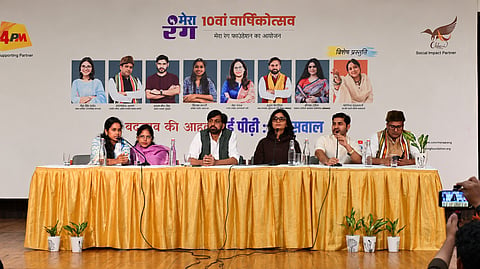

New Delhi: “If I am called Shurpanakha, I see it as a symbol of a courageous woman who embraces her desires and sexuality." Priyanka Bharti, national spokesperson of the Rashtriya Janata Dal (RJD), said that reclaiming words used to insult women in public life, rather than being intimidated by them, can itself become a form of resistance. Bharti also spoke about the use of Dr B.R. Ambedkar’s name in abusive remarks directed at her. Rather than allowing such attacks to demean her, she said, she chose to respond by invoking Ambedkar’s ideological legacy. Her point was that insults intended to humiliate her could instead become an opportunity to affirm her political convictions and her commitment to the values he represented.
These questions were at the heart of Badlav Ki Aahat: Nayi Peedhi, Naye Sawaal (The Winds of Change: A New Generation, New Questions), organised at the India International Centre to mark the tenth anniversary of Mera Ranng Foundation. The discussion explored the changing relationship between young people, politics, media, freedom of expression and women’s participation in public life.
The panel featured Atul Chaurasia, managing editor of Newslaundry Hindi and a senior journalist; independent journalist and YouTuber Shyam Meera Singh; folk singer Neha Singh Rathore, known for her political and social satire; Neha Yadav, national spokesperson of the Samajwadi Party; Priyanka Bharti, national spokesperson of the RJD; and Shah Nawaz Alam, national secretary of the Congress.
The session was moderated by senior journalist Atul Chaurasia. Opening the discussion, he asked how the younger generation was bringing change to politics, media, society and the creative world, and what these shifts meant for the future. He also asked the young political representatives why political parties were finding it difficult to bring larger numbers of young people into their fold.
Neha Singh Rathore questioned the popular image of Gen Z, arguing that the younger generation cannot be defined merely by young people who wear casual clothes, listen to music and appear ‘cool’. The definition, she said, must also include young people from small towns and rural areas who struggle to make a living through a variety of jobs and occupations.
Neha Yadav, national spokesperson of the Samajwadi Party, spoke about the challenges faced by women in public life. She observed that questioning a woman’s character has become one of the easiest ways to silence her. Women active in politics and public life often face personal attacks and character assassination, sometimes even more than substantive criticism of their views or politics.
Folk singer Neha Singh Rathore echoed this concern, pointing out that the structure of Indian society makes it difficult to accept women who speak their minds. She spoke about the challenges women face when asserting their right to free expression and questioning both social conventions and those in power.
Priyanka Bharti spoke candidly about online trolling and the abusive language directed at her in political and public life.
“If you are being abused, it means you are doing something right. The day the abuse stops, we will have to ask ourselves whether our edge has begun to dull,” she said.
She explained that, rather than allowing derogatory labels to intimidate her, she chooses to reinterpret them on her own terms. If she is called ‘Shurpanakha’, she sees the name as a symbol of a courageous woman who acknowledges her desires and sexuality. Similarly, when people invoke Dr B.R. Ambedkar’s name to insult her, she chooses to embrace the ideological legacy he represents.
Her remarks highlighted how women in public life can challenge attempts to shame and silence them by reclaiming the very language used against them.
‘Young people are searching for their own space to express themselves’
Independent journalist and YouTuber Shyam Meera Singh said that young people today were seeking spaces where they could express themselves freely. Social movements, he noted, were an important part of this process.
The discussion also examined the rise of digital platforms, the emergence of independent spaces for expression beyond traditional media, and the social and political questions confronting the younger generation.
Drawing on the experiences shared by the panellists, Atul Chaurasia brought together questions about the relationship between young people and political parties, the changing media landscape, and the growing participation of young people in public discourse.
Congress national secretary Shah Nawaz Alam also shared his views on youth participation in politics. Having moved into active politics after a background in journalism and writing, he participated in the discussion on democracy, representation and the role of the younger generation within political parties.
The programme opened with Shalini Shrinet, founder and managing trustee of Mera Ranng Foundation, reflecting on the organisation’s ten-year journey.
She recalled that Mera Ranng began in 2016 as a small initiative on social media, with the aim of creating a platform where women and young people, in particular, could express themselves. Over the past decade, the foundation has organised conversations and awareness programmes on women’s rights, domestic violence, gender equality, media, literature, politics and other social concerns.
Before the main discussion, The Tripathi Sisters—Ayushi Tripathi and Tiara Tripathi—presented a short Odissi dance performance centred on the theme of women’s power. The two artists, who have long been associated with classical dance, brought the programme’s central concerns to life through the language of movement and artistic expression.
On the occasion, advocate and social activist Jyoti Goyal was honoured with the Rang Sahas award for her work in women’s rights and gender justice.
Goyal has worked extensively on domestic violence, women’s rights, legal awareness and gender justice. The award was presented to her by Hindi poet and fiction writer Arun Aditya.
The programme concluded with a performance by Fauzia Dastango, who presented feminist poetry through her distinctive Dastangoi storytelling style. Through a selection of poems, she explored the social contradictions that shape women’s lives, as well as their struggles, desires and aspirations for freedom.
The event brought together people from the media and social sectors, along with a large number of young people and participants from diverse fields. Chhanv Foundation, which works for the rehabilitation and empowerment of acid attack survivors, also participated in the programme.
Writer and novelist Vivek Mishra delivered the vote of thanks, expressing gratitude to the speakers, artists, partner organisations and everyone who attended.n eha bora
You can also join our WhatsApp group to get premium and selected news of The Mooknayak on WhatsApp. Click here to join the WhatsApp group.
'The Mooknayak' practices democratic journalism. It is a media platform committed to the Constitution, democracy, and social justice. If you also want 'The Mooknayak' to always raise the voices of the marginalized and show the pain of the voiceless, please subscribe.
PLEASE SUBSCRIBE US