How Does Caste Survive Beyond India? Women in "Resisting Casteism in Australia" Share Their Experiences Before Melbourne Premiere

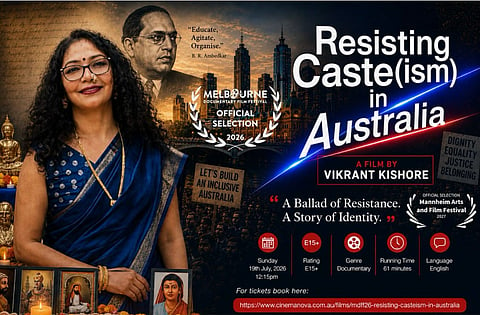
The documentary will have its premiere screening at the Melbourne Documentary Film Festival on July 19, at Cinema Nova, Melbourne, followed by a Q&A session with director Dr Vikrant Kishore and contributors featured in the film.
The documentary, which follows a 3,500-kilometre journey across Melbourne, Sydney, Newcastle and Coffs Harbour, brings together academics, community advocates and members of the Indian-Australian community to examine how caste continues to shape identity, belonging and everyday social interactions after migration.
The documentary, which follows a 3,500-kilometre journey across Melbourne, Sydney, Newcastle and Coffs Harbour, brings together academics, community advocates and members of the Indian-Australian community to examine how caste continues to shape identity, belonging and everyday social interactions after migration. (Movie poster)
Published on

Melbourne: As filmmaker and academic Dr Vikrant Kishore's documentary Resisting Casteism in Australia prepares for its premiere at the Melbourne Documentary Film Festival (MDFF) 2026 on July 19, three women contributors to the film have spoken about why they chose to share their experiences and why they believe conversations around caste discrimination in the Indian diaspora need greater public attention.

The documentary, which follows a 3,500-kilometre journey across Melbourne, Sydney, Newcastle and Coffs Harbour, brings together academics, community advocates and members of the Indian-Australian community to examine how caste continues to shape identity, belonging and everyday social interactions after migration. The screening at Cinema Nova, Melbourne, will be followed by a discussion featuring director Dr Vikrant Kishore and contributors from the film.

Among the contributors is Dr Rupali S. Bhamare, Unit Leader at Monash College, Monash University, whose work combines academic research with more than 15 years of Ambedkarite community advocacy in Australia. Dr Bhamare said she joined the project because she believed documenting lived experiences of caste-based discrimination was essential to raising awareness and encouraging informed public discussion.

“I first learned about the film through Dr Vikrant Kishore. I was drawn to the idea of documenting and sharing the real experiences of people who have faced caste-based discrimination. I felt this was an important step towards raising awareness and encouraging meaningful conversations, which led me to participate.”

Dr Rupali has been engaged in social justice work with a focus on gender equality, women’s rights and community empowerment. She has also been a committed Ambedkarite activist in Australia for over 15 years, advancing the vision and philosophy of Dr B. R. Ambedkar through community engagement and advocacy.

For Bhamare, caste discrimination remains a continuing concern for migrant communities, particularly as caste identities and practices travel with people across borders.

“Casteism is increasingly becoming a concern as Indian migrant communities grow across different countries,” she said. “Migration offers opportunities for cultural exchange and social mobility, but caste-based attitudes can still lead to exclusion and division. Addressing this through awareness, dialogue and education is essential for equality and social harmony.”

During filming, Dr Bhamare said the conversations often brought back difficult memories connected to caste-based exclusion:

“These discussions bring back painful memories of humiliation and discrimination faced by my community. It reminds me how caste has limited opportunities and affected social and economic progress for many people. It also reinforces the need to work towards a society where everyone is treated with dignity and equal opportunity.”

Looking ahead, Dr Bhamare said she hopes the documentary encourages audiences to better understand the impact of caste discrimination on individuals, families and communities, while also prompting stronger institutional responses in Australia through education, community dialogue and legal protections for those affected.

Asmita expressed hope that the documentary would reach viewers who may not realise caste-based discrimination continues to exist outside India.

Another contributor, Asmita Mahire-Singh, a Melbourne-based manager specialising in people systems and workplace technology, said she saw the documentary as an opportunity to contribute to broader awareness about caste discrimination within South Asian diaspora communities.

Asmita works at the intersection of human resources and technology, with a focus on equity and social justice. Her participation in the documentary reflects her engagement with questions of caste discrimination and its presence in South Asian diaspora communities in Australia.

She first became involved with the film through community engagement and through fellow contributor Dr Rupali Bhamare, who introduced her to Dr Kishore during earlier discussions and public conversations on caste and equality.

“I chose to be part of the documentary because I strongly believe in its potential to create a positive impact and bring greater awareness to caste discrimination within the South East Asian diaspora.” For Asmita, the documentary offered an opportunity to speak about both personal experience and wider community realities. “This is a meaningful opportunity to share my own story and that of my community, while contributing to a film that can positively impact awareness,” she said.

"While answering interview questions and reflecting on my family's journey, I felt a strong sense of appreciation for the work of those who came before me. My grandparents and parents have done a lot for the community. It also made me pause and think about how I can contribute and carry that legacy forward," she said.

She expressed hope that the documentary would reach viewers who may not realise caste-based discrimination continues to exist outside India.

"Many people may not even be aware that such discrimination exists. My hope is that this film brings it into the light and sparks greater awareness, understanding and dialogue," she said, adding that she hopes the film will encourage open conversations while unequivocally condemning caste discrimination.

Aparna said she agreed to participate because many of these conversations remain private despite being part of people's lived experiences.

The documentary also features Aparna Ramteke, who reflects on how caste can manifest through seemingly ordinary social interactions within migrant communities. In the film, she discusses how conversations among Indian migrants in Australia often conclude with questions about surnames, which, she says, may serve as a way of identifying caste backgrounds.

“It is common for Indians who meet in Australia to end their conversation by asking each other their last name,” she says in the documentary. “Why are we asking the last name? To understand which caste system you come from. It is treated as a casual social habit, but it carries meaning that many people do not always pause to think about," she said.

According to Aparna, these everyday exchanges are not insignificant because they can influence who feels included within social circles and who experiences exclusion.

"These are small interactions, but they are not neutral. They stay with people. They influence how relationships form, who feels included, and who feels left out of certain spaces. Over time, these moments accumulate into something that affects how people experience community life," she said.

Aparna also speaks in the documentary about her connection to Ambedkarite thought and the significance of greeting others with "Jai Bhim", describing it as a daily affirmation of Dr B. R. Ambedkar's ideals of equality and dignity rather than merely a form of salutation.

She said she agreed to participate because many of these conversations remain private despite being part of people's lived experiences.

"I decided to take part because these conversations are often avoided, even though they are part of many people's lives. When we do not speak about them, they remain unexamined. I felt it was important to speak honestly about what I have seen and experienced," she said.

The documentary, which follows a 3,500-kilometre journey across Melbourne, Sydney, Newcastle and Coffs Harbour, brings together academics, community advocates and members of the Indian-Australian community to examine how caste continues to shape identity, belonging and everyday social interactions after migration.
'Resisting Casteism in Australia' to Premiere at Melbourne Documentary Film Festival 2026
The documentary, which follows a 3,500-kilometre journey across Melbourne, Sydney, Newcastle and Coffs Harbour, brings together academics, community advocates and members of the Indian-Australian community to examine how caste continues to shape identity, belonging and everyday social interactions after migration.
'Khilawadi' to Bring Madhya Pradesh's Banchhada Girls' Trafficking Story to the World
The documentary, which follows a 3,500-kilometre journey across Melbourne, Sydney, Newcastle and Coffs Harbour, brings together academics, community advocates and members of the Indian-Australian community to examine how caste continues to shape identity, belonging and everyday social interactions after migration.
Dalit History Month | NSW Parliamentary Report on Right-Wing Extremism Submitted, Recognises Caste Discrimination as Aspect of Far-Right Threat
The documentary, which follows a 3,500-kilometre journey across Melbourne, Sydney, Newcastle and Coffs Harbour, brings together academics, community advocates and members of the Indian-Australian community to examine how caste continues to shape identity, belonging and everyday social interactions after migration.
Dalit History Month| Caste Discrimination Register- How Will It Help Dalits Fight Casteism in Australia?

You can also join our WhatsApp group to get premium and selected news of The Mooknayak on WhatsApp. Click here to join the WhatsApp group.

Support The Mooknayak

'The Mooknayak' practices democratic journalism. It is a media platform committed to the Constitution, democracy, and social justice. If you also want 'The Mooknayak' to always raise the voices of the marginalized and show the pain of the voiceless, please support us.

Please Contribute
The Mooknayak English - Voice Of The Voiceless
en.themooknayak.com