'Nata Marriage': How One Woman's Court Win Could Unlock Pensions for Thousands in Rajasthan

"Nata Vivah is a practice prevalent in some of the rural areas of Rajasthan where after death or separation from existing husband, she enters into a contractual type of marital relation with a man. Section 7 of the Hindu Marriage Act, 1955, recognized 'Nata Vivah', if performed in accordance with customary rites and ceremonies of the parties’ community.
The judgment empowers countless rural women in customary 'Nata Vivah' unions by affirming their legal entitlement to family pensions, bypassing bureaucratic hurdles and ensuring economic independence post their husband's death.
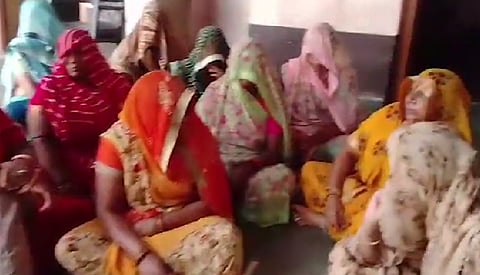
The judgment empowers countless rural women in customary 'Nata Vivah' unions by affirming their legal entitlement to family pensions, bypassing bureaucratic hurdles and ensuring economic independence post their husband's death.Symbolic Image
Published on

Jaipur- In a landmark ruling that could reshape economic justice for women in Rajasthan's rural heartlands, the Jaipur Bench of the Rajasthan High Court has upheld the validity of 'Nata Vivah' – a traditional form of remarriage, granting a widow the right to her late husband's family pension. Justice Ashok Kumar Jain's order not only delivers relief to petitioner Ram Pyari Suman but also challenges rigid bureaucratic interpretations of marriage, emphasizing that matrimonial disputes do not bar a wife's entitlements unless legally divorced. The decision, pronounced on January 8, directs authorities to release the pension along with arrears and 18% interest, marking a significant victory for women's financial security in customary unions.

The case traces back to the tragic death of Puran Lal Saini, a retired Patwari (revenue official) from Kota, on December 20, 2020. Saini, who had received Pension Payment Order upon retirement, left behind a complex family dynamic. Ram Pyari Suman claimed she was his second wife through a 'Nata Vivah' solemnized after his first wife's passing, and that their union produced a daughter. Despite this, pension officials denied her claim, citing the absence of her name in Saini's official family records from January 17, 2006, which listed only his two married sons, Anoop Kumar Saini and Pramod Kumar Saini, as dependents. Undeterred, Suman approached the court, arguing that her marital status was irrefutably established through prior legal proceedings.

The judgment empowers countless rural women in customary 'Nata Vivah' unions by affirming their legal entitlement to family pensions, bypassing bureaucratic hurdles and ensuring economic independence post their husband's death.
How Did a Woman Collector in Rajasthan Launch a Transformative Mission for Single Women in Tribal Areas? Dr. Anjali Rajoria Explains 'Mission Babul Ki Bitiya'

Suman's counsel, including Tushar Panwar, Rohit Kumar Mahrda, Vinita Saini, and Vijay Laxmi, built a compelling case rooted in evidence from family court battles. They highlighted that Suman had secured maintenance under Section 125 of the CrPC on April 25, 2008, which Saini dutifully paid. An enhancement petition under Section 127 culminated in Miscellaneous Criminal Case No. 359/2014, decided on February 14, 2017, by the Family Court in Kota.

Crucially, Saini himself testified as NAW-1, explicitly acknowledging Suman as his wife and confirming the birth of their daughter. The lawyers invoked Rule 66 of the Rajasthan Civil Services (Pension) Rules, 1996, asserting that nomination discrepancies or spousal conflicts cannot override a legally wedded wife's rights. They drew parallels to a coordinate bench's ruling in Urmila Devi vs. State of Rajasthan which held that "even if there exists a matrimonial dispute between husband and wife and wife is not nominated as the successor or a family member to receive service benefits after the death of Government servant, even then a wife is entitled as she has not been legally divorced from the deceased Government servant." Further bolstering their stance was a Delhi High Court Division Bench judgment in Smt. Soni Devi vs. Union of India, reinforcing that such disputes do not extinguish pension claims.

Opposing the petition, counsel for the respondents argued vehemently that Suman's 'Nata' status amounted to a mere contractual arrangement, not a formal marriage, as evidenced by her own application describing herself as a "Nata Wife." They stressed that without official nomination, she could not claim benefits, pointing to Annexure-3 in the petition as proof of an informal bond unworthy of pension privileges. "Unless the name of present petitioner is mentioned in Government record as one of the family member, the petitioner is not entitled to receive family pension after death of Government servant," they contended, underscoring the sanctity of bureaucratic documentation.

After meticulous review of the records, including the respondents' reply, Justice Jain dismantled these objections with forensic precision. The court zeroed in on Saini's courtroom admission as the linchpin of the case.

The judgment empowers countless rural women in customary 'Nata Vivah' unions by affirming their legal entitlement to family pensions, bypassing bureaucratic hurdles and ensuring economic independence post their husband's death.
Rajasthan IAS Showdown: After Tina Dabi 'Reel Star' Row, Pratapgarh Collector Dr. Anjali Rajoria Calls Out Udaipur MP's 'Undignified' Language in DMFT Funds Feud
In a pivotal observation, Justice Jain noted: "The evidence clearly indicate that Puran Lal Saini has termed present petitioner-Smt. Ram Pyari as his wife and admitted that a daughter was born out of wedlock. The evidence of Government servant is admissible and it is part of a judgment, thus can be read as conclusive to decide the controversy raised in current petition. There is no other material on record to rebut the claim of petitioner." This testimony, the judge ruled, was unassailable, extending even to Saini's payments for their daughter's maintenance until her marriage.

Delving deeper into the cultural context, the judgment illuminated 'Nata Vivah', a prevalent rural Rajasthani practice where a widow or separated woman enters a marital-like contract with another man. Far from dismissing it as informal, Justice Jain affirmed its legitimacy under Section 7 of the Hindu Marriage Act, 1955, provided it adheres to community customs. "Nata Vivah is a practice prevalent in some of the rural areas of Rajasthan where after death or separation from existing husband, she enters into a contractual type of marital relation with a man. Section 7 of the Hindu Marriage Act, 1955, recognized 'Nata Vivah', if performed in accordance with customary rites and ceremonies of the parties’ community. Thus, there is no dispute about the fact that Nata Vivah is also considered as a form of marriage in rural areas of Rajasthan," the court observed. Consequently, "considering the admission, we can draw a conclusion that the present petitioner is wife of deceased Government servant Puran Lal Saini."

Addressing the nomination shortfall head-on, Justice Jain referenced the precedents: "As regard to the provision of Rule 66 of the Rules of 1996 and further non submission of details to the Government is concerned, this issue has already been considered in case of Urmila Devi Vs. State of Rajasthan and Ors. (supra) by a Co-ordinate Bench of this Court and in case of Smt. Soni Devi Vs. Union of India and Anr. (supra) by a Division Bench of the High Court of Delhi. Therefore, the writ petition is liable to be allowed." The operative directions are clear: Respondents, including the Principal Secretary of Finance, Director of Pension and Pensioners' Welfare, Additional Director in Bharatpur, and the District Collector, must recognize Suman as Saini's legal heir and disburse the family pension per Rule 66, inclusive of arrears and interest.

Summary

This verdict transcends individual relief, signaling a broader societal shift. Legal experts hail it as a "milestone for economic empowerment," potentially easing access to government schemes for countless women entangled in traditional practices. By humanizing 'Nata Vivah' and prioritizing judicial evidence over paperwork, the Rajasthan High Court has struck a blow against outdated norms, fostering inclusivity in an era of evolving gender rights.

The judgment empowers countless rural women in customary 'Nata Vivah' unions by affirming their legal entitlement to family pensions, bypassing bureaucratic hurdles and ensuring economic independence post their husband's death.
Matrimonial Harassment: Allahabad HC Mandates Criminal Action for False FIRs, Directs UP Police to File Complaints Against Informants

You can also join our WhatsApp group to get premium and selected news of The Mooknayak on WhatsApp. Click here to join the WhatsApp group.

The Mooknayak English - Voice Of The Voiceless
en.themooknayak.com