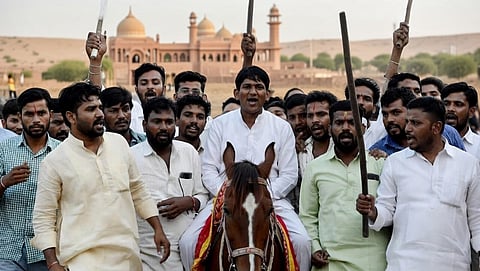
Jodhpur- In a stern rebuke against archaic social customs, the Rajasthan High Court has ordered immediate action against caste panchayats in a case involving a hefty fine levied on a family for a traditional wedding procession. The court, hearing a petition from Deepram Meghwal of Hathal village in the Anadar region, emphasized that such discriminatory practices violate fundamental constitutional rights and must be treated as serious crimes.
The controversy erupted during the wedding of Deeparam's son, Pannaram, on November 23, 2019. The groom's procession, featuring a horse and brass band, a customary celebration, drew ire from community elders.
Tensions escalated over two years later. On April 25, 2022, panchayat members convened in Malgaon village to address the issue. Deeming it a breach of unwritten social norms, the panchayat excommunicated the family and slapped a Rs 1 lakh penalty, arguing it could "corrupt" community traditions.
They halted proceedings when the family's son began recording the meeting. Undeterred, the elders regrouped on May 21, 2022, in Udwariya village, summoning the family and imposing a staggering Rs 10 lakh fine alongside a directive to host a community feast for 13 villages. The Meghwals, facing social ostracism, relocated from Hathal to Sirohi district headquarters for safety.
Despite lodging a formal complaint at Anadar police station against key panchayat figures including Posaram, Vagarama, Babaram, Suvaram, Nemaram, Rajaram, Chamnarama, and another Rajaram, no arrests or investigations followed. Frustrated by the inaction, Deepram turned to the High Court, where Justice Farzand Ali took up the matter.
During the hearing, the court lambasted the rising menace of khap and caste panchayats, declaring their edicts of social boycotts, economic penalties, and intimidation tactics as not just unlawful but grave offenses. "These bodies are not above the law," the judge asserted, underscoring that the right to live with dignity and choose one's spouse freely are enshrined in the Constitution and cannot be undermined by any self-appointed authority.
In a landmark ruling, the High Court issued a series of tough measures to dismantle such practices:
1. Law enforcement must swiftly identify and detain the perpetrators behind the panchayat decisions.
2. Accused individuals are to be barred from accessing government programs, ensuring accountability.
3. Police are directed to monitor khap and caste gatherings closely, with superintendents required to submit confidential reports.
4. Beyond routine charges, officers must invoke the Goonda Act and National Security Act (NSA) where applicable. Cases should also incorporate IPC Sections 384-389 (extortion and threats) and 499-500 (defamation) for thorough probes.
The court summoned the Inspector General (IG) of Police and the Commissioner to appear before it on January 22, with sworn affidavits detailing compliance steps.
You can also join our WhatsApp group to get premium and selected news of The Mooknayak on WhatsApp. Click here to join the WhatsApp group.