Discussion
When Equality Rides a Horse, Caste Strikes Back
Dalits were and are always paying the price for the crime that they did not commit.


— ✍️Samir B Bhalchakra
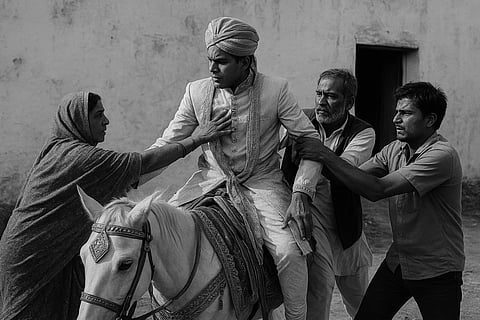
In many parts of India, when a Hindu caste person sits and rides a horse in wedding processions (Baraat), it is seen as a matter of pride, honour, status, and hierarchy in Hindu society. But for Dalits, it is a historical curse, seen as a crime against the customs, traditions, and rituals of Hindu society. It can provoke hostility and violence, as seen in a recent incident in Damoh, Madhya Pradesh, where a 23-year-old physically handicapped Dalit groom was dragged off a horse and brutally beaten to the point of being wounded during the wedding procession (Baraat). This showed how caste discrimination and Brahminical rules and regulations are controlling and have a grip on Indian society.
For thousands of years, caste has functioned as a key factor in dividing, marginalising, and degrading Indian society. It has not only created division among labourers but also divided the dignity of a person. Wearing certain traditional clothes, organising processions in society, and riding horses are seen as symbols of high status, strictly reserved for the dominant castes and the Rajputs. The horse represents martial power, masculinity, and social authority, mostly associated with the Kshatriya.
The Dalits were placed outside the four-fold Varna system, and according to the sacred law books (Manusmriti and Vedas) of the Hindu religion, it is stated that Untouchables (now Dalits) should be restricted from wearing gold, jewellery, fancy and traditional clothes, as it would hurt the sentiments of caste Hindu people and break the rules of the sacred law books. Wedding processions are highly seen as moments of prestige and celebration, and a Dalit sitting on a horse is a direct challenge to the graded inequality. Thus, restricting Dalit grooms from sitting on a horse, and if the Dalit defies this, a harsh reaction should be taken to stop this imbalance in society.
Some parts of caste discrimination do not make any sense, as the upper caste person knows that the oppressor doing the killing, assault, and lynching of the Dalit groom will be mandatorily charged under the SC/ST Prevention of Atrocities Act, 1989, yet the person still commits the crime against the Dalits. Because above the Constitution, law, and order, their caste and religion matter to them, indeed!
As per Articles 14 and 17 of the Indian Constitution, which clearly state the Right to Equality and Abolition of Untouchability respectively, yet for the caste Hindu people, their sacred religious books are above all. It does not matter whether all have equal rights according to the authorised law book of India; for the caste Hindu people, there is a direct mandate from an unknown, invisible authority to commit atrocities against the Dalits when someone from the Untouchables (Dalits) tries to break the religious rules.
Dalits were and are always paying the price for the crime that they did not commit. Never. This is not the first time that a Dalit groom has been dragged off a horse and assaulted; there are numerous examples. In fact, every fifteen minutes in states like Uttar Pradesh, Bihar, Rajasthan, Haryana, and Madhya Pradesh, these are the states prominent in assault against Dalits, such incidents occur.
Why is it significant for the caste Hindu people to curb and always keep the Dalits downtrodden in society? Because “if all become equal in society, then who will be the King? Who will do the menial work for the status-authorised people?”
Dalit politicians would always remain deaf when such incidents happen against their own Dalit community. Because after getting elected and grabbing money from corruption, they behave like an upper caste person, despite remaining a Dalit until their last breath, and society recognises them as Dalit only—they behave like upper caste due to the larger impact of Sanskritisation. For them, Dalit issues, untouchability, and discrimination issues do not matter.
Because of power, money, and holy touch with the caste Hindu people, their caste has changed. “Power does not follow any caste; they build their own.”
Unless and until people read the Annihilation of Caste, written by Dr. B. R. Ambedkar, changes and annihilation will not be possible in society. As the Honourable Kanshiram, before becoming a politician, said: “A single book written by Dr. Ambedkar has completely changed my life; how come my entire Dalit community is not getting changed?”
Caste discrimination is an immortal reality that has stuck with Indian society. There are many solutions to it, but the Hindu caste society will not allow us to be civilised and free from this curse. For them, caste still matters!
- Samir B Bhalchakra is a postgraduate journalism student at the Asian College of Journalism, Chennai, and an alumnus of Fergusson College, Pune. His work focuses on marginalized communities, social justice, and global issues, with a strong interest in international relations.
You can also join our WhatsApp group to get premium and selected news of The Mooknayak on WhatsApp. Click here to join the WhatsApp group.
'The Mooknayak' practices democratic journalism. It is a media platform committed to the Constitution, democracy, and social justice. If you also want 'The Mooknayak' to always raise the voices of the marginalized and show the pain of the voiceless, please subscribe.
PLEASE SUBSCRIBE US