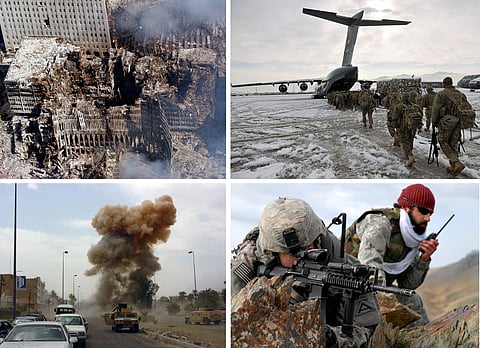
Around 8:00 am in the morning, the Air Traffic Control towers faced an unusual problem of numerous passenger planes heading different routes instead of their scheduled one. Before contact could be established to reroute them, the first plane crashed into the North Tower of the World Trade Centre , subsequently local authorities assumed it as an air accident and rushed to rescue, but suddenly witnessed another flight crash into the South tower. By the time it was clear that this was a well coordinated and unprecedented terrorist attack on the US soil. Beyond US citizens , around 80 countries lost their people in the attack and several hundred injured from it.
Within weeks the United States metastasized the event , into a global campaign that reshaped alliances, redrew the boundaries of state sovereignty, and recalibrated the normative vocabulary of security itself. The 25 anniversary is a critical movement for us to revisit the incident, following the Global war on terror (GWOT) with its results that largely shaped
international politics and security of West Asia in particular.
As the US President Bush stated in his speech next day, “the attack took place on American soil, but it was an attack on the heart and soul of the civilized world. And the world has come together to fight a new and different war, the first, and we hope the only one, of the 21st century. A war against all those who seek to export terror, and a war against those governments that support or shelter them.
(https://2001-2009.state.gov/s/ct/rls/wh/6947.htm)
This attack was portrayed as an assault, not just on the US, but on the believers of free market economics, secular governance and the entire edifice of liberal order and liberal structure.
The scaffolding of post Cold War contestations were laid bare in Francis Fukuyama's end of history thesis and Samuel Huttington’s thesis on Clash of civilisation, which laid the framework for the future of securitization. Huttington's idea that future conflict would arise because of eminent civilizational conflicts and religious faultlines got theoretical and political legitimacy post 9/11 attack. Adversaries were now categorised in the bracket of ‘us versus them’, unlike the cold war where it was ‘us and them’ in structural ideological differences. The once Cold War adversary of "Communism" was now shifted to "transnational jihadism" , genealogy of which can be traced back to decades of 1980's when US supported Mujahiddens (Op cyclone) backed by ISI in Afghanistan , offshoots of which Al Qaeda and Taliban later trapped US in forever wars.
The post 9/11 developments were a classic case study for Copenhagen school of scholars, as the concept of securitization was extensively used by US administration. It was a post Cold war era, almost a decade after the disintegration of the Soviet Union and the unopposed unipolarity of the US was also increasingly facing a ‘threat deficit’, which eroded its global stature of the ‘protector’ without visible threat. The US administration elevated macro-securitization against growing terrorism, which was lethal enough to adopt emerging technology, communication and mobilization across the countries. Non-state actors' elevation to the global scale, replacing market based ideological war with religious identity clashes made people compromise their liberties in order to ensure security by locally invoked emergency provisions , apart from it hyperlegality laws were implemented which enabled the US government to use classified legal memos and torture methods unlawfully in the name of combatting terrorism.
The Hobbesian insecurity framework where the state's monopoly reinforces, legitimizes their violence against perceived threats and designates them as protector of citizens security was expanded to an international level. The securitized communities' feeling of possible future attacks and the idea that “Islamic terrorism is a threat to humanity” effectively convinced global audiences to subscribe to the GWOT and extend assistance in all practical ways. GW Bush declaration of “either with us or with them” was a statement of closure. The formation of a coalition for dismantling the transnational terror network was an assemblage of nations offering financial , military and intelligence support. Alliance meant alignment and neutrality meant complicity with terror designs , with no grey areas and middle ground. The event succeeded as it resulted in rallying of almost all the countries including arch rivals like Iran which shared intelligence on Al-Qaeda and Taliban,Russia extending US and NATO forces to use its bases in central Asian countries.
(https://www.chathamhouse.org/2021/09/russia-and-911-roads-not-taken)
Beyond condolence and condemnation, over 140 countries offered military assistance, stringent action against terror financing, freezed funds; around 90 countries granted over flight and landing rights to military purposes. Groupings like OAS, ANZUS reaffirmed treaty obligations, NATO invoked article 5 for the first (only) time in history. The level of committed coalition is unimaginable at any moment in human history. As Bush’s declaration of “US is again called by history to use our overwhelming power in defence of freedom. We have accepted that duty”, is a reflection of the impact of securitisation. Besides punishing terrorists who were responsible for 9/11, preventing another one from occurring, the US utilized it to retain global position & achieve its objectives.
Within the US, they carried out a largest restructuring of the federal government, instituting the Department of Homeland Security by integrating 22 agencies, funded adequately, manned professionally. The DHS emerged more powerful among its peers, and coordinated law enforcement, assisted intelligence sharing, enhanced agencies abilities and empowered through Patriot Act. Guantanamo Bay became a centre for tortures, extrajudicial detentions, drone strikes beyond war zones resulted in numerous civilian casualties.
The GWOT went beyond its mandates and extended unjustifiably. The enacted legislation empowered executive powers over civil liberty and eroded the system of checks and balances which was built over decades. The revealed violations of US forces severely questioned their mandates, commitments as it extended wars to Iraq , Afghanistan, Syria and to some point Pakistan because of its geographic proximity to Afghanistan.United States demanded that Islamabad to choose whether to align with Washington or support the Taliban regime in Afghanistan as admitted by then President General Pervez Musharraf.
According to Musharraf, Richard Armitage , U.S. Deputy Secretary of State , warned: "Be prepared to be bombed. Be prepared to go back to the Stone Age" if Pakistan refused to cooperate with the U.S.-led war on terror.
(https://www.theguardian.com/world/2006/sep/22/pakistan.usa)
From the late 2001 through fiscal year 2022, the U.S. spent an estimated $8 trillion for the post-9/11 wars , an estimate of $5.8 trillion in the appropriations, additional $2.2 trillion for obligations to care for the veterans of these wars
Of the $8 trillion total, about $2.3 trillion were spent on the budget category for post-9/11 military operations.The base budget of the Pentagon was increased by about $900 billion above what it would have been in the absence of war.Homeland Security spending on preventing and countering terrorism within the U.S. has totaled over $1.1 trillion since the inception of the Department of Homeland Security in 2002.
From 2001 to 2019, the US spent over $2 trillion on the war in Afghanistan alone.
In the 20 years of war from 2003 to 2023, the U.S. spent and obligated over $2.89 trillion on the wars in Iraq and Syria.
(https://costsofwar.watson.brown.edu/costs/economic/us-federal-budget)
Nearly 2 decades later , the cost of the US' global war on terror stands at $8 trillion and 900,000 deaths, according to a new report from the Costs of War project at Brown University. (Costs of the 20-year war on terror: $8 trillion and 900,000 deaths | Brown University)
Two signature military interventions of the GWOT era - the 2001 invasion of Afghanistan and the 2003 invasion of Iraq were justified through overlapping but distinct logics , the former as direct retaliation against the regime that had sheltered Al-Qaeda, the latter through contested and ultimately discredited claims about weapons of mass destruction, later folded into a broader democratization rationale.
US invasion of Afghanistan and the objective of removing the Taliban government came to full circle in August 2021, creating almost a Saigon-like movement where US and NATO forces left over fortnight , ending a so-called “forever war” achieving no objective it intended to as mentioned by Bush and successive US presidents.
The first major rift on GWOT appeared when the US invaded Iraq without UN explicit authorization, it was accused of aiding terrorist groups and possessing WMDs. The supporting coalition publicly dissented as France, Germany and a handful of US traditional allies declined to participate in it. Philosopher and critic Slavoj Zizek called out the US invasion of Iraq with the logic of ‘borrowed kettle’ in his book Iraq: The Borrowed Kettle, equating it with the Freudian metaphor.
Justifications for the war relied on contradictory, shifting rationales - The arguments shifted from : an alleged link between Saddam Hussein and Al-Qaeda, to Iran posing regional threats, possessing weapons of mass destruction , noncompliance with UN Sanctions and ‘sardonically’ the 1993 assassination attempt on former US president HW Bush on his visit to Kuwait. These objectives were laid down in the Iraq War Resolution passed by the U.S. Congress in October 2002.
Direct U.S. military intervention against ISIS officially began in August 2014 with targeted airstrikes in Iraq under what later became known as Operation Inherent Resolve.
American forces primarily partnered with the Kurdish-led Syrian Democratic Forces (SDF) in northeastern Syria to clear ISIS of its strongholds The U.S. military evacuation concluded on April 16, 2026, when troops left the Qasrak base, ending more than ten years of continuous military presence on the ground. After the fall of longtime Syrian leader Bashar al-Assad’s regime in 2024 , Ahmed al-Sharaa,who earlier founded Jabhat al-Nusra , one of Al-Qaeda's affiliates , took over. US hosted Sharaa , previously a UN-designated terrorist , in white House back in November 2025 and as of recent , United States officially removed Syria from its list of State Sponsors of Terrorism in August 2026.
With the inclusion of Iran in the Axis of resistance , the US used the same playbook : suspicion of nuclear ambition , supporting terror networks in the region , and threat to long term regional security. As of late 2026 , Trump like Bush used the same inconsistent ‘kettle’ logic’ to justify grounds for attacking Iran - nuclear infrastructure bluff despite claiming they destroyed it (Operation Midnight Hammer), liberating Iranian citizens from the fortress of repression , regional security threat and to one’s amusement - “specific intelligence about them killing POTUS in 2024”.
Despite US NSS 2025 explicitly mentioning the vision of limiting transnationalism and ending foreign interventions , the US went into what seems to be another “forever war” with Iran since February 2026.
Ultimately the quarter century of war on terror was unable to eliminate the menace of terrorism completely. Structurally the GWOT focused on obliterating active terror groups and emanators of terrorism but twenty-five years after 9/11, the Global War on Terror launched by the US has produced no clean verdict. With the Al-Qaeda affiliate governing from Damascus ; unstable Iraq , Afghanistan ruled by Taliban , the question still remains , what actually did the Global war of terror achieve in all these years other than few failed states , proliferation of non-state actors , increased schism in the middle east.
The Authors
-Vivek Kumar Tripathi is a Post graduate scholar at IIT Madras , specialising in International Relations and West Asia.
-Thirunavukarasu S is a JRF scholar at Dept of Defence and Strategic Studies, University of Madras.
You can also join our WhatsApp group to get premium and selected news of The Mooknayak on WhatsApp. Click here to join the WhatsApp group.
'The Mooknayak' practices democratic journalism. It is a media platform committed to the Constitution, democracy, and social justice. If you also want 'The Mooknayak' to always raise the voices of the marginalized and show the pain of the voiceless, please subscribe.
PLEASE SUBSCRIBE US