Acharya Prashant Receives Death Threat Over Ambedkar Remarks; Know What He Said About Hindu Religion and Baba Sahab

Acharya Prashant explained that Ambedkar’s method was far more revolutionary compared to Gandhi’s. When Ambedkar realised that Hindu society was not showing signs of genuine reform, he eventually suggested leaving the religion altogether if it could not be corrected.
Acharya Prashant stressed that while Ambedkar acknowledged the necessity of religion and ultimately chose Buddhism for its egalitarian principles, true reform requires questioning the very definition and content of religion.
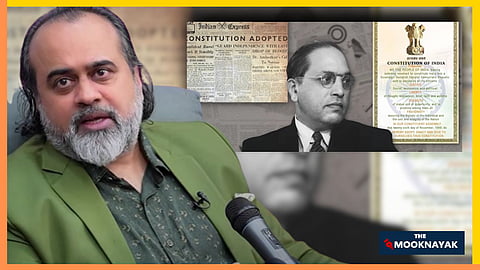
Acharya Prashant stressed that while Ambedkar acknowledged the necessity of religion and ultimately chose Buddhism for its egalitarian principles, true reform requires questioning the very definition and content of religion. Graphic- Asif Nisar/ The Mooknayak
Published on

New Delhi- Indian philosopher and spiritual teacher Acharya Prashant has received a new death threat after making positive comments honouring Dr. B.R. Ambedkar. The incident has caused worry among his followers, and his organisation has started legal proceedings against those involved.

The SC/ST Cell of Kirori Mal College, Delhi University, had invited Acharya Prashant as a speaker on the occasion of Dr. B.R. Ambedkar’s birth anniversary. During the event, a student from Ramjas College named Shahnawaz asked Acharya Prashant a pointed question: Dr. Ambedkar relied on constitutional and legal measures against social injustice rather than a revolutionary movement. Was his belief correct that deep-rooted social injustice in India could be eradicated through legal reforms, and was this approach sufficient?

In his detailed response, Acharya Prashant stated that Dr. Ambedkar’s method was undoubtedly correct. He identified Mahatma Gandhi and Dr. B.R. Ambedkar as the two major figures of the first half of the last century who worked for the upliftment of the Dalit community. Gandhi advocated reforming the existing varna system through moral, ethical, and spiritual means, describing untouchability as a blot on Hinduism that needed to be removed. However, Acharya Prashant noted that Ambedkar, having personally endured the pain of discrimination, took a more practical and realistic approach. He demanded institutional safeguards, legal protections, and constitutional measures.

On almost every human development indicator, the communities for whom Ambedkar fought are in a much better state compared to the time of independence.
Acharya Prashant
Acharya Prashant emphasised that the constitutional and legal safeguards advocated by Ambedkar have produced visible results, benefiting a large section of India’s population today.

Acharya Prashant explained that Ambedkar’s method was far more revolutionary compared to Gandhi’s. When Ambedkar realised that Hindu society was not showing signs of genuine reform, he eventually suggested leaving the religion altogether if it could not be corrected. He made sincere efforts for reform but concluded that continuing to accept exploitation served no purpose. Acharya Prashant emphasised that the constitutional and legal safeguards advocated by Ambedkar have produced visible results, benefiting a large section of India’s population today. Had his approach not been correct, we would not be sitting here discussing these issues freely. He pointed out that people from underprivileged backgrounds, especially women and girls present in the audience, enjoy far better conditions today than they did 50 years ago. On almost every human development indicator, the communities for whom Ambedkar fought are in a much better state compared to the time of independence.

However, Acharya Prashant then raised a deeper question: Was this sufficient? He asked whether caste-based discrimination has been completely eradicated from India. Despite 150 to 200 years of continuous struggle against caste atrocities- beginning with reformers like Mahatma Jyotirao Phule- a strange and contradictory situation still persists in the country. While everyone, including Gandhi, opposed untouchability and caste discrimination at the surface level, the deep-rooted prejudices within minds have not been washed away. Gandhi wanted to remove this evil through morality, compassion, truth, non-violence, and love, but this approach proved inadequate because old beliefs remained firmly entrenched in people’s hearts.

Acharya Prashant observed that Dr. Ambedkar understood Indian society more deeply and intimately, having emerged from the same oppressed community. He pushed for separate electorates, reservations, education, and organisation. Just two months before his death, he spoke of religious conversion because he saw the urgent need for change. Yet, even after all these efforts, the situation has improved but has not changed completely. If caste discrimination had truly been eliminated, there would have been no need for such discussions today.

He made it clear that legal, institutional, and constitutional measures are necessary but not sufficient. Laws can force compliance, for instance, one may have to obey a Dalit boss or accept reservation in jobs and education, but they cannot change hearts or remove the deep sense of superiority and inferiority. The roots of discrimination lie in the religious sanction given to the caste system through scriptures and traditions. Acharya Prashant stressed that while Ambedkar acknowledged the necessity of religion and ultimately chose Buddhism for its egalitarian principles, true reform requires questioning the very definition and content of religion. Religion, he said, is meant to address the eternal restlessness and fundamental questions of human existence, not to perpetuate rituals, beliefs, or social hierarchies that justify exploitation.

Acharya Prashant concluded that until society directly challenges and cleanses the religious and cultural roots that justify caste discrimination, the work started more than two centuries ago will remain incomplete. He warned that without this deeper cleansing, divisions will persist even if economic and political inequalities are removed. He described religion as something deeply personal that addresses the inner human quest, and criticised how it has been corrupted into bundles of rituals and beliefs used to protect narrow interests. He called for genuine inquiry and questioning, the true spirit of religion, which Dr. Ambedkar exemplified by boldly raising uncomfortable questions about Hindu society.

Following this interaction and similar public statements, Acharya Prashant has reportedly received death threats from a YouTube account. The PrashantAdvaita Foundation has confirmed the threat and stated that legal action has been initiated. Such threats, according to the foundation, are not new and often follow Acharya Prashant’s candid remarks on sensitive social and religious issues.

The PrashantAdvait Foundation reported that the threat appeared in a comment on a YouTube video featuring Acharya Prashant’s recent statement paying tribute to Dr. Ambedkar. The message used strong and abusive language while directly threatening his life, which quickly spread on social media platforms.

Foundation officials have confirmed they are preparing a formal police complaint and are urging authorities to take swift action. This marks yet another instance of threats directed at the thinker for his public views on various issues.

A representative from the Foundation noted that such threats have become recurring whenever Acharya Prashant addresses sensitive subjects. “Speaking in favour of women often draws aggression from one side, criticising blind beliefs invites backlash from another, and his views on terrorism or social issues trigger reactions from different groups,” the spokesperson said.

The Foundation also highlighted an ongoing pattern of distorted clips and misinformation campaigns against him that appear designed to create hostility. They expressed concern that this environment contributes to the rise in threats. Despite multiple such episodes in the past, no official security has been provided to him so far.

Supporters have appealed to law enforcement agencies to investigate the matter promptly and ensure his protection while addressing the spread of online abuse and intimidation.

About Acharya Prashant

Acharya Prashant, whose real name is Prashant Tripathi, was born on March 7, 1978, in Agra, Uttar Pradesh. He is a well-known author, speaker, and social commentator. An engineering graduate from IIT Delhi and a management alumnus of IIM Ahmedabad, he qualified for the Indian Civil Services but decided against joining. Instead, he founded the PrashantAdvait Foundation to promote teachings based on Advaita Vedanta, the Bhagavad Gita, and the Upanishads. He has written more than 160 books, many of which have become bestsellers, and maintains a significant online presence where he discusses philosophy, self-inquiry, and contemporary social matters.

You can also join our WhatsApp group to get premium and selected news of The Mooknayak on WhatsApp. Click here to join the WhatsApp group.

Support The Mooknayak

‘The Mooknayak’ practices people-centric and democratic journalism. It is a media platform committed to upholding the Constitution, democracy, and social justice. We consistently raise the voices of the marginalized, highlight the struggles of the voiceless, and bring their pain to the forefront. If you also believe that ‘The Mooknayak’ should continue to stand with the oppressed and amplify the concerns of those pushed to the margins, please support us.

Please Contribute
The Mooknayak English - Voice Of The Voiceless
en.themooknayak.com