The Missing Data on Caste in India's Private Sector: What We Cannot Measure, We Cannot Fix

Without trustworthy figures on who is hired, promoted, paid and placed in leadership, nobody can say how deep workplace inequality runs, or whether any remedy is working.
On 14 August 2026, the Centre notified the questions for the 2027 Census, and for the first time in independent India the household schedule will ask for caste beyond the SC and ST categories, with enumeration due in February 2027.
Published on: 

— ✍️Suraj Kumar Prajapati

Ask a large Indian company how many of its senior managers come from Scheduled Caste families, and you will rarely get an answer. No law requires the company to count, so most do not publish. That silence is the subject of this article. My argument is that when hiring, promotions, pay and leadership are not broken down by caste, discrimination can be neither proved nor ruled out, and every remedy on offer—from quotas to mentoring schemes to doing nothing at all—is chosen in the dark.

What the few studies show

Since companies do not publish such data, researchers have had to work around them. A 2010 study of the boards of the top 1,000 listed companies, carried out at a Canadian university, found almost no caste diversity. Its own abstract puts the forward-caste share of board members at nearly 65 per cent, although a newspaper report on the same work gave a much higher figure of 93 per cent for executive board members. I could not reconcile the two numbers from public material, and that is exactly the trouble: even the best-known statistic on the subject is hard to pin down.

Later work by management scholars went further. Because companies do not record caste, they inferred it from surnames, an approach that is clever but only approximate. They found that boards tend to be dominated by a single caste, that such boards often have a chief executive from the same caste, and that public-sector affirmative action has not carried over into private firms. They also linked low caste diversity with lower firm value.

On hiring, a well-known field experiment sent equally qualified applications to private employers under different names. The odds of a Dalit applicant being called for an interview were about two-thirds those of a high-caste Hindu applicant. On the workforce itself, a 2011 survey by the Confederation of Indian Industry covered 8,250 member firms employing 35 lakh people. It found that Scheduled Castes and Scheduled Tribes made up only 5 per cent of private-sector staff in Maharashtra, against 19.1 per cent of the state's population, and about 9 per cent in Gujarat and Karnataka, against roughly 22 and 23 per cent respectively. Tamil Nadu, at around 18 per cent, was the exception.

Taken together, this is a thin and ageing body of evidence. It is old, it relies on samples and guesswork, and none of it tracks the same firms year after year.

A voluntary system that stayed silent

It is not that nobody asked. In 2007, industry chambers agreed to a voluntary code on affirmative action, and a government reply in Parliament later confirmed that they had agreed to report SC and ST employment on a voluntary basis. In 2010, an official request to the 1,000 biggest companies to disclose the caste of their employees reportedly drew fewer than 60 responses. Around the same time, 55 firms, led by the Tata group companies, said they would include such figures in their annual reports.

A decade later, a think-tank review of 300 of the top 500 listed companies found that only 39 had volunteered any information on SC, ST or OBC employees. One commentator has noted that industry bodies could report how many students they trained, but not how many of them reached senior jobs, and that no public caste-wise breakdown of private-sector staff exists at all. Voluntary reporting produced numbers that cannot be compared, checked or followed over time. Even the headcounts that do exist say little about the four things that matter most: who gets hired, who gets promoted, what each group is paid, and who reaches the top.

The census will help, but only part of the way

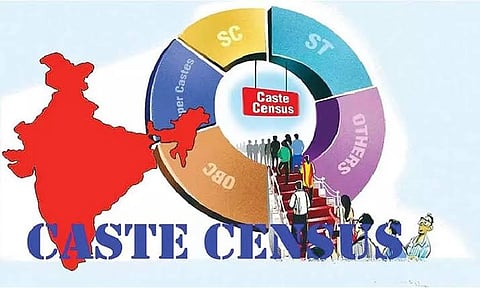
A real change is coming. On 14 August 2026, the Centre notified the questions for the 2027 Census, and for the first time in independent India the household schedule will ask for caste beyond the SC and ST categories, with enumeration due in February 2027. This will give us a reliable count of how many people belong to each group, which is the benchmark against which any company's workforce should be compared.

But a household count is not built to tell us what happens inside a particular firm. That is my own inference, not an official statement. A census can say how many people of a caste live in a state; it cannot say how many were promoted last year at a given company. One commentator has argued that caste enumeration can support reform of the private sector only if it counts every caste, the privileged included, and also gathers economic data. Meanwhile, Karnataka's backward classes commission has considered asking private firms for employee data, with officials admitting that many may not cooperate, and in an earlier survey some companies described the question as an embarrassment.

What would help

None of these steps is simple, but each one can be tested and improved over time:

  • Make reporting routine. Add a caste-category line to the sustainability and workforce disclosures that large listed companies already file, instead of leaving it to goodwill.

  • Measure the whole ladder. Report SC, ST, OBC and general-category staff at entry, middle and senior levels and on the board, along with hires, promotions, exits and median pay at each level.

  • Protect the individual. Let employees identify their caste voluntarily and anonymously, publish only grouped figures with minimum group sizes, and keep the data away from line managers and recruiters.

  • Open the data to audit. Give independent researchers access to anonymised records, and run name-based hiring audits so that discrimination is tested for and not merely assumed away.

  • Publish one common dataset. Use the same definitions every year, count privileged castes as carefully as disadvantaged ones, and let the public compare firms and sectors.

The case against collecting caste data

There are serious objections. Employers say they hire on merit and that asking about caste divides the workplace. On 31 August 2026, the Madras High Court directed that no private employer or private educational institution in Tamil Nadu may make the collection of caste details mandatory, in a case where the petitioner feared that candidates who withheld their caste could face adverse treatment. That worry is legitimate, and as reported the order concerns compulsory collection, which is not what I propose. How it sits alongside voluntary, anonymous, aggregated reporting is a question for lawyers to settle.

The better answer is to count differently, not to count nothing: keep the information out of recruitment decisions, collect it only with consent, and report it only in groups. There is also a simple test. If employers are right that merit alone decides, the numbers will show it, and the companies concerned will have nothing to fear from publishing them.

Conclusion

A country cannot repair what it refuses to see. For seventy years the public sector has been counted and the private sector has been taken on trust, even as most new jobs are created there. Census 2027 will finally give us a denominator. What is still missing is the numerator: honest, comparable and privacy-safe figures from the places where Indians actually work. Until we have them, the debate over caste in the private sector will remain one of competing claims and no evidence.

- Suraj Kumar Prajapati is a B.Tech Computer Science and Engineering student at Lovely Professional University, Punjab. His interests include Indian electoral politics, youth civic engagement, caste and social justice.

On 14 August 2026, the Centre notified the questions for the 2027 Census, and for the first time in independent India the household schedule will ask for caste beyond the SC and ST categories, with enumeration due in February 2027.
Dalit Youth Files Police Complaint Against IIT Patna Registrar; BANAE Writes to Education Ministry Demanding Suspension
On 14 August 2026, the Centre notified the questions for the 2027 Census, and for the first time in independent India the household schedule will ask for caste beyond the SC and ST categories, with enumeration due in February 2027.
“Time To Review Reservation”: LinkedIn Post Attributed to IIT Patna Registrar Sparks Row, Inquiry Begins
On 14 August 2026, the Centre notified the questions for the 2027 Census, and for the first time in independent India the household schedule will ask for caste beyond the SC and ST categories, with enumeration due in February 2027.
Sahil Wakode’s Case: Dalit Grief and Online Caste Violence
On 14 August 2026, the Centre notified the questions for the 2027 Census, and for the first time in independent India the household schedule will ask for caste beyond the SC and ST categories, with enumeration due in February 2027.
TM Special | How Sahil Wakode’s Death Convulsed IIT Bombay: Everything That Has Happened Since 18 September

You can also join our WhatsApp group to get premium and selected news of The Mooknayak on WhatsApp. Click here to join the WhatsApp group.

Subscribe The Mooknayak

'The Mooknayak' practices democratic journalism. It is a media platform committed to the Constitution, democracy, and social justice. If you also want 'The Mooknayak' to always raise the voices of the marginalized and show the pain of the voiceless, please subscribe.

PLEASE SUBSCRIBE US