Lessons from the office of Governor: A Republic Tested by Its Own Design

This case raises a larger question : how far may a Governor, appointed by the Union, intrude into the legislative life of a state before his actions give way to the de facto centre’s meddling?
Tamil Nadu is not new to the tussle between Governor and elected government.
Published on

— ✍️Thirunavukarasu S and Saumya Gupta

Picture this: a stately Lok Bhavan, the official residence of the Governor of Tamil Nadu suddenly feels like a crowded movie set. Pun intended. Vijay visits Rajendra Arlekar the Governor thrice to stake claim to government, DMK’s erstwhile alliance partners namely INC, VCK, IUML, CPI, CPM find themselves making difficult partnership choices each with more political sagacity than the last, official letters of support are first forgotten and then reappear almost embodying the conceptual sloppiness that are miring the coalition negotiations. Amidst all this, the Governor seems to be following “procedure,” by not inviting Vijay to form government as he doesn’t have required magic number 118.

Meanwhile, TVK insists that all is under control, as though motion and action itself were proof of lucidity and direction. In the interim, the public watches like it’s first-day-first-show, unsure whether to laugh, clap, tear up or demand a refund. Feels like a classic Priyadarshan movie: maximum confusion, minimal closure. While we may have some closure as we now know who occupies the Chief Minister’s chair, yet the Governor’s office has come out trapped in a performance of  procedural piety that obscures any pretense of constitutional clarity and conscience.

Tamil Nadu is not new to the tussle between Governor and elected government so much so that the former CM of TN C.N. Annadurai said, Aatukku thaadi Etharku? nattukku governor Etharku? [neither does a goat need a beard nor does a state need a governor]. As one of the writers has noted  elsewhere, the former Governor, R. N. Ravi proved adept at the politics of omission: even words like “social justice” could vanish from his speech, and scarcely two years ago he was already locked in a contest with the DMK government over assent to more than ten bills.

This case raises a larger question : how far may a Governor, appointed by the Union, intrude into the legislative life of a state before his actions give way to the de facto centre’s meddling? The Governor's office was imagined to be a constitutional and federal buffer between the Union and the states. As per Article 163 of the Indian constitution, the Governor was supposed to exercise his powers “on the aid and advice from the Council of Ministers with the Chief Minister at the Head”. However, the same article also added “except in so far as he is by or under this Constitution required to exercise his functions at his discretion”  and “the decision of the Governor in his discretion shall be final, and the validity of anything done by the Governor shall not be called in question on the ground that he ought or ought not to have acted in his discretion” a pair of clauses that, with exquisite irony, hand the Governor discretion so wide it risks becoming sovereignty by another name.

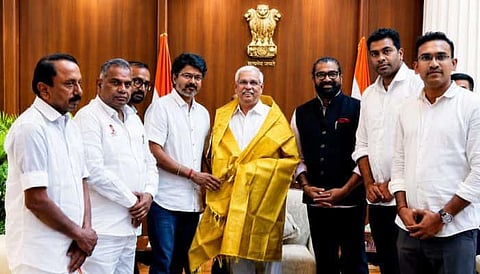
Tamil Nadu is not new to the tussle between Governor and elected government.
The Rise of TVK and the Search for Inclusive Politics in Tamil Nadu

Now in the case of state elections, as long as a party secures required numbers of seats it is incumbent on the governor to decide but to call the leader of the concerned party to assume Chief ministership. However, when no single party secures the numbers to form a government, the Governor is handed a kind of circumstantial veto. That is when discretion ceases to be a safeguard and becomes one person’s arbitrary preference set against the people’s mandate, a temptation India has repeatedly had to endure. As it happened with much irony, post-independence India first tested gubernatorial discretion in the Madras Presidency. INC held 155 of 321 seats, the United Democratic Front (a coalition bloc) 166, yet Governor Sri Prakasa summoned C. Rajagopalachari, a INC leader not even a member of the House—to form the government.

Consequently, a formal attempt to regulate the practice of appointing CM emerged from the Report of Committees of Governors which was published in 1971. It suggested that, “the leader of the Single largest party had an absolute right of Chief Ministership irrespective of the fact whether such party commanded a stable majority or not”. It also advised governors should use their discretion without extraneous influence or consideration. Although, what  followed was nothing of the sort. Instead of exercising dispassionate judgment, Governors have too often made decisions that were more impulsive than constitutional, yielding to partisan pressure rather than the discipline of principle. In the 1982 Haryana hung assembly the governor ended up inviting both the pre-poll INLD & BJP alliance and their opponent Congress which was also in minority to form the government. From Orissa to Jharkhand, Governors repeatedly bent discretion into partisan choice, denying mandates, reversing invitations, and installing chief ministers by preference rather than principle. For instance in 1974, Biju Patnaik was denied the chance to form a government in Orissa, similarly in 1984 NTR government was removed rather unceremoniously and Bhaskar Rao was made chief minister by then AP Governor Ram Lal, in the same year 1984 in the state of Jammu and Kashmir, Governor Jag Mohan disallowed Farooq Abdullah’s request to summon Assembly to test the majority and instead appointed G. M. Shah as the chief minister.

In 1980’s Sarkaria commission again attempted to provide concrete guidelines and principles for governors to exercise their discretionary power, it says,  governors must first invite the largest assembly party to form government, then pre-poll alliances, single-party claims with support, full coalitions, or outside-support alliances, prioritizing constitutional duty over personal political preferences In addition it instructed governors that, “their task is to see the government is formed and not to try to form a government which will pursue policies which he/she approves”.  The National Commission to review the working of the Constitution (2000-2002) under Justice M.N.R Venkatachaliah also suggested that a vote of confidence must be held in assembly within 30 days of assuming post to curb the arbitrary use of Governor’s discretion. The latest State- Central relations committee under former CJI M.M. Punchhi(2010) also consolidated the order provided by the Sarkaria Commission guidelines. More importantly it recommended that the guidelines should be framed as constitutional convention for avoiding ambiguity and future bias.  

Tamil Nadu is not new to the tussle between Governor and elected government.
Allowed to Represent, Not to Rule! The Unfinished Journey of Dalit Political Empowerment

As the distinction between the Governor’s role as a non-partisan constitutional office and perhaps a representative of the Centre’s political interests continues to diminish, the legitimacy and neutrality of their decisions are increasingly likely to be subjected to judicial scrutiny. Initially, Judiciary declined to entertain the cases against governors as their discretion were entrusted by the Constitution and such discretions were insulated from judiciary as article 361 which provides absolute immunity for exercising his/her functions.  In Samsher Singh vs State of Punjab, the court played a restrictive approach by declaring that, Governor has a power to exercise his discretionary power. This was reiterated in B.R. Kapur vs State of Tamil Nadu as the court decided to not apply judicial review over the discretionary action.  

S.R. Bommai v. Union of India marked a watershed in constitutional history, boldly instituting judicial review over Governors’ actions, unlike prior cases where courts demurred to apply judicial review to Governor’s actions. It reviewed the discretionary actions in case of mala fides, arbitrariness or irrelevant grounds to appoint CM or dissolve the floor. Judiciary’s role was further cemented in the case of Rameshwar Prasad vs Union of India (2006) which questioned the Governor’s immunity under article 361, subsequently strengthening the court’s role in scrutinizing the discretionary orders ‘ of the Governors on the  ground of visible mala fides and ultra vires.

Despite the Apex Court’s injunctions and the commissions’ guidelines on gubernatorial discretion, arbitrariness survives-mendacious, untamed, and evidently at home in the republic. In Goa 2017,  INC emerged a single largest party in hung assembly, but the Governor invited BJP to form a government with support of independent MLAs. The Goa episode drafted a template of declining single largest party doctrine, by emphasis on post - poll coalition. But the template was in fact ignored in the following year in Karnataka, where BJP emerged as the single largest party with 104 MLAs, post poll coalition INC 78 and JD(S) 37 formed claimed power. The governor preferred B.S. Yeddyurappa as Chief Minister, in which Supreme court intervened and demanded him to prove majority which made him resign from the post.  The pattern is consistent. The Governor's office is riddled with partisan biases. This story issues a stark warning: when institutional accountability and scrutiny are allowed to wither, the Governor’s office can harden into a predatory instrument, leaving democracy hollow and the state too enfeebled to restore it.

Unmute the Constitutional silence

Perhaps the constitutional framers did not fully anticipate a political future in which the discretionary powers of governors would press so directly upon the principles of democracy. Yet they were not without foresight. They cautioned, with notable clarity, that while the Constitution may provide only a skeletal framework of legal provisions, its vitality would depend on what they termed “constitutional morality”. Dr. B.R. Ambedkar sharpened this further by saying, “constitutional morality  is not a natural sentiment. It needs to be cultivated.” This was not merely a philosophical reflection but rather a structural warning. He insisted, moreover, that the people of India were yet to acquire this disposition. Democratic life is often said to rest on the reason and rationality of its participants, and not without justification.

But such claims risk overstating the coherence of civic virtue. Conscience, reason, rationality and constitutional morality admit no litmus test, no stable measure by which their presence can be confirmed or their absence can be decisively exposed. What follows from the stories of governors’ decisions, is a system that must function in the absence of assured virtue, relying not on presumed moral alignment, but on the disciplined restraint of power. Hence, the Governors must be guided by established convention which effectively handles hung assembly situations, and order of preference must meet democratic values not discretion of an individual. While the cultivation of constitutional morality remains a protracted political endeavor, we cannot, in the interim, entrust the daily exercise of the governor’s office to the uncertain arrival of that distant horizon.

- Thirunavukarasu S, is a Ph. D. Research Scholar at the Department of Defence and Strategic Studies, University of Madras. 

-Saumya is a PhD candidate at the University of Amsterdam. She taught Indian Politics at Flame University until a few months ago and was the Political Intelligence unit lead for West Bengal Elections for TMC, Punjab for INC on behalf of IPAC.

Tamil Nadu is not new to the tussle between Governor and elected government.
Beyond Binary Politics: Social Justice and the Crisis of Ideology in Tamil Nadu

You can also join our WhatsApp group to get premium and selected news of The Mooknayak on WhatsApp. Click here to join the WhatsApp group.

Support The Mooknayak

'The Mooknayak' practices democratic journalism. It is a media platform committed to the Constitution, democracy, and social justice. If you also want 'The Mooknayak' to always raise the voices of the marginalized and show the pain of the voiceless, please support us.

Please Contribute
The Mooknayak English - Voice Of The Voiceless
en.themooknayak.com