Allowed to Represent, Not to Rule! The Unfinished Journey of Dalit Political Empowerment

Dalit chiefs are always nominated in those constituencies with reservation requirements but it is still limited when it comes to becoming a state leader. Formally, general constituencies are open to anyone but the electoral race is still conducted on the basis of old caste combinations, unequal distribution of resources and social preeminence.
The Dalit leaders have sometimes made it to the top executive office in the state, but hardly any of them have managed to consolidate and maintain power. Entry has been possible. Continuity has not.
The Dalit leaders have sometimes made it to the top executive office in the state, but hardly any of them have managed to consolidate and maintain power. Entry has been possible. Continuity has not.Social Media
Published on

— ✍️Nidhi Jarwal

In India, democracy is based on the aspect of political equality. The universal adult franchise meant that all the citizens of a country regardless of their caste received an equal vote in the political arena. The reservation of the Scheduled Castes in the Constitution was intended to go even higher by redressing centuries of political silence. Almost eight decades after Independence, Dalit representatives can be found in legislatures, both in Parliament and state assemblies. However, a closer examination of political leadership brings an unwarranted contradiction. There has been an expansion of representation, but there has been an extremely rare case of durable Dalit control over executive power.

Today, the Lok Sabha has 84 seats of Scheduled Castes represented in 543 seats ensuring minimum legislative representation to the communities that collectively make up about 16 to 17 percent of the Indian population. The political institutions in India have been changed by reservation without a doubt. Dalit MPs have become an institutional reality rather than a token inclusion in the democratic governance.

Democracy, however, cannot be judged by the entry point of legislatures only. It has to be determined as well by what leaders do.

The historical analysis of Dalit Chief Ministers shows a very noticeable and regular trend. The Dalit leaders have sometimes made it to the top executive office in the state, but hardly any of them have managed to consolidate and maintain power. Entry has been possible. Continuity has not.

The Dalit leaders have sometimes made it to the top executive office in the state, but hardly any of them have managed to consolidate and maintain power. Entry has been possible. Continuity has not.
Casteist Remark Sparks Row in Rajasthan PHQ: Woman SP Accused of Calling Senior 'Reservation Director', FIR Registered Under SC/ST Act

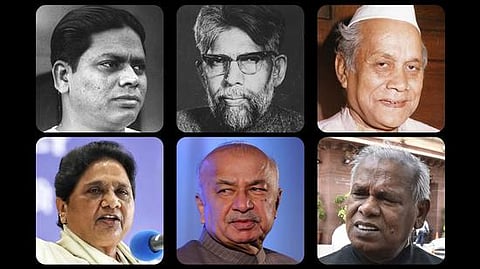
Andhra Pradesh had the first Dalit Chief Minister, Damodaram Sanjivayya, who ruled the state between 1960 and 1962, but never served a complete electoral term. Sushilkumar Shinde would make a short-lived executive inclusion in a mainstream party system when he was Chief Minister of Maharashtra between 2003 and 2004, another moment of executive inclusion that was short-lived.

The sole drastic shift in this trend was with Mayawati in Uttar Pradesh. The first Dalit woman to serve over six years, between 1995 and 1997, 2002-03 and most notably between 2007 and 2012, she is the only Dalit woman to serve a full five-year term in an uninterrupted electoral mandate in independent India. Her leadership was based on independent Dalit political mobilisation in the form of Bahujan Samaj Party that transformed social assertion into bargaining power in the electoral politics.

A noticeable shrink in longer-term Dalit executive leadership begins with Mayawati. Jitan Ram Manjhi, the Chief Minister of Bihar from May 2014 through February 2015, was in office at a period of internal political change and was ousted before he could consolidate power. The state was only months prior to elections as Charanjit Singh Channi, the first Dalit Chief Minister of Punjab since September 2021, took over the state who in April 2022, elections ensued wherein his party lost power and Charanjit Singh Channi himself lost his seat.

Almost 79 years after Independence, India does not have a Dalit Chief Minister even though Dalits are still represented in the legislatures in the various states. This trend posits that Dalit leadership has been allowed to have occasional spurts of highness but seldom the time or space in politics to ensure long-lasting power.

This trend poses a more profound form of democracy of whether or not reservation is even a form of democracy. The case of political reservation in India has been quite successful in making sure that a person gains access to the legislative apparatus, but the shift in leadership and executive authority has been much less so. It has seen growth of representation but few cases have been in which the power of the historically powerful groups has been transferred to leadership of Dalits. This fact does not erase the existence of this gap, which, perhaps, makes one consider whether the current system of reservation guarantees the presence without necessarily changing the power distribution.

Political parties are most instrumental in sustaining this disproportion. The process of choosing the candidates and promotion of leadership is highly blocked in party hierarchies. Dalit chiefs are always nominated in those constituencies with reservation requirements but it is still limited when it comes to becoming a state leader. Formally, general constituencies are open to anyone but the electoral race is still conducted on the basis of old caste combinations, unequal distribution of resources and social preeminence.

The loss of autonomous Dalit political mobilisation has opened even fewer avenues to executive power. The emergence of the Bahujan Samaj Party once proved that the political representation could be converted into the governing power by independent political organisation. It has also gotten weaker with the loss of stable Dalit chief ministerships and this implies that inclusion in dominant party systems has not had similar results. The institutions have been increasing their representation but not the leadership in the party structures.

This does not reduce the historic need of reservation. Otherwise, the Dalit influence in the democratic institutions would be crippled. Reservation served to open political areas which had been closed long ago. But there is also a democratic challenge that remains unsolved in its success. In areas where representation is pooled in the reserved seats with the executive elusive, inclusion merely stabilises inequality as opposed to transforming it.

Almost 80 years after the establishment of the republic, the fact that there has been no Dalit Chief Minister in office cannot be explained only by coincidence. It is an indication of the boundaries of a political system where inclusion is frequently handed over without decentralization of power. The issue that arises is not the representation of Dalits. They are. The question would be the reason the representation has failed to bring duration of leadership at the top of governance.

Indian democracy was opened as a result of reservation. The task to be fulfilled is to make sure that the doors which lead to participation also lead to power. India has not yet achieved political equality fully because, until Dalit leadership can be sustained, not exceptional, governance will only be partially achieved.

- Nidhi Jarwal works with the National Campaign on Dalit Human Rights (NCDHR) and writes on caste, democracy, and political representation.

The Dalit leaders have sometimes made it to the top executive office in the state, but hardly any of them have managed to consolidate and maintain power. Entry has been possible. Continuity has not.
Why India Cannot Achieve the SDGs Without Including Communities Discriminated on Work and Descent
The Dalit leaders have sometimes made it to the top executive office in the state, but hardly any of them have managed to consolidate and maintain power. Entry has been possible. Continuity has not.
The Silent Crisis of Agricultural Scientists: Pensioners of MPUAT on the Brink

You can also join our WhatsApp group to get premium and selected news of The Mooknayak on WhatsApp. Click here to join the WhatsApp group.

The Mooknayak English - Voice Of The Voiceless
en.themooknayak.com