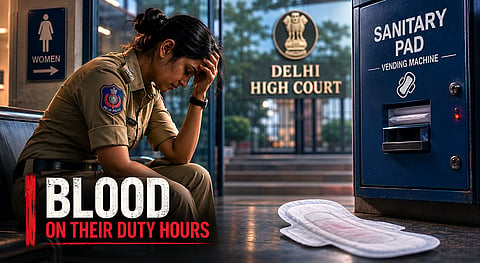
New Delhi- In a landmark petition that exposes a stark gap between the rising number of women in policing and the basic infrastructure to support them, the Justice for Rights Foundation has approached the Delhi High Court, demanding the installation of sanitary pad vending machines in every police station across the National Capital Territory.
The Public Interest Litigation (PIL), filed under Article 226 of the Constitution, also seeks a historic directive to frame a comprehensive menstrual hygiene policy for thousands of female police personnel who currently work without assured access to hygienic washrooms, rest-rooms, or emergency sanitary products.
The petition filed through Advocates Karnika Bahuguna and Pooja Kushwaha on behalf of authorised representatives Muskan Singh Bankura (Secretary) and Shreya Sejwal (Joint Secretary, Women Cell, Delhi) argues that the State’s inaction amounts to a brutal violation of fundamental rights under Articles 14 (equality), 15 (non-discrimination), and 21 (right to life with dignity) of the Constitution.
According to the petition, the Foundation filed multiple RTI applications between 2024 and 2025 with the Delhi Police’s Public Information Officer. The responses revealed a damning picture:
Across hundreds of police stations and several thousand female police personnel, there are hardly any sanitary pad vending machines installed proportionally.
The only exception is the New Delhi District, which stands alone in having some infrastructure.
There is zero budgetary allocation for menstrual hygiene in police stations.
Most shockingly, the Delhi Police Headquarters has no policy, circular, standing order, or institutional mechanism on the subject, a complete administrative void.
“It is not a matter of privilege, but of basic biological need and human dignity,” the petition states. “Female police officers work grueling shifts, often through the night, in stressful law-and-order situations. Denying them sanitary pads and hygienic disposal facilities is not neglect — it is structural discrimination.”
The PIL raises a substantial question of public importance: whether the failure of the State to provide menstrual hygiene infrastructure, especially given the demanding nature of policing duties for women, violates their constitutional rights.
Legal experts note that while several judgments have affirmed menstrual dignity in workplaces and prisons, this is the first litigation specifically targeting police stations as workplaces for women in uniform.
“Police stations are not just places of detention, they are workplaces for thousands of women. If schools, railways, and airports can have pad vending machines, why not a police station where a woman officer may be posted on a 12-hour night shift?” asked Advocate Karnika Bahuguna, co-counsel for the petitioner.
The Foundation has sought a series of binding directions, including:
Installation of functional sanitary pad vending machines in all Delhi Police stations within a time-bound period, with a verified compliance report.
Earmarked budgetary allocations from the Ministry of Home Affairs to Delhi Police for procurement, installation, maintenance, and sanitary waste disposal units.
Formulation of Standard Operating Procedures (SOPs) covering installation, maintenance, accessibility, periodic replenishment, and safe disposal mechanisms.
A time-bound action plan from Delhi Police specifying phase-wise installation and funding sources.
A direction that sanitary pads be made available free of cost or at subsidised rates to female police officers and women visitors, with adequate hygienic disposal provisions at every police station.
The petition names four key respondents: Delhi Police, Government of NCT of Delhi, Union of India through the Ministry of Home Affairs and the Ministry of Women and Child Development.
The matter is expected to be listed for hearing before the High Court of Delhi in due course.
While the Delhi Police has significantly increased the recruitment of women in recent years, including in combat roles, night patrolling, and investigative positions, the PIL argues that infrastructure has not kept pace. The absence of menstrual hygiene facilities often forces women officers to take unscheduled leave, suffer in silence, or risk infections.
“We are not asking for special treatment. We are asking for basic dignity. A vending machine costs less than a traffic barrier. If the State can install CCTV cameras in every station, it can install a pad vending machine,” said Shreya Sejwal, Joint Secretary, Women Cell, Delhi.
You can also join our WhatsApp group to get premium and selected news of The Mooknayak on WhatsApp. Click here to join the WhatsApp group.
'The Mooknayak' practices democratic journalism. It is a media platform committed to the Constitution, democracy, and social justice. If you also want 'The Mooknayak' to always raise the voices of the marginalized and show the pain of the voiceless, please support us.
Please Contribute