Periods Leave Row: MP Chandra Shekhar Azad Writes to CJI, Calls SC's 'No Jobs' Warning 'Patriarchal Mindset'

Azad emphasized that just as maternity leave is now a settled right, menstrual leave must be recognized as a matter of dignity and health, not a concession.
Taking on the court's observation that such pleas portray women as "inferior," the MP countered that menstruation is not a disease or weakness, but a natural biological process.
Published on

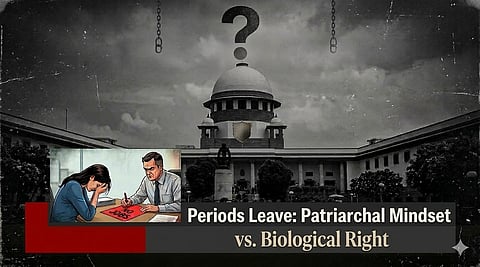
New Delhi- A fierce debate has erupted across the country after the Supreme Court refused to entertain a Public Interest Litigation (PIL) seeking a nationwide menstrual leave policy. Stepping into the center of this controversy, Nagina MP and Advocate Chandra Shekhar Azad has written a detailed letter to the Chief Justice of India, urging the court to reconsider its stance and highlighting what he calls a "deep-rooted patriarchal mindset" reflected in the observations 

On March 13, a bench comprising Chief Justice Surya Kant and Justice Joymalya Bagchi dismissed a PIL filed by lawyer Shailendra Mani Tripathi, which sought mandatory menstrual leave for women students and workers across the country.

What Did the Supreme Court Say?

While refusing to entertain the plea, the bench made several critical observations:

Impact on Employability: The Chief Justice remarked, "Creating awareness and sensitisation is different... but the moment you bring in a law mandating menstrual leave, nobody will hire them (women)" . He further warned, "You don't know the mindset of employers. They will not hire women if we make such a law".

Reinforcing Stereotypes: The court observed that such pleas are "made to create fear, to call women inferior, that menstruation is something bad happening to them" . The CJI added that mandatory leave might make young women feel they are "not at par" with their male colleagues, which could be "harmful for their growth".

Voluntary vs. Mandatory: While rejecting the compulsory model, the bench clarified that voluntary policies by states or private companies are "excellent." However, they cautioned that making it a legal mandate could lead to employers excluding women from the workforce entirely, saying, "They will say you should sit at home after informing everyone".

The court disposed of the petition with a direction to the competent authorities to consider the petitioner's representation and examine the possibility of a policy after consulting stakeholders.

Karuna Nundy, Senior Advocate, suggested a middle path, stating, "One paid day of menstrual leave, to be taken as required, would be a good start. It’s like maternity leave... you shouldn’t have to pretend to be a pain-free hero when you have a cycle that literally allows the human race to perpetuate itself".

Activist Yogita Bhayana criticized the court's concern, stating, "This is very stupid of them to think like that. Women already deal with biological realities like pregnancy and childcare. If you deny them opportunities because of that, you should rather guide or dictate to corporates not to hamper jobs" 

MP Azad's Intervention: A Lesson from History

In his letter to the CJI, MP Chandra Shekhar Azad provided a sharp rejoinder to the court's concerns, drawing parallels with historical social reforms.


Azad argued that the same apprehensions being raised today about menstrual leave were once raised against maternity leave. "History is witness that there were many such social systems and traditions in India that were considered normal for a long time. When laws were made to abolish them, a large section of society opposed them. But over time, those very steps proved to be social reforms and progressive changes," he wrote.

Taking on the court's observation that such pleas portray women as "inferior," the MP countered that menstruation is not a disease or weakness, but a natural biological process. He argued that accepting women's health needs at the workplace is an extension of the constitutional principles of equality, dignity, and social justice.

Addressing the court's fear that the private sector might stop hiring women, Azad proposed a practical alternative. He suggested that the policy be tested first in the government sector. "If the Honorable Court has apprehensions that practical difficulties may arise in the private sector due to such a policy, a practical option could be to first implement the menstrual leave system in the government sector and test its impact and practicality. Based on this, a broader national policy can be considered further," he stated.

Taking on the court's observation that such pleas portray women as "inferior," the MP countered that menstruation is not a disease or weakness, but a natural biological process.
Menstrual Health: Survey Reveals 81.3% Girls Discuss Periods with Mothers Only and 40.9% Avoid School
Taking on the court's observation that such pleas portray women as "inferior," the MP countered that menstruation is not a disease or weakness, but a natural biological process.
Ranjeeta Priyadarshini's Campaign Gains Momentum: Seminar on Paid Period Leave Sparks Discussion and Action

You can also join our WhatsApp group to get premium and selected news of The Mooknayak on WhatsApp. Click here to join the WhatsApp group.

The Mooknayak English - Voice Of The Voiceless
en.themooknayak.com