Women News
TM Exclusive | Why the Ruchika Singh Row Is Reviving Memories of Mayawati
Critics Say Former UP CM Endured Decades of Sexist and Casteist Abuse Without Ever Using State Machinery

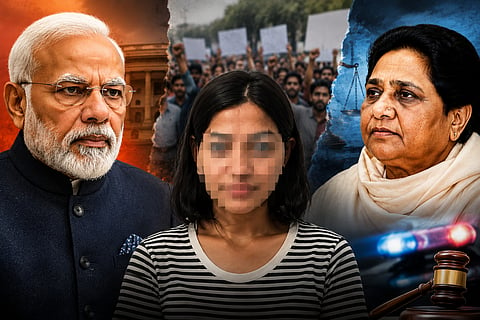

New Delhi: The controversy surrounding Noida resident Ruchika Singh who was booked after allegedly raising abusive slogans against Prime Minister Narendra Modi during a protest at Delhi's Jantar Mantar, has sparked a wider debate on political tolerance, free speech, the treatment of minors, and the use of state machinery.
Following the registration of a Zero FIR and the emergence of Ruchika's public apology video, social media users, activists and political commentators have drawn parallels with the political journey of Bahujan Samaj Party (BSP) chief and former Uttar Pradesh Chief Minister Mayawati. They argue that despite facing decades of deeply sexist, casteist and personal attacks, Mayawati largely refrained from using the coercive power of the state against her critics.
The controversy began after a video from a protest held at Jantar Mantar on July 23, went viral on social media. In the video, a young woman, identified as Ruchika Singh, was allegedly seen using abusive language against Prime Minister Narendra Modi.
Following the video's circulation, Delhi Police registered a Zero FIR under Sections 352, 353(1), and 356(1) of the Bharatiya Nyaya Sanhita (BNS).
The case also gave rise to questions regarding Ruchika's age. While the FIR reportedly mentions her age as 25 years, Ruchika claimed in her apology video that she is 15 years old, creating a discrepancy that has since become part of the public discussion.
In a video released after the FIR, Ruchika folded her hands and apologised publicly. She said she had gone to Connaught Place, where a protest was taking place.
"People there were shouting abusive slogans against Prime Minister Narendra Modi. I got influenced and repeated what they were saying. I am only 15 years old. This was my first and last mistake. I never uploaded that video on social media. I apologise to the entire country. I am deeply ashamed and cannot even look people in the eye."
The apology video generated sharply divided reactions. While some welcomed her acceptance of responsibility, others questioned whether a teenager should have been pushed into making a public apology after criminal proceedings had already begun.
Prime Minister Narendra Modi also responded to the controversy. Referring to the abusive slogans directed at him and his late mother, he described them as culturally painful but said young people often make mistakes.
He urged that youth should be guided rather than punished and appealed for a compassionate approach if the girl had genuinely realised her mistake and apologised.
Soon after Ruchika's apology surfaced, social media users began recalling the decades of personal abuse faced by BSP supremo Mayawati.
Many commentators argued that Mayawati is perhaps among the few Indian political leaders, particularly women, to have endured sustained sexist, casteist and deeply personal attacks targeting her appearance, body, caste identity and private life.
Critics contend that despite these repeated attacks, she generally chose not to invoke state machinery against those making offensive remarks.
"Modi Ji's case is nothing in front of the sexist and castiest abuses mayawati ji faced in her career. Yes people have apologised to her also, but not out of fear of state machinery, but out of fear of public anger from the most vulnerable sections of society ; cobblers, artisans, sanitation workers, and d marginalized groups whose services they rely on daily. Mayawati never used the state machinery to book even grown up adults or prominent figures, let alone a 15yr old Ruchika Singh. Modi ji should have learned lessons about resilience of democracy from Mayawati", a long post from Lawyers Dice reads.
The post further points out to the several instances when the BSP chief had endured nasty comments from prominent influencers and actors. "Nobody has ever been that vulgar to Mayawati than any other politician,no mainstream leader has been subjected to such inherently vulgar and deeply personalized degradation than Mayawati. But Mayawati chose a path of dignified silence, letting her massive base speak for her. Modi ji unnecessarily got angry like a kid whereas Mayawati chose not to take state actions and let people decide."
Several old incidents involving comedians and public personalities have resurfaced during the debate.
Comedian Abish Mathew came under criticism after an old 2012 tweet mocking Mayawati's appearance resurfaced in 2021. Following widespread backlash, he publicly apologised, acknowledging that the remark was insensitive and inappropriate.
Writer-comedian Varun Grover also faced criticism after an old tweet referring to Mayawati's appearance resurfaced. He later apologised and admitted that the comment reflected an earlier mindset he no longer endorsed.
Some excerpts from comedian Vir Das' older stand-up performances also drew criticism for comments about Mayawati's appearance and public image. Complaints were filed against him in connection with those remarks.
Actor Randeep Hooda faced severe backlash in 2021 after an old video from 2012 resurfaced in which he narrated an obscene joke about Mayawati.
The controversy triggered the social media campaign #ArrestRandeepHooda. Soon afterwards, the Convention on the Conservation of Migratory Species of Wild Animals (CMS), a UN environmental treaty, removed Hooda from his role as CMS Ambassador.
Hooda later issued an unconditional public apology, saying he had never intended to hurt anyone's sentiments.
Political commentators and Bahujan activists argue that while offensive remarks against Mayawati frequently attracted intense public backlash, the response came primarily from society rather than through criminal prosecution initiated by the state.
According to this view, Dalits, sanitation workers, artisans, daily wage earners and other marginalised communities see Mayawati not merely as a politician but as a symbol of dignity, social mobility and political representation. Consequently, offensive remarks directed at her often generated spontaneous outrage among her supporters.
Several comedians and public figures eventually apologised after facing widespread public criticism. Dr Rajkumari, a college professor in Sociology, opines that the Ruchika Singh episode has reignited questions about how democracies should respond to offensive political speech.
One side argues that abusive language against public representatives cannot be normalised and must have consequences. The other believes that, particularly in cases involving young people, corrective and educational responses should take precedence over criminal action.
The comparison with Mayawati has therefore become part of a broader discussion on freedom of expression, political civility, state power, and whether public accountability or legal coercion should be the primary response to offensive speech.
You can also join our WhatsApp group to get premium and selected news of The Mooknayak on WhatsApp. Click here to join the WhatsApp group.
'The Mooknayak' practices democratic journalism. It is a media platform committed to the Constitution, democracy, and social justice. If you also want 'The Mooknayak' to always raise the voices of the marginalized and show the pain of the voiceless, please subscribe.
PLEASE SUBSCRIBE US