Tribal
TM Special | Why 35 in Every 100 Young Tribal Women in India Still Rely on Cloth or Other Unhygienic Methods During Periods
Why Pads Remain Unused Even When They Are Just Metres Away: The Shame, Habit and Cost Behind Tribal Women's Choices

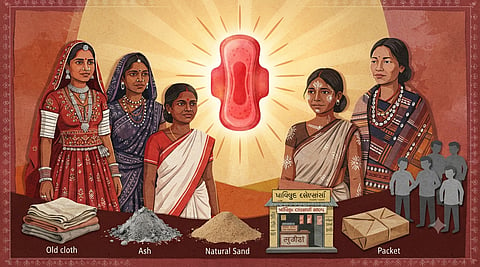

A new nationwide study has found that only 65.4% of young tribal women in India exclusively use hygienic methods to manage their periods. The remaining 34.6%, roughly one in three, rely on cloth or other unhygienic materials, either instead of or alongside safe products.
The research, published in Discover Social Science and Health, was carried out by Sandhya Kumar, Sumit Narayan Dwivedi and R. S. Reshmi of the International Institute for Population Sciences in Mumbai. It draws on data from the National Family Health Survey-5 (2019–21), covering 44,392 tribal women aged 15 to 24.
The tribal population in India accounts for about 104 million people, encompassing 8.6% of the population and constituting over 730 Scheduled Tribes notified under Article 342 of the Constitution of India. Tribal populations face unique challenges to better health, exacerbated by tribal populations’ geographical isolation, poverty, and lack of access to healthcare. Prior studies on menstrual health in India have demonstrated a lack of knowledge of the ovulatory cycle and a lower prevalence of hygienic menstrual practices among tribal women and girls compared to general caste women in India.
Most earlier studies compared rural women with urban women, or tribal with non-tribal women. This one looks only inside the tribal population and asks what separates women who use hygienic methods from those who don't. The authors argue that tribal women have often been treated as one uniform group, even though India's tribal population is huge and varied.
The differences between these communities are large. The average tribal literacy rate was 59% in the 2011 Census, yet among some "Particularly Vulnerable Tribal Groups" in Odisha, literacy among women is as low as 3.52%. Women hold property rights in some tribal communities but not in others. The paper also cites an earlier study in a tribal area of Nagpur, where 98% of adolescent girls were not allowed to attend religious functions during menstruation and 65.9% were kept out of classes. Separately, about 70% of households in tribal districts still lack piped water
Women in the survey were asked what they use "to prevent bloodstains" during their periods. The study counted sanitary napkins, locally made napkins, tampons and menstrual cups as hygienic. Cloth, nothing at all, and other materials were counted as unhygienic, because earlier research has linked them to reproductive tract infections and abnormal vaginal discharge. The study also used a strict definition called "exclusive" hygienic use. A woman who uses a sanitary napkin in some months and cloth in others is not counted as an exclusive user, which makes the 65.4% figure a demanding benchmark.
The profile of the women surveyed shows why the numbers look the way they do. Nearly 87% (86.7%) live in rural areas. About 44.4% belong to the poorest wealth group and another 26.3% to the second poorest, so roughly seven in ten sit at the bottom of the economic ladder. Most (68.9%) have completed secondary education, 11.8% have no schooling at all, and only 10.4% have studied beyond secondary school. Around 71.5% are exposed to newspapers, radio or television. Just over half (55.7%) live in homes with an improved toilet, while 84.6% have an improved water source. Only 23.5% are currently working. The largest shares of the sample live in the East (25.2%) and the Central region (24.6%), followed by the West (19.7%).
When the researchers looked at what women actually use, cloth came out on top nationally, at 60.5%. Sanitary napkins were used by 53.4%, locally made napkins by 14.7%, and tampons or menstrual cups by just 1.9%. Using nothing, or "other" materials, was very rare at 0.2% each. Because women can use more than one material, these figures add up to more than 100%.
The regional differences are striking. Central India is the weakest region, with 78.2% of tribal women using cloth and only 42.3% using sanitary napkins. In the North, 64.6% use cloth and 61.8% use sanitary napkins. In the East the figures are 59.6% and 53.3%, and in the West 47.8% and 51.3%.
The North-East and the South are the only two regions where sanitary napkins beat cloth: the North-East has 68.1% napkin use against 55.4% cloth use, while the South has 57.3% against 39.4%. The South also has the highest use of locally made napkins, at 25.1%, which hints that local production and distribution may be helping women there.
Behind these figures are everyday realities that a survey with fixed answer options cannot capture. The Mooknayak spoke to Dr Gaytri Tiwari, a retired assistant professor from the College of Home Science, Maharana Pratap University of Agriculture and Technology (MPUAT), Udaipur. Recalling her past research on menstrual hygiene, Dr Tiwari said that even today, in remote areas of southern Rajasthan, women use ash or sand to clean themselves during menstruation.
"I even remember women telling me, who had never seen pads, that their extra-long ghagras serve as a kind of support cloth during periods," she said.
Her account is a reminder of how far the lived experience can be from the official categories. The study itself notes that the survey does not capture stigma, taboos, knowledge or access to washing facilities, and it counts every kind of cloth as unhygienic without knowing whether it was clean or properly dried. Rajasthan makes up 9.2% of the tribal sample in the study, with 1,822 women surveyed.
Hope is also coming from a younger generation. Khushi Paliwal, a 24-year-old youth activist from Udaipur, runs the Red Pad Movement, which works to spread menstrual awareness among adolescent girls in remote villages of Rajasthan. Her motivation comes from her own experience. When she first went to buy pads with her mother, the chemist wrapped the packet in newspaper, and she spent years wondering why carrying pads in public was considered wrong. Even in a private co-ed school, she says, periods were never normalised, and no teacher ever gave the girls a "period talk."
After joining an NGO that works with underprivileged girls, she realised her own experience was only "the tip of the iceberg." Her work in villages has not been easy, as male sarpanchs and school principals were initially unwelcoming to the idea. Even so, she and her team managed to win over the villages of Upli Badi and Chapra to begin with. More than two years on, the movement continues to challenge period shaming and promote what Khushi calls "period positivity."
The researchers also mapped hygienic use district by district. Southern India shows the highest rates, along with pockets in the North and North-East. A dark band of low-use districts, where fewer than 32% of tribal women use hygienic methods exclusively, runs through central India.
The map also shows how misleading a single state average can be. In Karnataka, some districts have more than 72% of tribal women using hygienic methods while others have fewer than 32%. Across the country, district rates range from below 32% to as high as 98%. The authors caution that in some districts only a small number of tribal women were surveyed, so individual district figures should be read carefully.
To separate out the effect of each factor, the researchers used a statistical method called logistic regression, which reports results as "odds ratios." A figure above 1 means a woman is more likely to use hygienic methods, and a figure below 1 means less likely.
Wealth turned out to be the strongest factor. Compared with the poorest women, those in the "poorer" group had 1.57 times the odds of hygienic use, the middle group 2.26 times, the richer group 2.87 times, and the richest group 5.43 times. Each step up the wealth ladder brought a clear improvement.
Education also mattered, though less than it first appeared. Compared with women who had no schooling, those with secondary education had 2.05 times the odds, and those with higher education had 3.12 times. Primary schooling alone made no clear difference once other factors were taken into account.
Having an improved toilet at home raised the odds by a third (1.33 times). This fits with earlier findings that managing periods safely is difficult without private, clean facilities and a way to dispose of used products. The paper cites one study from a remote area near Udaipur that describes the difficulty tribal women face in disposing of menstrual products compared with women in cities.
Rural women were behind urban ones, with about 30% lower odds (0.70). Women aged 20 to 24 had about 20% lower odds than those aged 15 to 19 (0.80). The authors suggest that younger women may have been reached by school programmes and menstrual health campaigns, or that the gap reflects a general shift over time.
Even after everything else was accounted for, region still mattered. Compared with the North, the Central region had less than half the odds (0.48), while the East (1.62), West (1.54) and South (1.94) had higher odds. The North-East was not clearly different from the North.
Several results ran against common assumptions. Access to an improved water source showed no clear link to hygienic practice, although toilets did. The data cannot explain why, but it suggests that privacy and disposal may matter more than water supply alone. Exposure to mass media also made no difference, even though many awareness programmes rely on television and radio. That suggests messaging by itself may not be enough if women cannot afford or reach the products.
The apparent power of education shrank sharply once other factors were accounted for. Before adjustment, secondary education seemed to make women 13 times as likely to use hygienic methods, and higher education 16 times. After adjustment, those figures fell to about 2 and 3 times. Much of what looked like the effect of schooling was really tied up with wealth and living conditions.
Religion told a similar story. Muslim women initially appeared more likely to use hygienic methods (1.29 times the odds of Hindu women), but after adjusting for wealth, education and other factors they were less likely (0.58). Christian women went from 1.70 to 0.94. The apparent differences between religious groups seem to have been driven largely by differences in income, schooling and region.
Working women were also less likely to use hygienic methods (0.80), which many would find counterintuitive. The authors note that earlier studies have shown mixed results on this and offer no firm explanation.
Lack of access to sanitary pads cannot, by itself, explain why tribal women use them less. Even among women who can reach them easily, shyness, habit and money often push them back towards old cloth. Kesar Bai, a tribal woman from Jhadol, has lived in Udaipur city for the past seven years because her husband works as a security guard in an apartment complex. She herself works as a domestic help in a few flats in the same building. Getting hold of hygienic pads should be easy for her, as a medical shop stands just a few metres from their rented room near Udaipur University. "I know how to use pads. One of the Madam jis once gave me a packet and asked me to use them every month," she told The Mooknayak. But did she ever go and buy a packet afterwards? The answer is a shy nod. "No, I feel ashamed. There are men in the shops and I don't know how to ask. Even my husband feels shy about going to get a packet for me," she explains. Then, almost coyly, she adds that she does not really need them anyway. "I get so many clothes from the homes where I work, and when they get old, I tear them up and use them during my periods," she says.
The researchers conclude that one-size-fits-all national programmes will not work. They call for strategies designed for specific regions and districts, using maps like theirs to identify priority areas. They suggest subsidising or otherwise making menstrual products affordable, running educational campaigns led by respected community leaders, and improving water, sanitation and toilet infrastructure. They also argue that menstrual health should be linked to education, poverty reduction and reproductive health programmes. The paper stresses that national improvements in menstrual hygiene have not reached tribal women at the same pace, and that they continue to lag behind the national average.
India has made progress on menstrual hygiene overall, but for young tribal women, poverty, rural isolation, limited schooling and poor sanitation keep millions dependent on cloth and other unsafe methods. The map shows that the problem is not uniform. It is worst in central India and varies sharply even within one state. As Dr Tiwari's recollections from southern Rajasthan suggest, behind every percentage point is a woman improvising with whatever is within reach.
Source: Kumar S, Dwivedi SN, Reshmi RS. "Determinants and spatial patterns of hygienic menstrual practices among tribal women in India." Discover Social Science and Health, 2026.
You can also join our WhatsApp group to get premium and selected news of The Mooknayak on WhatsApp. Click here to join the WhatsApp group.
'The Mooknayak' practices democratic journalism. It is a media platform committed to the Constitution, democracy, and social justice. If you also want 'The Mooknayak' to always raise the voices of the marginalized and show the pain of the voiceless, please subscribe.
PLEASE SUBSCRIBE US