Society
Rajasthan High Court Grants Divorce to Woman, Criticizes 'Atta-Satta' Custom Involving Minors | Full Report
'Atta-Satta' is a reciprocal marriage practice in regions like Rajasthan where families exchange daughters.

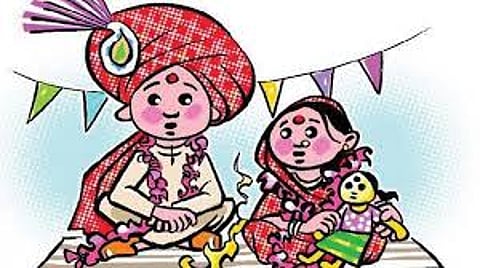

Jodhpur- The Rajasthan High Court at Jodhpur has allowed a divorce appeal filed by woman against her husband, setting aside the Family Court, Bikaner’s judgment dated 24.09.2025 that had dismissed her petition under Section 13 of the Hindu Marriage Act, 1955.
The marriage between Kiran Bishnoi and Sunil Kumar was solemnized on 31 March 2016 at Bikaner as per Hindu rites. According to the wife’s case, despite adequate dowry, she faced continuous harassment, physical assault, and demands for additional dowry including a motorcycle and gold articles. She alleged grave cruelty, including sexual assault by her brother-in-law and father-in-law, and claimed she was forcibly ousted from the matrimonial home on 19 March 2020 along with her minor daughter. An FIR (No. 87/2020) was lodged, leading to a charge-sheet against the husband and his father under Sections 498-A, 406, 323, and 34 of the IPC.
The husband denied the allegations of cruelty and dowry demands. He contended that the marriage was part of an ‘atta-satta’ (exchange marriage) custom, linked to the simultaneous marriage of his minor sister Suman with the wife’s brother. Disputes arose when Suman, upon attaining majority, refused to perform ‘muklawa’ and join her marital home, leading to family pressure and interference.
The Family Court had framed issues on cruelty and, after examining evidence, dismissed the wife’s divorce petition. It held that the primary cause of discord was the ‘atta-satta’ dispute rather than cruelty by the husband, viewing the wife’s legal actions as attempts to exert pressure and concluding that she had voluntarily deserted the matrimonial home, thereby committing cruelty on the husband.
In its judgment dated 10 April, a Division Bench comprising Justices Arun Monga and Sunil Beniwal reversed the Family Court’s findings. The High Court observed that the Family Court had erred by overemphasizing the collateral ‘atta-satta’ dispute instead of focusing on the merits of cruelty in the couple’s marriage.
The court noted, “The fundamental error committed by the learned Family Court is the failure to recognize and properly distinguish between two separate spheres, i.e., first, the dispute arising out of ‘atta-satta’, a customary practice; and second, the independent statutory standard for determining matrimonial cruelty and desertion.”
It further held that the wife’s departure could not be termed voluntary desertion given the circumstances, stating, “A woman cannot be expected to maintain marital normalcy when she has endured years of sustained emotional isolation and psychological pressure in the matrimony. Mere shared physical residence does not always equate to harmonious cohabitation.”
The High Court added that continued cohabitation for years does not negate cruelty, as “Many women remain in difficult marriages because of economic dependence, social pressure, children, lack of shelter, fear of stigma, or absence of parental support. Continued residence under compulsion of circumstances is not the same thing as voluntary, harmonious cohabitation.”
On the evidentiary aspect, the bench observed that in matrimonial cases the standard of proof is preponderance of probabilities, and the long separation of about five years without genuine efforts at restitution reinforced the inference of cruelty. It noted that mediation attempts before the Family Court had failed and there was no possibility of reconciliation.
The court allowed the appeal, dissolved the marriage under Section 13 of the Hindu Marriage Act, and recorded the wife’s statement that she would forgo all claims for alimony and maintenance. It clarified that its observations were limited to the divorce proceedings and would not affect ongoing criminal or custody matters.
In a detailed critique at the end of the judgment, the High Court addressed the ‘atta-satta’ practice, particularly when involving minors. It stated, “Any custom that requires a girl to marry because another marriage occurred is per se morally bankrupt. Much worse is the practice that binds a minor to such an arrangement. Such a custom is completely indefensible.”
The bench further observed, “The very idea that a minor (her or his), who has attained majority can be compelled to go to a spouse chosen for his/her in childhood reflects a mindset in which children... are seen as transferable obligations rather than rights-bearing individuals. This is the cruel essence of ‘atta-satta’... ‘Atta Satta’ involving a minor is a system of gender coercion, child-rights violation, and familial extortion disguised as custom. In a constitutional democracy governed by Rule of law, such practices deserve unequivocal social and legal repudiation.”
You can also join our WhatsApp group to get premium and selected news of The Mooknayak on WhatsApp. Click here to join the WhatsApp group.
'The Mooknayak' practices democratic journalism. It is a media platform committed to the Constitution, democracy, and social justice. If you also want 'The Mooknayak' to always raise the voices of the marginalized and show the pain of the voiceless, please subscribe.
PLEASE SUBSCRIBE US