Politics
'Democracy's Soul Has Been Taken': Yogendra Yadav Warns SC's SIR Verdict Will Allow 'Curated Voter Lists' for Next 50 Years
Yadav's Blunt Verdict on SC's SIR Order Shocks Democracy Debate

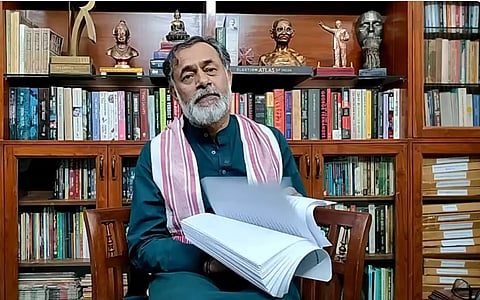

New Delhi- In a sharp and emotional critique that has quickly gained attention, political analyst and psephologist Yogendra Yadav has termed the Supreme Court’s recent verdict upholding the Special Integrated Revision (SIR) of electoral rolls as a potential turning point for Indian democracy, warning that it effectively allows the government to create “curated voter lists” and draws an alarming parallel to the infamous ADM Jabalpur case of the Emergency era.
Speaking in a detailed video analysis after reading the entire 124-page judgment related to the SIR process in Bihar, Yadav made it clear from the outset that while he was not surprised by the outcome, he was deeply distressed.
“This is a judgment that will be cited and debated not for two years or five years, but possibly for the next 50 years. It will decide the future of our democracy,” he said, explaining that the writing had been on the wall for months, especially after the Supreme Court allowed Bihar elections to proceed based on SIR data and later permitted the same exercise in 12 other states without any intervention.
Yadav argued that the fundamental principle of democracy that voters choose the government, not the other way around has been reversed by this verdict. According to him, the judgment gives the government, and specifically the BJP, a free hand to decide who gets to vote. “The government will now get the freedom to prepare voter lists according to its own wishes. A curated voter list,” he said, adding that the Election Commission has been granted near-absolute power.
He described the situation as one where the Commission can follow existing laws, create its own laws, or even sidestep all rules entirely, and the court has effectively declared that whatever the Election Commission says is correct. “It is like the old saying instead of ‘the king can do no wrong,’ now replace it with ‘whatever the Election Commission says is right,’” Yadav remarked.
Breaking down the legal reasoning of the judgment, Yadav pointed to a specific clause- Clause 21/3 of the Representation of the People Act, which was originally meant for exceptional situations in a single constituency or a small group of villages. The Election Commission argued that this thin lane could be used to drive an entire parade of elephants across the country, citing reasons such as urbanization and migration, which Yadav called unexceptional global phenomena. Yet, the Supreme Court accepted this as a valid “special reason,” thereby granting the Commission extraordinary powers far beyond what the law originally intended.
On the question of citizenship, Yadav highlighted what he sees as a legal contradiction. He noted that a three-judge bench of the Supreme Court had already ruled in the Lal Babu Hussain judgment that the Election Commission cannot decide citizenship. However, the current two-judge bench has effectively bypassed that ruling by stating that while the EC cannot decide if someone is a citizen, it can remove a person from the voter list on the ground of not being a citizen. “If you did not understand this, I do not blame you,” Yadav said. “This is the game of fine legal distinctions for which lawyers are paid lakhs of rupees.”
Yadav also expressed shock at the court’s dismissal of the scale of voter deletion. He pointed out that six crore names have already been removed from voter lists across the country, and another four crore are expected to be deleted, yet the Supreme Court stated in paragraph 95 that this does not appear to be widespread or systemic. “When will it be widespread? When 60 crore names are cut?” he asked in disbelief.
He noted that gender ratios have fallen in every state, with women’s names being disproportionately removed, but the judgment does not contain a single word on this issue. He also criticized the court’s claim that the voter lists now have completeness, accuracy, and integrity, pointing to evidence that the adult-to-elector ratio, which should be around 100, has dropped from 99 to below 90 due to SIR. He mentioned that the Election Commission itself had admitted to anomalies such as Tamil names appearing in Bihar’s voter lists and blank entries, yet the court still described the process as accurate.
In his strongest indictment, Yadav compared the current ADR versus Election Commission of India case to the ADM Jabalpur versus Union of India case of 1976, a dark chapter in Indian judicial history when the Supreme Court surrendered to the executive during the Emergency and ruled that citizens could not challenge state actions even if it involved killing. “Every law student in India reads that case and feels ashamed. Judges themselves admit it was the lowest moment for Indian judiciary,” Yadav said. He then drew a direct parallel: “In the ADM Jabalpur case, permission was given to take people’s lives. In the ADR case, permission has been given to take the soul of democracy.”
However, Yadav ended on a note of constitutional hope, recalling that the ADM Jabalpur verdict was eventually reviewed and corrected after 42 years, notably by Justice Y.V. Chandrachud’s son, the current Chief Justice of India. “History has its own judgment. Truth will win. I have faith in the Constitution and in the judiciary. It is every citizen’s right to interpret a court’s judgment, understand its consequences, and warn the country of its dangers,” he concluded.
You can also join our WhatsApp group to get premium and selected news of The Mooknayak on WhatsApp. Click here to join the WhatsApp group.
'The Mooknayak' practices democratic journalism. It is a media platform committed to the Constitution, democracy, and social justice. If you also want 'The Mooknayak' to always raise the voices of the marginalized and show the pain of the voiceless, please subscribe.
PLEASE SUBSCRIBE US