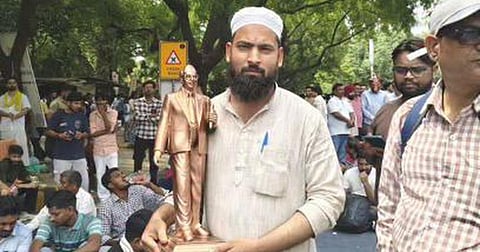
New Delhi- Claiming that his "only fault was feeding hungry students," Junaid Malik, a law graduate and social worker from Ghaziabad, Uttar Pradesh, has approached the Supreme Court seeking protection from what he describes as illegal police action against him and his family. Malik has filed an intervention application in Writ Petition (Criminal) No. 283 of 2026, pending before the Supreme Court, alleging that he was targeted solely because he volunteered to distribute food and water during the NEET-UG 2026 protest at Jantar Mantar in New Delhi. Live Law shared a copy of the petition by Malik.
According to the application, Malik volunteered at the protest site for around 35 days, beginning on June 20, helping coordinate and distribute food and drinking water to students and members of the public participating in the agitation. He states that he was never part of the protest leadership or its organisers, but his role in ensuring meals for protesters drew media attention, making him a recognisable face of the movement. He alleges that this visibility eventually led to police targeting him.
In his petition, Malik narrates that on the night of July 24, after suffering a dog bite, he visited Dr. Ram Manohar Lohia Hospital to receive an anti-rabies injection. Around midnight, while returning to Jantar Mantar in an auto-rickshaw with a friend, he claims their vehicle was intercepted by a white Scorpio without a number plate.
He alleges that four to five police personnel forcibly removed them from the auto, blindfolded them, ordered them to keep their heads down, confiscated their mobile phones, compelled them to unlock the devices, and searched through their contents before driving them for nearly 30 to 45 minutes to an undisclosed location.
Malik says he and his friend were kept overnight in what appeared to be an interrogation room and questioned by senior police officers the following morning.
According to the petition, the officers repeatedly asked who was funding the protest and where the money for food distribution came from. Malik alleges that he was verbally abused and threatened during the interrogation. Among the statements attributed to the officers are warnings that his release would become impossible if his blindfold was removed, that a video of him using the washroom would be leaked if he returned to the protest, that he could be booked under the National Security Act (NSA) in future, and that because he was from Uttar Pradesh, he could be "eliminated" if he continued his activities.
The petition further alleges that around 11:30 a.m. on July 25, officials told Malik and his friend they would be dropped home. Instead, they were allegedly driven for another five to six hours before being abandoned in a forested area about 16 kilometres from the Dehradun-Mussoorie Road.
Before leaving, the officers allegedly instructed them to face the mountains and not switch on their mobile phones for an hour after the devices were returned. The two men later managed to reach Dehradun and hired a cab back to Delhi.
Malik alleges that police action extended to his family members as well.
According to the application, on July 23, his father was picked up from their Ghaziabad residence and taken to Masuri Police Station, where he was questioned for nearly six hours regarding the family's bank accounts and Malik's whereabouts. The petition states that officers told his father that Malik was participating in protests alongside "anti-national elements."
The following day, Malik claims that a team of 10 to 12 police personnel raided his home, broke furniture, forcibly opened cupboards, searched the premises, and demanded identity documents and bank account details of all family members. The petition specifically identifies two police officials, Parmod Kumar and Tinku Tyagi, as members of the raiding team.
Malik further alleges that another police team visited the residence of his married sister in Meerut, detained her father-in-law and brother-in-law for questioning, and released them only after lawyers intervened. The petition claims the family was repeatedly pressured to persuade Malik to leave the protest and disclose the source of funds used for food distribution.
The intervention application argues that neither Malik nor his family members were provided arrest memos, detention records, General Diary entries, or any official documentation during the alleged police action. It contends that these actions violated their fundamental rights under Article 21 of the Constitution.
To support these arguments, the application relies on several landmark Supreme Court judgments, including Maneka Gandhi v. Union of India, D.K. Basu v. State of West Bengal, Anita Thakur v. Government of Jammu & Kashmir, In Re: Ramlila Maidan Incident, and Mazdoor Kisan Shakti Sangathan v. Union of India, arguing that peaceful protest and dissent are constitutionally protected and that police powers must be exercised within legal limits.
Malik has requested the Supreme Court to permit him to intervene in the pending writ petition, restrain any coercive action against him and his family in connection with the Jantar Mantar student protests, and order an inquiry into his alleged illegal detention, the threats to his family, and the conduct of the police officials involved.
You can also join our WhatsApp group to get premium and selected news of The Mooknayak on WhatsApp. Click here to join the WhatsApp group.
'The Mooknayak' practices democratic journalism. It is a media platform committed to the Constitution, democracy, and social justice. If you also want 'The Mooknayak' to always raise the voices of the marginalized and show the pain of the voiceless, please support us.
Please Contribute