
New Delhi- As thousands of young protesters continue their sit-in at Delhi's Jantar Mantar, an unexpected form of solidarity has emerged from across the country. People who cannot physically join the demonstrations are using food delivery platforms such as Zomato and Swiggy to send meals directly to the protest site, transforming delivery apps into an instrument of civic support.
Videos circulating on social media over the past few days show delivery executives arriving at Jantar Mantar with multiple food packets ordered by strangers from cities hundreds and sometimes over a thousand kilometres away. Many of the delivery notes reportedly carry a simple instruction: "Please give this meal to whoever is hungry at Jantar Mantar." The gesture has drawn widespread attention online.
One of the most widely shared videos features a Zomato delivery partner explaining that the order had been placed by one Anuj Rawat, a resident of Mumbai, who requested that the food be distributed among hungry protesters in Delhi. The clip quickly spread across X, Instagram and Facebook, inspiring many others to place similar orders.
Media reports indicate that since the video went viral, meals, snacks and beverages have continued to arrive throughout the day, funded by people from different parts of India who wanted to express solidarity despite being unable to attend the protest in person.
The trend rapidly gained momentum on social media, where users shared videos of food deliveries reaching protesters amid rain and long hours of demonstrations. Several posts encouraged supporters to "send food if you cannot be there." These posts have collectively attracted thousands of views and comments, with many users describing the initiative as an example of "digital solidarity."
The phenomenon illustrates how digital platforms are increasingly being used not only for communication but also for direct civic participation. While previous mass movements in India including the 2020–21 farmers' protests were sustained through community kitchens, volunteer-run langars and donations on the ground, this protest has seen individuals use commercial food delivery platforms to remotely support demonstrators in real time.
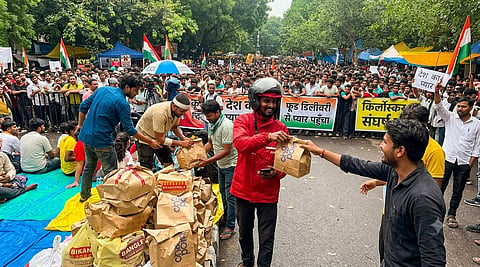
Unlike organised relief efforts, many of these food deliveries appear to be spontaneous acts by individual citizens who simply wish to ensure that protesters have something to eat.
For many protesters, the deliveries have become symbolic of national support. Volunteers at the site have thanked anonymous donors and delivery personnel in videos shared online, saying the gestures boosted morale during long hours of protest.
The story has resonated because it demonstrates how ordinary citizens, armed with nothing more than a smartphone and a food delivery app, can participate in public movements from hundreds of kilometres away.
As India's youth protests continue to evolve, the use of delivery apps to provide food has become one of the most visible examples of how technology is reshaping civic engagement, allowing solidarity to travel across state borders with just a few taps on a mobile phone.
You can also join our WhatsApp group to get premium and selected news of The Mooknayak on WhatsApp. Click here to join the WhatsApp group.
'The Mooknayak' practices democratic journalism. It is a media platform committed to the Constitution, democracy, and social justice. If you also want 'The Mooknayak' to always raise the voices of the marginalized and show the pain of the voiceless, please support us.
Please Contribute