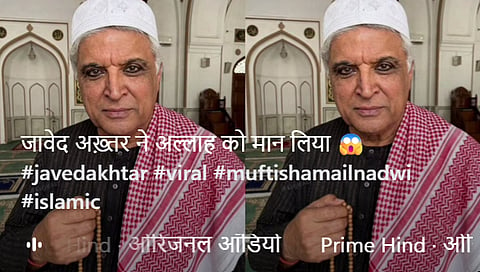
New Delhi- Renowned poet, lyricist, and screenwriter Javed Akhtar has publicly condemned a circulating deepfake video that manipulates his image to falsely portray him wearing a topi (Muslim prayer cap) while claiming he has "ultimately turned to God." In a strongly worded post on X (formerly Twitter) on Thursday, Akhtar dismissed the content as "rubbish" and announced his intent to file a complaint with the cyber police, vowing to pursue legal action against the creators and those who shared it for tarnishing his reputation and credibility.
The 81-year-old Padma Shri awardee, known for his outspoken atheism and progressive views, shared the alert on his official X handle @Javedakhtarjadu, which has over 4.3 million followers. The post, which garnered more than 4,200 likes and 300,000 views within hours, reads: "A fake video is in circulation showing my fake computer generated picture with a topi on my head claiming that ultimately I have turned to God. It is rubbish. I am seriously considering to report this to the cyber police and ultimately dragged the person responsible for this fake news and those few who forward it to the court for damaging my reputation and credibility."
This incident adds to growing concerns over the misuse of AI-generated deepfakes in India, where such content has increasingly targeted public figures to spread misinformation or mock personal beliefs.
Around 90 per cent of Indians are exposed to fake or artificial intelligence (AI)-generated celebrity endorsements in India, with victims losing an average of ₹34,500, according to a report by security services firm McAfee.
The video's emergence coincides with Akhtar's history of fielding threats and backlash due to his candid commentary on religion and society. As an avowed atheist, he has often critiqued organized faith, drawing ire from conservative groups across communities. Just last June, Mumbai Police provided him security following intelligence reports of threats from right-wing Muslim factions, a detail he referenced in past X exchanges.
This comes at a time when several actors and celebrities have opted for legal protection against deepfakes and AI-generated content or unauthorised use of their identities on social media platforms. Actors like Akshay Kumar, Aishwarya Rai Bachchan, Abhishek Bachchan, Amitabh Bachchan, Hrithik Roshan, Karan Johar, Asha Bhosle, Ajay Devgn, Salman Khan and prominent personalities like Shri Shri ravi Shankar, ex cricketer Sunil Gavaskar have already secured court protection in the last few months in this matter, as per media reports.
Legal experts note that under India's Information Technology Act, 2000 (as amended), creating and disseminating deepfakes that harm reputation can attract penalties including imprisonment up to three years and fines. Akhtar's move could set a precedent for celebrities combating online defamation.
Akhtar's remarks thrust him into the spotlight amid ongoing debates on religious attire and women's rights in India. In late December 2025, during a literary festival in Bihar, he sparked controversy by questioning the cultural logic behind the burqa and hijab, describing it as a form of "peer pressure" and "brainwashing." Responding to a student's query about his upbringing by women who did not veil, Akhtar asked, "Why should you be ashamed of your face? What is vulgar about a woman's face?" His comments drew sharp criticism from conservative voices who accused him of insensitivity toward Islamic traditions, while supporters hailed them as a call for gender equality.
The row escalated when Akhtar slammed Bihar Chief Minister Nitish Kumar for an incident where a doctor’s hijab was allegedly pulled during a public event, calling it a violation of personal dignity. A viral video from November 29, 2025, was later fact-checked as misleading, falsely portraying Akhtar as supporting Kumar's actions, when in reality, he condemned them.
Javed clarified his stand in a post where he wrote, " Every one who knows me even in the most cursory manner knows how much I am against the traditional concept of Parda but it doesn’t mean that by any stretch of imagination I can accept what Mr Nitish Kumar has done to a Muslim lady doctor. I condemn it in very strong words . Mr Nitish Kumar owes an unconditional apology to the lady .".
This episode reignited national discussions on the 2022 Karnataka hijab ban, highlighting tensions between religious freedom, secularism, and women's autonomy. Akhtar's intervention, as in past controversies, positioned him as a polarizing yet influential voice, with detractors labeling him "anti-Islam" and admirers praising his fearless advocacy for rationalism.
You can also join our WhatsApp group to get premium and selected news of The Mooknayak on WhatsApp. Click here to join the WhatsApp group.