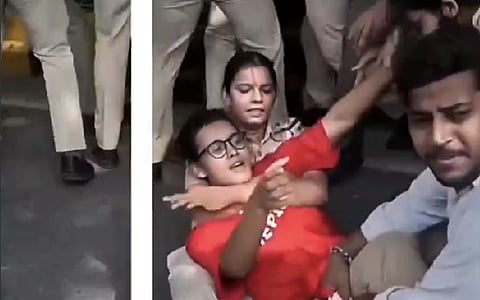
New Delhi- Three key detainees Dipke, Saurav and Ranka were not released late last night even as all other protesters detained during Saturday’s demonstrations against Chief Election Commissioner Gyanesh Kumar were set free. They will be produced before the Executive Magistrate at Delhi Cantt Police Station at 9 AM today, CJP Legal Head Ratna Singh confirmed early Sunday morning.
“A Delhi police official informed me about this in the morning. As CJP’s Legal Head, I will be at the police station along with other advocates representing us,” Singh said. Abhijeet, Ashutosh and Saurav are among those scheduled to appear.
The three leaders were detained by the Delhi Police directly from an Air India flight (AI 2428) immediately after landing at Delhi's Indira Gandhi International Airport on Saturday. Delhi Police personnel boarded the aircraft from Mumbai minutes after it reached the gate, taking the trio into custody before they could deboard. High drama unfolded inside the plane, where Dipke livestreamed the interaction, challenging the police and questioning the legal grounds for their detention. Later they were taken to some unknown location.
The overnight developments follow a day of intense clashes, mass detentions and heavy restrictions across the national capital as civil society groups, student organisations and opposition figures protested alleged irregularities in the electoral rolls and demanded the resignation of the Chief Election Commissioner.
Police detained three former Chief Ministers, Pinarayi Vijayan, Mamata Banerjee, Arvind Kejriwal who joined the youth groups’ protests in Delhi on Saturday in a show of solidarity. Senior leaders like party general secretary M A Baby, Vrinda Karat, MP John Brittas, Yogendra Yadav, Student leaders Neha Bora and several others were detained by the police from different locations as the police struggled to stop them from reaching Jantar Mantar.
Advocate Aman Prasad has filed a contempt petition in the Supreme Court against Delhi Police Commissioner Anurag Kumar, IPS. The petition alleges that Delhi Police personnel resorted to indiscriminate violence against unarmed citizens during the October 10 protests, in clear violation of principles laid down by the Court.
The petition states that police detained and assaulted several protesters, manhandled women, and operated without visible name tags or identifiers. It specifically cites violations of the Supreme Court’s earlier orders in Shailendra Mani Tripathi v. Union of India (which examined police excesses during the July student protests) and the October 9 order in M.A. Baby v. Union of India concerning restrictions on public transport during protests.
According to the petition, protesters near Jantar Mantar, INA and Dilli Haat faced physical violence. One protester was allegedly lifted, thrown to the ground and beaten near INA. Senior Advocate Shadan Farasat was dragged along the road by police personnel near the Safdarjung Airport flyover. A young advocate who intervened when police were allegedly pulling at a woman’s trousers near INA was beaten, sustained head injuries, detained and later taken to a hospital in Chhatarpur Enclave.
The petition further alleges that women protesters were manhandled by male officers. Videos purportedly show a woman being dragged by her hair inside a detention bus and a woman journalist being dragged across the road towards a bus. Journalist Ayush Tiwari of Scroll was detained outside HKS Surjeet Bhawan despite displaying his press pass.
Police personnel were allegedly deployed without visible name tags, an issue the Supreme Court has previously flagged. Restrictions included the closure of 45 out of 57 metro stations, road blockades, movement curbs and a shutdown of mobile internet in parts of Central Delhi. The petitioner contends these measures violated the Court’s October 9 observation that restrictions on public transport must be proportionate and that essential services cannot face blanket prohibition.
The petition relies on the Court’s July 28 and August 18 orders in the Shailendra Mani Tripathi matter, in which a High-Powered Enquiry Committee was constituted to examine alleged police excesses, treatment of women protesters, use of force and accountability in the chain of command. It seeks initiation of contempt proceedings against the Delhi Police Commissioner for wilful disobedience of earlier orders and further directions.
The matter is likely to be mentioned today before the bench of Justice Joymalya Bagchi and Justice V. Mohana, which is holding a Sunday sitting to hear another similar contempt petition as well as Senior Advocate Menaka Guruswamy’s petition against detentions of political leaders in Delhi on Saturday.
Protests against alleged deletion and manipulation of nearly 13 crore votes and demands for the CEC’s resignation spilled onto the streets of Delhi. Demonstrations were reported near Jantar Mantar, INA, Dilli Haat and other locations. Police responded with large-scale detentions, physical force and sweeping movement restrictions.
Speakers at subsequent briefings described the capital as having been turned into “a cantonment or fortress.” Over 15,000 individuals including students, civil society members and political figures such as former chief ministers were allegedly subjected to illegal detentions and clampdowns. Transportation networks were severely disrupted: trains, buses and flights were cancelled or restricted, metros shut down, and heavy jammers deployed.
The Cockroach Janta Party (CJP) has declared that civil disobedience and street protests will continue across the country until Chief Election Commissioner Gyanesh Kumar resigns and accountability is established over the alleged electoral roll irregularities.
Ajinkya Shinde, National Organisation In-charge of CJP, condemned the state response: “Undeclared Emergency. Speakers strongly condemned the heavy-handed state response, accusing the government of turning Delhi into a cantonment or fortress. Mass Detentions: Over 15,000+ individuals (including students, civil society members, and political figures like former Chief Ministers) have faced illegal detentions and police clampdowns. Sabotage of Movement: The administration was criticized for blockading transportation networks (canceling trains, buses, and flights, shutting down metros, and deploying heavy jammers) to suppress peaceful assembly.”
Anish Gawande, national spokesperson of the Nationalist Congress Party, rejected attempts to create divisions: “The protests that have taken place against Chief Election Commissioner Gyanesh Kumar have always featured unity between civil society actors and the opposition. Today you witness two former chief ministers, three former chief ministers actually being detained across the country. You witness MPs like John being detained and joining protests that the Congress Party had called for. Several members of the Congress Party have been actively involved in other protests called for by the opposition, including protests called for by the Shiv Sena, the MNS and the NCPSP in Maharashtra, including those called for by the Congress Party in New Delhi. A false attempt is being created wherein divides between the opposition and civil society actors demanding for accountability are being manufactured by a government that is scared of young people across party lines beyond politics coming together. I don’t think that false divide exists today. I don’t think that false divide will exist tomorrow.”
Srijan Bhattacharya of the Students’ Federation of India (SFI) stated: “We are working with broadest possible unity against dictatorship.” He strongly condemned the administration’s actions in turning New Delhi into a fortified zone by blocking access to public assembly grounds at Jantar Mantar, closing metro stations, suspending train services, deploying signal jammers, and executing pre-emptive detentions at transit hubs.
Party representatives said the extreme measures demonstrated fear on the part of the government and an unwillingness to address core concerns regarding electoral integrity. Organisers reaffirmed that the movement will not halt its campaign for electoral transparency and that peaceful mobilisations will persist across multiple states until constitutional rights are safeguarded.
The press conference concluded with a clear message: “Civil disobedience and street protests will continue relentlessly until jails are filled and the government is held accountable. Democracy is not for sale.”
UN Human Rights Spokesman Thameen Al- Kheetan expressed concerns on reports of mass detentions in India of demonstrators, protest leaders, members of civil society organisations, lawyers and journalists, on the large-scale demonstrations in Delhi.
In a statement he stated, "We call on the authorities to ensure that the right to peaceful assembly is fully respected and fulfilled. Restrictions on peaceful protests must meet strict tests of necessity and proportionality.
The Indian authorities should also ensure law enforcement forces exercise utmost restraint in response to peaceful protesters, consistent with the country’s democratic traditions and human rights obligations. All those arbitrarily detained must be immediately and unconditionally released.
We also urge the authorities to engage in meaningful dialogue to address the broadly held concerns expressed."
You can also join our WhatsApp group to get premium and selected news of The Mooknayak on WhatsApp. Click here to join the WhatsApp group.
'The Mooknayak' practices democratic journalism. It is a media platform committed to the Constitution, democracy, and social justice. If you also want 'The Mooknayak' to always raise the voices of the marginalized and show the pain of the voiceless, please subscribe.
PLEASE SUBSCRIBE US