Education
"We Never Got Anything Without Protesting": AIISCA Janata Adalat Puts Institutional Casteism on Public Trial
Parents of Sahil Wakode, Payal Tadvi and Raghavi Testify at Nagpur Janata Adalat, Call for Rohit Act.

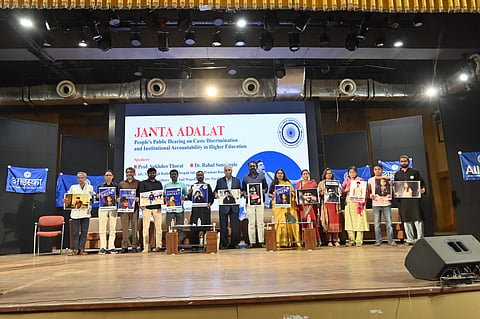

Nagpur- The All India Independent Scheduled Caste Association (AIISCA) organised a Janata Adalat - Against Institutional Casteism and Murders on 22 November in Nagpur, bringing together families of students who lost their lives, academics, Ambedkarite activists, legal experts and students to highlight institutional caste discrimination in educational institutions and demand accountability and justice.
The Janata Adalat heard testimonies from families who have been fighting for justice following the deaths of their children, including Sahil Wakode, Dr Payal Tadvi, S Anitha, Raghavi, alongside discussions on the failure of educational institutions to address caste-based harassment, the lack of effective grievance redressal mechanisms and the urgent need for stringent legal safeguards.
Speaking at the gathering, Prof. Sukhdeo Thorat highlighted the structural nature of caste discrimination in educational institutions, pointing to segregation, prejudice and the hostility faced by students from marginalised communities. Emphasising that legislation alone cannot bring about social transformation, he stated, “Law can only punish an individual, not society.” He further stressed, “Till social values aren’t in line with parliamentary values, the conflict will always be there.” He underlined the importance of education and transforming social consciousness alongside legal intervention.
Dr. Rahul Sonpimple, Founder of AIISCA questioned the continued silence and lack of accountability surrounding institutional deaths and the treatment of students from marginalised communities. Drawing attention to the fact that students' struggles often come to light only after their deaths, he said, “We come to know of students only when we lose them, not when they dropout.” Calling for sustained collective resistance, he added, “We never got anything without protesting.” He also stressed that the State must take urgent responsibility for investigating cases involving caste-based discrimination and institutional harassment.
The families' testimonies brought the human cost of institutional discrimination to the forefront. Sahil Wakode's father recounted his son's academic achievements, his aspiration to study at IIT Bombay and the casteist remarks and threats he allegedly faced during his time at the institution. Recalling how the family had initially encouraged Sahil to endure the situation, he said, “My student wasn’t one who could commit suicide. He was a sportsperson.” Addressing students at the gathering, he urged them to speak up against discrimination and said, “I implore that you shouldn’t cry, but fight.”
Sahil's mother spoke about the devastating loss of her son and the need for legal safeguards to prevent similar tragedies. She said, “If a law was in place when we lost Payal, Rohit, Ragini, Sahil could’ve been alive with us today.”
Abida Parvin, mother of Dr Payal Tadvi, recounted the discrimination her daughter allegedly faced from the very beginning of her medical career at Nair Hospital. Speaking about her daughter's dream of becoming a doctor and serving marginalised communities, she described the loss as one that continues to shape the family's fight for justice. She said, “I am not cured and not scared of cancer anymore. We want to fight for her along with all parents for Rohit Act.” She reiterated that the family has been fighting for justice for seven and a half years.
The father of Raghavi spoke about his daughter's prolonged struggle and the harassment and humiliation she allegedly faced over her appearance, clothing and lifestyle. Sharing how the past four years had affected his family's faith in the justice process, he said, “I don’t trust anybody. In all these 4 years, I lost trust. He is trusting us and asking us to fight, we are asking for help.” Expressing his determination to continue seeking justice, he stated, “I have no money, but I need justice.”
The Janata Adalat concluded with calls for a dedicated legal framework to address institutional caste discrimination, effective implementation of anti-discrimination regulations, independent grievance redressal mechanisms, institutional accountability and accessible support systems for students. The gathering reiterated that students from marginalised communities must be able to pursue education with dignity and equality, and that the fight for justice must extend beyond individual cases to address the structural roots of caste discrimination.
The All-India Independent Scheduled Castes Association (AIISCA) is an autonomous Dalit movement organisation founded on July 16, 2023. It works towards building grassroots and national-level leadership, challenging caste-based discrimination and advancing the dignity, rights and representation of Dalit communities. Its work includes grassroots mobilisation, advocacy, political engagement and solidarity-building. The organisation also runs initiatives such as the Savitribai Phule Resource Centre, which supports marginalised communities through education, resources and mentorship.
You can also join our WhatsApp group to get premium and selected news of The Mooknayak on WhatsApp. Click here to join the WhatsApp group.
'The Mooknayak' practices democratic journalism. It is a media platform committed to the Constitution, democracy, and social justice. If you also want 'The Mooknayak' to always raise the voices of the marginalized and show the pain of the voiceless, please subscribe.
PLEASE SUBSCRIBE US