— ✍️ Dr. Krishan Kumar
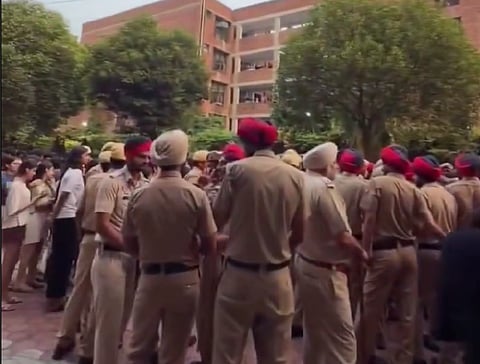
Punjab has witnessed an extraordinary episode of students’ protest and unrest at Lovely Professional University (LPU) in Phagwara on September 26, 2026. What began with the circulation of unverified information on social media about the alleged rape of a female student quickly escalated into a large-scale protest, vandalism, arson and the blocking of the Jalandhar–Phagwara National Highway. Students reportedly received messages claiming that a female student had been sexually assaulted by a university worker, that the university had failed to take action against the alleged accused and had attempted to suppress the incident, and that the victim had subsequently faced harassment and died by suicide. These claims, however, remain subject to investigation and should not be treated as established facts.
Therefore, the episode raises questions that go beyond the immediate conclusion. It invites a revisit of the changing character of the relationship between students and private universities in India, and the question of what happens when a generation of students encounters an institution primarily through the language of fees, infrastructure, rankings and employability.
Student protest is not new to Indian higher education. Universities such as Jawaharlal Nehru University, Delhi University and the University of Hyderabad have historically been important sites of protest and agitation. However, such protests have generally been associated with concrete demands and documented concerns, including affordable and quality food, cheaper hostel facilities, campus security and social justice. More recently, student protests have also emerged at institutions such as IIT Bombay following the suicide of a student, Sahil, amid allegations that he had faced caste-based discrimination. Such protests have often generated debates over whether students are genuinely responding to institutional or political issues or whether they are being influenced by external political organisations.
Private universities, however, have generally occupied a different position on the question of students’ protests. Over the past decade, the expansion of private higher education has produced campuses that often emphasise infrastructure, internationalisation, professional courses, placements and employment-oriented education, rather than socio-economic and political issues.
The LPU episode creates an important sociological question: what happens when students act collectively before institutional information becomes available?
The question is not simply whether the information circulating among students was true or false. It is also about why an unverified claim was capable of producing such a rapid collective response. In a university with thousands of students, why did social-media information acquire greater mobilising power than the formal communication channels of the institution? If students can be mobilised and misguided within hours by information that has not been independently verified, the problem cannot simply be described as a failure of the students. It also raises questions about trust, institutional communication and the credibility of authority and pedagogy of teaching. A university may tell students to rely on official information, but that instruction is meaningful only when students regard the institution as a credible source of information, when students have a feeling of belongingness regarding the institute, management and teachers. In other words, misinformation does not operate in a social vacuum. It becomes more destructive when there is already uncertainty, exploitation or distrust.
There is another uncomfortable question for private higher education. For years, private universities have often presented themselves as alternatives to the politically charged campuses of public universities. Their emphasis has been on discipline, professional education, placements, infrastructure and a relatively controlled campus environment. But the LPU protest demonstrates that the absence of agitations does not necessarily mean that all students are happy with the system; indeed, their consciousness may emerge suddenly when students perceive a threat to their dignity, security or institutional trust. However, in the case of LPU, damage to university property, arson, attacks on vehicles and disruption of a national highway represent a fundamentally different stage of mobilisation. The distinction between legitimate protest and violence therefore needs to remain clear. Students have the right to seek information, demand accountability and protest against an institution. But those rights do not extend to destroying property or endangering others.
Yet the violence itself requires sociological explanation. Why would students damage the physical infrastructure of the institution in which they study? One possible explanation lies in the changing relationship between students and private universities. When education is experienced primarily as a commercial transaction — fees paid in exchange for degrees, facilities and employment opportunities — the emotional relationship between students and the institution can become different from the relationship traditionally associated with a public university. Another possible explanation may be that when a university is perceived primarily as the property of an individual or a family, students and others may not develop the same sense of responsibility and attachment towards it as they might towards a public university. This does not mean that students at private universities have no sense of belonging. Nor does it establish that private universities are driven only by profit. Rather, it raises a broader question about what kind of relationship should be developed among students, society and private universities. A university is not merely a campus, a collection of buildings or a service provider. It is also an intellectual and social community. Its legitimacy ultimately depends not only on infrastructure and rankings but also on whether students believe that the university listens to them, communicates with them and treats them with dignity.
The LPU episode therefore should not be reduced either to a story of “misguided students” or to a story of an “uncaring private university”. Both explanations risk oversimplifying a complicated event that is still under investigation. There is also a political dimension that requires caution. Allegations have emerged that the unrest was connected to Punjab’s political contestation surrounding LPU Chancellor Dr. Ashok Mittal, who entered the Rajya Sabha with the Aam Aadmi Party and later moved to the BJP. Such claims have been made publicly by political figures, but they remain allegations and require evidence. The appropriate response, therefore, is investigation rather than speculation.
The LPU unrest may ultimately prove to have been triggered by misinformation, genuine student fears, institutional mistrust, political mobilisation, or some combination of these factors. The SIT investigation will be important in establishing what actually happened.
But irrespective of the final findings, the episode has already raised a larger question for India’s rapidly expanding private higher-education sector: Can a university maintain institutional legitimacy through infrastructure, rankings and employment prospects alone?
Perhaps the more difficult task is to create an educational environment in which students develop not only employable skills but also the capacity to distinguish evidence from rumour, question authority without resorting to violence, and participate in collective action without destroying the very institution in which they study.
That is ultimately a question of pedagogy as much as governance. A university that produces graduates who can secure high-paying jobs but cannot distinguish verified information from misinformation has an educational problem. Equally, a university that expects students to trust its authority without providing transparent and credible communication has a problem of institutional legitimacy.
The LPU episode, therefore, should be read neither simply as a story of unruly students nor merely as a confrontation between students and management. It is a moment that exposes a deeper tension within India’s private higher-education model: when education becomes increasingly institutionalised as a market, what happens to the idea of the university as a community? Another important issue is the limited attention that private higher-education institutions have given to the inclusion of marginalised sections of society. And perhaps that is the question that deserves more attention than the immediate politics of the protest. This question assumes greater significance in light of the Supreme Court's long-standing position that education cannot be reduced to profiteering or commercialisation. The Supreme Court has repeatedly held that educational institutions may generate a reasonable surplus for development, but the predominant purpose must remain education rather than profit.
- Dr. Krishan Kumar is a political sociologist and the author of Reading Caste in India: Prejudice, Discrimination and Exclusion.
You can also join our WhatsApp group to get premium and selected news of The Mooknayak on WhatsApp. Click here to join the WhatsApp group.
'The Mooknayak' practices democratic journalism. It is a media platform committed to the Constitution, democracy, and social justice. If you also want 'The Mooknayak' to always raise the voices of the marginalized and show the pain of the voiceless, please subscribe.
PLEASE SUBSCRIBE US