Discussion
The Violence of Honour: Caste, Patriarchy and Constitutional Morality
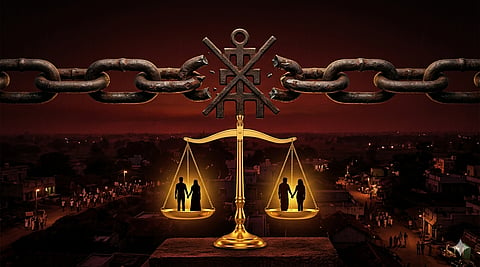
Honour-based violence, is not merely an act of personal revenge; it is a social practice designed to enforce conformity and preserve existing hierarchies.


— ✍️Sandeep Kumar Kushwaha
Honour as a System of Social Control Honour is often understood as personal dignity, but in caste-based patriarchal societies it is primarily a collective value. A person's actions are seen as reflecting not only on themselves but also on their family, caste, and community. Consequently, honour becomes a powerful mechanism of social control, defining what is acceptable, who can marry whom, and where individual freedom ends. Because honour belongs to the collective, personal choices are rarely treated as private. Love, marriage, and sexuality are judged according to social expectations rather than individual preference.
When someone enters an inter-caste or socially disapproved relationship, it is viewed not simply as a personal decision but as a challenge to the family's reputation and the community's established order. The response may take many forms—threats, social boycott, forced marriage, forced abortion, confinement, emotional abuse, physical assault, or even murder. Honour-based violence, therefore, is not merely an act of personal revenge; it is a social practice designed to enforce conformity and preserve existing hierarchies.
The roots of this violence lie in the close relationship between caste, marriage, property, and patriarchy. Marriage is not merely a union between two individuals; it is the institution through which caste identity, family status, property, and social privilege are reproduced across generations. Dr. B.R. Ambedkar, in Annihilation of Caste, argued that endogamy, the practice of marrying within one's own caste, is the foundation of the caste system. Once people begin marrying across caste boundaries, the rigid divisions that sustain caste hierarchy gradually weaken. This is why inter-caste relationships are often treated as threats to the social order rather than as matters of individual choice. Patriarchy reinforces this system by placing women at its centre. Since property and family lineage traditionally pass through male heirs, controlling women's sexuality and reproductive choices becomes essential for preserving inheritance and caste identity. The logic is simple: property depends on inheritance; inheritance depends on recognised lineage; recognised lineage requires control over women's reproductive autonomy; and that control ultimately protects caste endogamy. This burden falls most heavily on women from socially privileged groups. When they choose partners from lower castes, they challenge both caste hierarchy and the unequal distribution of social status and property. As a result, dominant communities defend rigid notions of purity and pollution while portraying inter-caste love as a threat to society itself. Women's bodies thus become the symbolic sites where caste prestige and patriarchal authority are protected.
Caste is sustained not only through economic inequality but also through ideas of purity and pollution. Some communities are considered pure, respectable, and superior, while others are labelled impure and inferior. Such beliefs transform inequality into a moral order and deny dignity to those placed at the bottom of the social hierarchy. Literature vividly illustrates this process of dehumanisation. In Franz Kafka's The Metamorphosis, Gregor Samsa is gradually abandoned by his family after losing his social usefulness. His real suffering begins long before his death through isolation and rejection. Similarly, Jainendra Kumar's Tyagpatra portrays Mrinal, whose personal choices are condemned because they threaten patriarchal honour. She is punished through humiliation and exclusion rather than recognised as an individual with her own agency. Both works demonstrate that honour-based violence begins with social death. Before victims are physically attacked, they are first denied acceptance, affection, dignity, and belonging. Physical violence often becomes the final stage of a much longer process of social exclusion.
Honour-based violence remains one of India's least visible forms of violence because most cases are never officially recognised as honour crimes. Families frequently conceal such incidents, while police often register them under general offences such as murder, kidnapping, suicide, or accidental death. Official statistics therefore reveal only a fraction of the actual problem. Its hidden nature also appears in the control exercised over women's reproductive choices. According to the Guttmacher Institute, nearly 77% of unintended pregnancies in India end in abortion. Government data further shows that medically terminated pregnancies reported by public health facilities increased from 5.34 lakh in 2020–21 to 8.93 lakh in 2024–25, an increase of about 67%. While many abortions are undertaken for legitimate medical or personal reasons, researchers have also documented cases in which women are pressured to terminate pregnancies because of son preference, caste stigma, or the need to conceal relationships considered socially unacceptable. These instances reveal that honour-based control extends beyond physical violence to the regulation of women's reproductive autonomy.
Marriage patterns reinforce the same reality. Although arranged marriage is not inherently oppressive, studies estimate that only about 5–10% of marriages in India are inter-caste, while nearly 90–95% continue to take place within caste and community boundaries. These figures reflect the continuing social pressure to preserve caste endogamy and discourage individual choice. The consequences can be deadly. In March 2025, twenty-three-year-old Neha Rathore from Greater Noida was allegedly strangled by her father and brother just one day after marrying a man from another caste in an Arya Samaj temple. In another case from Nanded, Maharashtra, twenty-three-year-old Saksham Tate, a young man from a Scheduled Caste community, was allegedly murdered by the family of his girlfriend because they opposed their inter-caste relationship. These cases show that honour-based violence is neither confined to any religion nor limited to any particular caste or region. It is a structural consequence of a social order that places family reputation above individual freedom, equality, and human dignity.
The Indian Constitution offers a fundamentally different vision of society. It rejects inherited hierarchies and places liberty, equality, dignity, and individual autonomy at the centre of public life. Constitutional morality requires that the rights of individuals take precedence over customs rooted in caste supremacy or patriarchal control. No tradition can justify murder, forced marriage, social exclusion, or the denial of personal choice. The struggle against honour-based violence, therefore, is not only about punishing offenders but about transforming the values that sustain such violence. True honour lies not in preserving caste boundaries or controlling women's lives but in respecting every person's freedom, dignity, and equal citizenship.
- The author is a Research Scholar at the Central University of South Bihar.
You can also join our WhatsApp group to get premium and selected news of The Mooknayak on WhatsApp. Click here to join the WhatsApp group.
'The Mooknayak' practices democratic journalism. It is a media platform committed to the Constitution, democracy, and social justice. If you also want 'The Mooknayak' to always raise the voices of the marginalized and show the pain of the voiceless, please subscribe.
PLEASE SUBSCRIBE US