Discussion
Is Criticising the Government Sedition?
Criticising a government policy, by itself, is lawful political speech. Calling it “anti-national” tells us how someone feels about the criticism.

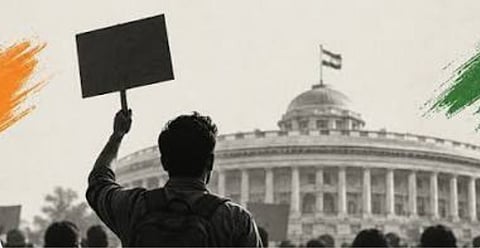

— ✍️Samridhi Kumari
Think back to the last time you talked politics at a chai stall, over a family dinner or in a group chat that went on far too long. Someone says the government got a policy wrong. The discussion gets heated. Then someone cuts in. "You can't say that. It's anti-national." Most of us would laugh it off. As a first-year law student, I found myself wondering whether there was any legal basis for the accusation. Could saying that the government got something wrong really be a crime? Of course, some speech does cross legal lines, but the mere accusation of being "anti-national" is not a legal test.
The right to disagree
Article 19(1)(a) of the Constitution guarantees Indian citizens the right to freedom of speech and expression. That freedom gives us room to question a minister's decision, write against a policy or campaign peacefully for Parliament to change a law. Article 19(2) permits reasonable restrictions on specified grounds, including public order, the security of the State and India's sovereignty and integrity. Someone's anger at a political opinion does not by itself make that opinion a criminal offence. Nobody has to agree with every decision a government takes. Someone who says they disagree with the government's economic policy and wants Parliament to change it is simply expressing political disagreement.
How the Supreme Court reads the old sedition law
For much of independent India's history, sedition was an offence under Section 124A of the Indian Penal Code (IPC). The provision used broad language about stirring up hatred, contempt or disaffection towards the government established by law. In Kedar Nath Singh v. State of Bihar (1962), the Supreme Court upheld the provision but limited its reach to conduct involving incitement to violence or an intention or tendency to cause public disorder. Even strongly worded criticism of government action could fall within the protection of free speech.
In Balwant Singh v. State of Punjab (1995), the Court showed why context matters. Two men raised separatist slogans a few times on the day Prime Minister Indira Gandhi was assassinated. The Court considered the circumstances, including the absence of any public response or disturbance, and held that the facts did not establish sedition. The judgment looked at what the men said, how they said it and what happened around them. In May 2022, the Supreme Court issued an interim order in S.G. Vombatkere v. Union of India, asking governments to refrain from invoking Section 124A and putting pending proceedings on sedition charges in abeyance. In May 2026, according to news reports, the Court clarified that pending cases involving the old charge could proceed if the accused had no objection. The interim order otherwise remains in force unless modified.
From the perspective of a law student, the most compelling aspect of the decision is the Court's methodology. Rather than invalidating the statute outright, it adopted a narrow construction. This illustrates how the judiciary can interpret penal provisions to safeguard free expression, underscoring the critical weight of precise language and surrounding context, where the exact same statement might serve as a light grievance in one setting yet act as a stirring spark in another.
The term 'sedition' is gone. Section 152 now covers acts endangering India's sovereignty, unity and integrity, and it isn't just a copy-paste of the old Section 124A. It targets those who purposely or knowingly use words, digital communication or other methods to incite secession, armed rebellion or subversive acts, foster separatist feelings or threaten the nation's integrity.
I keep coming back to those two words, 'purposely or knowingly.' Criminal law looks at both the act itself and the intent behind it. That means you can't test a statement under Section 152 just by asking if it offended someone. Being offended isn't a requirement of the offense, and understanding that clears up a whole lot of dinner-table arguments.
What Section 152 says
The Bharatiya Nyaya Sanhita, 2023 (BNS), replaced the IPC on 1 July 2024. Section 152 uses different language from the old sedition provision. It applies to conduct that, among other things, purposely or knowingly stirs up or attempts to stir up secession, armed rebellion or subversive activities, encourages separatist activity or endangers India's sovereignty, unity or integrity. It can apply to spoken or written words as well as electronic communications. Kedar Nath Singh interpreted Section 124A, so it is not obvious that its test can simply be carried over to the differently worded Section 152; courts will need to consider whether and how far that test applies.
Two words in the new provision deserve particular attention. The act must be done "purposely or knowingly." The section also expressly protects comments that disapprove of government measures or actions and that seek to change those measures through lawful means, provided the comments do not stir up or attempt to stir up the activities covered by the provision. Saying, "This policy is unfair and we should campaign peacefully to change it," is an example of the criticism the explanation protects. A call for armed rebellion, by contrast, would plainly fall within the express terms of the law. In a real case, the words, the context and the evidence of purpose or knowledge all matter.
When the process becomes the punishment
The concern is how Section 152 will be applied. A phrase like "subversive activities" leaves room for interpretation, and the stakes are high when that interpretation can lead to a criminal case. In Tejender Pal Singh v. State of Rajasthan (2024), the Rajasthan High Court stressed the need to give effect to the requirement of purpose or knowledge and warned against using the provision to suppress legitimate dissent. The constitutional validity of Section 152 has also been challenged before the Supreme Court.
This is what stays with me as a law student. It takes far less time to register a case than it can take for a court to decide whether the charge was justified. In the meantime, the person who spoke may have to find a lawyer, attend hearings and live with the uncertainty of a criminal case. Others watching may decide it is safer to keep their opinions to themselves. By the time a court steps in, the process may already have done its damage.
So I would answer the person at the chai stall this way. Criticising a government policy, by itself, is lawful political speech. Calling it “anti-national” tells us how someone feels about the criticism. A democracy depends on people being able to voice it, even when the conversation gets uncomfortable.
(Views are personal.)
- Samridhi Kumari is a First Year Law Student at the National University of Study and Research in Law, Ranchi, Jharkhand.
You can also join our WhatsApp group to get premium and selected news of The Mooknayak on WhatsApp. Click here to join the WhatsApp group.
'The Mooknayak' practices democratic journalism. It is a media platform committed to the Constitution, democracy, and social justice. If you also want 'The Mooknayak' to always raise the voices of the marginalized and show the pain of the voiceless, please subscribe.
PLEASE SUBSCRIBE US