Discussion
Dimagi Naxals and the Future of Dissent
The academicians, intellectuals, human rights activists, opposition leaders, especially belonging to marginalised communities, were exclusively labelled as urban or Dimagi Naxals and anti-nationals.


— ✍️ Sana Z Ahmed
Democracies cannot survive without dissent, opposition, and questioning. The suppression of dissent may lead to an aristocratic or fascist form of government. Even the Indian philosophical traditions are constructed on dissent; in the Gita and the Vedas, questioning is seen as the pursuit of knowledge. History shows that scientific knowledge and inventions emerged only through questioning existing propositions. From Socrates (questioning as citizenship), J.S Mill (danger of silencing error), Phule (questioning social authority), Mahatma Gandhi (civil disobedience), Tagore (freedom of mind), Swami Vivekananda (fearless enquiry), Periyar (questioning the tradition), Ambedkar (democracy is more than elections), Radhakrishnan (university education), Hannah Arendt (danger of thoughtlessness), and Popper (the open society), offers a very important and relevant conceptual framework for dissent, questioning and accountability for a better society.
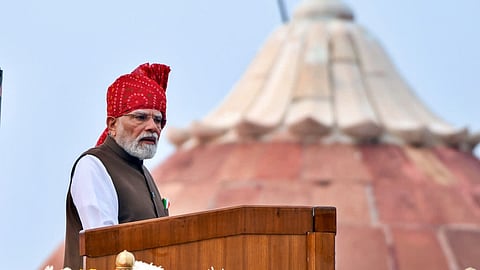
In the 80th Independence Day address, PM Narendra Modi introduced a new concept, “Dimagi Naxals” (Mental Naxals), which warrants serious academic scrutiny to distinguish between conceptual frameworks of ideas vs violence; criticism vs conspiracy; dissent vs armed rebellion.
The Naxal movement emerged as an agrarian movement in the 1960s and eventually adopted revolutionary and violent methods, which were considered anti-democratic in the modern rules-based world order. The organisations and parties associated with the left-wing extremist (LWE) ideology are identified as terrorist organisations by the Ministry of Home Affairs and the international community.
The revolutionary movement to overthrow the government cannot be equated with peaceful political opposition. In response, the state has every right to eliminate extremist organisations to protect its citizens and promote peace and the rule of law.
The Indian state and union governments launched Operations Green Hunt, Anaconda, Cobra, Prahar, Kagar, Kandhamal, and West Singhubum to suppress extremist organisations and activities across the country. According to the Ministry of Home Affairs, the number of LWE-affected districts declined from 126 in 2014 to 11 in 2025. Inclusive methods of surrender, rehabilitation, incentives, financial support, employment, and social reintegration played a major role in reducing LWE.
However, phrases and identities like anti-national, urban Naxals, Dimagi Naxals, and Tukde Tukde Gang were frequently used by political leaders and media without any conceptual framework or clarity. The academicians, intellectuals, human rights activists, opposition leaders, especially belonging to marginalised communities, were exclusively labelled as urban or Dimagi Naxals and anti-nationals.
The students who question the government on employment guarantees, the academicians who write on government failures, the journalist who criticises the mining project, and the opposition leaders who oppose the government or the ruling party's policies are not necessarily part of the Tukde Tukde Gang, urban Naxals, insurgency, or anti-nationals.
Even though there is no specific law or legal provision which defines Dimagi Naxals, in a general conceptual framework, it can be understood if: “any individual who is involved in armed rebellion insurgency, recruits’ people for LWE, collects funds and finances their activities, provides shelter, advocates violence or plans to dismantle the government and rule of law can be considered as Dimagi Naxals with suitable evidence”. But in reality, a student who demands accountability from the government over employment and paper leaks is labelled a Tukde Tukde Gang. The professor who criticises industrialisation or deforestation and writes for the rights of Adivasis is called Dimagi Naxal. The activists who fight for minority rights are labelled as anti-national. This trend poses a dangerous threat to Indian democracy and the prime minister's agenda for Viksit Bharat 2047.
Viksit Bharat and Vishwaguru cannot be measured solely by GDP, Highways, and economic projects; they also encompass socio-economic and cultural aspects such as personal security, life expectancy, health, access to water, education, and freedom of expression. The intellectual and academic community play a significant role in achieving the objectives of Viksit Bharat 2047. Without conducting research into caste, tribal displacement, poverty, unemployment, human rights violations, and women's empowerment, India cannot move forward in manufacturing, AI, space, defence, and the semiconductor industry, all of which are necessary for the Viksit Bharat project.
Any form of extremism and violence is not tolerated or justified in a liberal democracy. However, in the beginning, Naxalism emerged due to income inequalities, tribal marginalisation, the landlord system and unemployment. Subsequently, the Naxal movement adapted violent methods to achieve its objectives. In this regard, conducting research and recommending subsequent policies to eradicate Naxalism.
The scholar who studies literature and investigates terrorism is not a terrorist; similarly, the academicians and students who study and research Naxalism are not necessarily Maoists or Naxalites. Academic discourse on Naxalism, insurgency, violence, and left-wing extremism is very necessary in contemporary India to prevent the rise of similar ideologies and organisations in future.
- Sana Z Ahmed is an independent researcher and writer from Bengaluru, Karnataka.
You can also join our WhatsApp group to get premium and selected news of The Mooknayak on WhatsApp. Click here to join the WhatsApp group.
'The Mooknayak' practices democratic journalism. It is a media platform committed to the Constitution, democracy, and social justice. If you also want 'The Mooknayak' to always raise the voices of the marginalized and show the pain of the voiceless, please subscribe.
PLEASE SUBSCRIBE US