The nationwide social media campaign titled "Reservation Hatao Andolan (RHA)" has reignited one of India's most enduring constitutional and social debates. Advocating the abolition of caste-based reservations, the campaign argues that education and employment should be determined solely by merit rather than caste. Gaining significant traction, particularly among young users on platforms such as Instagram, it has once again placed the future of affirmative action at the centre of public discourse.
Yet, the debate raises a far more fundamental question: Can reservations, conceived by the Constitution as a remedy for centuries of structural discrimination, be judged exclusively through the lens of merit? Can a constitutional commitment to social justice be set aside merely because a social media campaign has become popular?
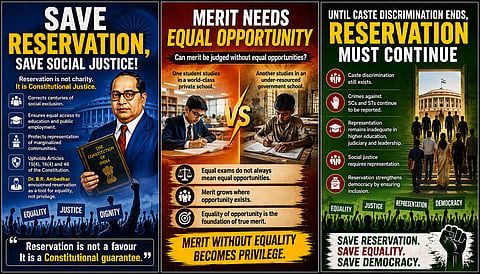
Reservations are neither acts of charity nor political concessions. They are constitutional instruments designed to address historical exclusion and ensure meaningful equality of opportunity. Dr. B.R. Ambedkar envisioned reservations not as special privileges but as corrective measures to dismantle entrenched social inequalities. This vision is reflected in Articles 15(4), 16(4) and 46 of the Constitution, which empower the State to promote the educational and socio-economic advancement of socially and educationally backward communities.
The argument that "merit alone should determine opportunity" appears persuasive at first glance. However, merit does not emerge in a vacuum. It is shaped by access to quality education, social capital, financial stability and institutional support.
A student educated in an elite private institution with world-class infrastructure cannot be meaningfully compared with another studying in an under-resourced government school struggling with inadequate teachers and poor facilities. Likewise, a family with generations of educational and economic privilege cannot be equated with one that continues to survive on daily wage labour. Measuring both by identical examination scores without accounting for unequal starting points risks confusing privilege with merit.
Equally important is the question of whether caste discrimination has truly disappeared from Indian society. Incidents of social exclusion, untouchability, caste-based violence, disputes over land rights and so-called honour killings continue to be reported across several parts of the country. Data released periodically by the National Crime Records Bureau (NCRB) indicates that offences against Scheduled Castes and Scheduled Tribes remain a matter of serious concern. If structural discrimination persists, the constitutional mechanisms designed to mitigate its consequences cannot be dismissed as obsolete.
The frequent attempt to equate reservations with poverty alleviation also overlooks their distinct constitutional purpose. Poverty is an economic condition that requires targeted welfare programmes, employment generation, scholarships and financial assistance. Reservations, however, address systemic social exclusion arising from caste-based discrimination. An economically well-off Dalit may still encounter social prejudice rooted in caste identity, while an economically weaker individual from a socially dominant community may experience financial hardship without necessarily facing comparable forms of social exclusion. Economic welfare and social justice therefore address different dimensions of inequality.
Social media has undoubtedly democratised public participation. At the same time, it has also become a fertile ground for oversimplified narratives. A trending hashtag or a viral reel cannot substitute constitutional reasoning or historical understanding. Public opinion deserves to be informed by evidence, constitutional values and social realities rather than algorithm-driven popularity.
Calls for the simultaneous abolition of caste and reservations overlook an uncomfortable reality. Has caste discrimination ended? Have inter-caste marriages become universally free from fear and violence? Do all villages provide equal access to places of worship, burial grounds and common water resources irrespective of caste? Have caste-based humiliation and social boycotts disappeared? Until these questions can be answered affirmatively, demands to dismantle reservations remain difficult to reconcile with India's lived social realities.
Another important dimension of the debate concerns representation. Despite constituting a substantial proportion of India's population, Backward Classes (BCs), Other Backward Classes (OBCs), Scheduled Castes (SCs) and Scheduled Tribes (STs) continue to be underrepresented in higher education, senior public services, the higher judiciary, corporate leadership and several policy-making institutions. Many scholars and civil society groups therefore argue that reliable caste-disaggregated data through a comprehensive caste census is essential for designing evidence-based public policy. Social justice without credible data risks becoming incomplete.
Reservations are undeniably a politically sensitive issue. That makes it all the more important that public debate remains informed, balanced and constitutionally grounded. It is equally legitimate to examine the motivations, implications and long-term consequences of campaigns seeking to abolish affirmative action. Numerous organisations representing BC, OBC, SC and ST communities have expressed concern that such campaigns could weaken the constitutional architecture of social justice. Those concerns deserve careful democratic engagement rather than dismissal.
This is not to suggest that the reservation system is beyond scrutiny. Implementation challenges, procedural shortcomings and issues of effectiveness should be openly discussed and addressed. Simultaneously, governments must strengthen public education, improve rural schooling, expand skill development, create employment opportunities and provide robust economic support to disadvantaged households. Reform, however, should strengthen the constitutional promise of equality—not weaken it.
Ultimately, reservations are not a favour extended to a particular community. They are a constitutional assurance intended to build a more inclusive republic. Dr. B.R. Ambedkar's vision of India rested not merely on political democracy but on social democracy—where equality is realised through substantive opportunity rather than formal rhetoric.
The debate, therefore, is not simply about reservations. It is about the meaning of equality itself. Protecting reservations is, for many, not merely about preserving a policy but about safeguarding the constitutional ideals of justice, dignity and equal opportunity that continue to define the Republic of India.