Mahad Satyagraha: The Struggle for Water, Dignity, and Human Rights | Dalit History Month

The movement transformed the simple act of drinking water into a powerful statement about the humanity of those whom caste society had historically marginalized and oppressed.
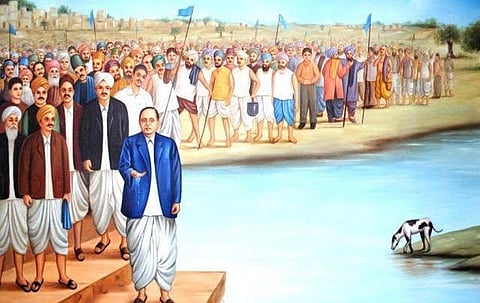
Even animals had the right to drink water from Chawdar Tank but "untouchable" humans could not drink water from this water body.
Even animals had the right to drink water from Chawdar Tank but "untouchable" humans could not drink water from this water body.Pic- Internet
Published on

— ✍️Prakash Priyadarshi & Akhilesh Kumar

On 20 March 1927, a historic event unfolded in the small town of Mahad, forever altering the trajectory of social justice movements in India. Under the leadership of Dr. B. R. Ambedkar, thousands of Dalits gathered to assert their right to access water from the Chavdar Lake, a public tank from which they had long been excluded because of the rigid hierarchies of the caste system.At first glance, the protest seemed to revolve around a basic human necessity—drinking water. Yet the Mahad Satyagraha was far more profound than a struggle over access to a water source. It was an assertion of human dignity and equality. Dr. Ambedkar made this clear when he declared:

“Our struggle is not for water; it is for human rights.”

The movement transformed the simple act of drinking water into a powerful statement about the humanity of those whom caste society had historically marginalized and oppressed. By challenging the deeply entrenched practices of untouchability, the protest questioned the moral legitimacy of a social order that denied basic rights to an entire community. It demonstrated that the demand for equality could emerge from everyday acts that symbolized larger structures of exclusion. In this sense, Mahad became not merely a site of protest but a turning point in the struggle for social justice. The event inspired generations to assert their rights and challenge the oppressive foundations of caste discrimination.

Caste, Water, and Social Exclusion:

In early twentieth-century India, caste hierarchies regulated every dimension of social life. Dalits—then referred to as “Untouchables”—were denied entry into schools, and public roads. Even access to water, the most basic requirement for survival, was restricted.

Public wells and tanks were controlled by dominant caste groups who believed that the touch of Dalits would “pollute” these water sources. As a result, Dalits were forced to depend on distant or inferior sources of water, often walking miles to collect it. The denial of water was not merely a matter of inconvenience; it was a systematic mechanism of humiliation and exclusion.

In 1923, the Bombay Legislative Council passed a resolution introduced by S. K. Bole, recommending that public places such as wells, tanks, and schools be opened to the Depressed Classes. However, despite this legal provision, social practices remained unchanged.

The contradiction between legal rights and social reality set the stage for the Mahad Satyagraha.

Even animals had the right to drink water from Chawdar Tank but "untouchable" humans could not drink water from this water body.
Mahad Satyagraha Marches Towards 100: A Century Later, What Is the Reality of Dalits’ Access to “Public Spaces”? | Dalit History Month

The Mahad Satyagraha of 1927

Mahad was strategically chosen for the movement because the municipal authorities had already declared the Chavdar Lake open to all communities. Yet Dalits continued to be denied access.

In March 1927, Dr. Ambedkar organized a conference of the Depressed Classes in Mahad. Thousands gathered to discuss their rights and to challenge the discriminatory social order. After the conference, Dr. Ambedkar led the crowd to the Chavdar Lake. In a symbolic act of defiance, he drank water from the tank. Thousands followed him, asserting their right to use the public water source.

Dr. Ambedkar explained the deeper meaning of this act in a powerful speech:

“We are not going to the lake merely to drink its water. We are going to assert that we too are human beings.” The act transformed a basic necessity into a political claim to equality. By drinking water from the lake, Dalits challenged the ideological foundations of caste hierarchy.

Water and Social Power

The Mahad Satyagraha can be understood through broader sociological theories of power and inequality.The French sociologist Pierre Bourdieu argues that social domination often operates through everyday practices that appear natural but are structured by relations of power. The prohibition against Dalits touching water sources exemplifies this form of symbolic power. By embedding inequality in routine social practices, caste society normalized discrimination.

Similarly, Michel Foucault emphasized that power is exercised through the regulation of bodies and everyday spaces. The segregation of wells, tanks, and water pots reflects precisely such regulation. By controlling access to water, dominant castes were able to enforce social hierarchy in everyday life. Dr. Ambedkar’s intervention disrupted this system. By asserting the right of Dalits to drink from the Chavdar Lake, he exposed the absurdity of caste ideology and challenged its moral legitimacy. The United Nations Human Rights Council's 2010 resolution (15/9) declared safe and clean drinking water a fundamental human right (Resolution adopted by the Human Rights Council 15/9). The UN Special Rapporteur on the Human Right to Safe Drinking Water, in successive reports through 2015 to 2022, has identified caste-based discrimination as a primary mechanism of water rights violation in South Asia. The 2023 World Water Development Report, published by UNESCO, includes a dedicated section on 'social exclusion and water access,' explicitly naming caste as a structural determinant of water inequity in India, Nepal, and Sri Lanka (2023 United Nations World Water Development Report (WWDR): Partnerships and Cooperation for Water, published by UNESCO).

Yet the framework of 'access'  as though the problem were merely distribution — is insufficient.

What environmental justice theory must still fully integrate, is that water denial under caste is not a resource allocation problem. It is an ontological claim. The denial of water to the Dalit is the assertion that the Dalit body does not belong to the same order of being as the Privileged Caste body — that Dalit thirst is not the same kind of thirst, Dalit biology not the same kind of biology. This is what Nietzsche would recognize as the most complete expression of life-denial: a system that uses the most elementary requirement of biological life to enforce a hierarchy of humanity.

Robert D. Bullard, in one of his essays , ‘Race and Environmental Justice’ makes explicit the analytical parallel: 'The mechanisms of environmental racism and caste-based environmental exclusion are structurally homologous. Both operate through the spatial segregation of bodies, the differential allocation of environmental goods and bads, and the ideological naturalization of these disparities as expressions of divine or natural order.' What Dr. Ambedkar fought at the Chavadar Tank in 1927 was, in the language of 21st-century environmental justice, a case of severe environmental racism — and the first organized, philosophically articulate challenge to it in the history of the colonized world.

Ambedkar and the Ethics of Human Dignity

At the heart of Dr. Ambedkar’s politics was the principle of human dignity. Dr. Ambedkar believed that the greatest injustice of the caste system was not only economic deprivation but the systematic destruction of self-respect among the oppressed.

The caste order relegated Dalits to a position where even their touch was considered polluting. They were denied entry into public spaces and excluded from resources essential for life. Such practices were designed to humiliate and degrade them.Dr. Ambedkar understood that a community subjected to constant humiliation could not achieve genuine freedom without reclaiming its sense of dignity. The Mahad Satyagraha was therefore conceived as a moral act as much as a political one.

When Dalits drank water from the Chavdar Lake, they were asserting their self-respect and rejecting the stigma imposed upon them. The act represented a declaration that they were equal human beings who deserved dignity and recognition.

Dr. Ambedkar also linked this struggle to a broader vision of democracy based on liberty, equality, and fraternity. These ideals, historically associated with transformative movements such as the French Revolution, were reinterpreted by Dr. Ambedkar within the context of India’s caste-ridden society. For him, democracy was not merely a system of governance but a moral order rooted in mutual respect and shared humanity.

The Continuing Struggle for Water

Nearly a century after the Mahad Satyagraha, the struggle for water continues in many parts of India. Caste-based discrimination around water sources has not disappeared; it has merely taken new forms. The Murder of Inder Meghwal, who was assaulted by a teacher belonging to the privileged Caste. shows the Castiest mindset prevailing in every system. Similarly, Kamlesh from Uttar Pradesh lost his life for daring to drink from a public tank, in Madhya Pradesh Narad Kumar was murdered for taking water to irrigate his fields, there are numerous incidents that are continuously happening where Dalit is being killed merely for drinking Water.

These incidents reveal a disturbing reality: water continues to carry a caste identity in contemporary India. The very substance that sustains life becomes a site of violence and exclusion.The deaths of Dalits for accessing water are cruel reminders that the ideals of equality proclaimed at Mahad remain far from fully realized.

The National Crime Records Bureau (NCRB) data for 2022 records 51,656 cases of atrocities against Scheduled Castes, a figure widely acknowledged by scholars including Professor Sukhadeo Thorat (Chairman, Indian Council of Social Science Research, 2005–2010) to be a severe undercount, as the majority of caste crimes are never reported due to social intimidation, police complicity, and the perpetrators' position of local power. The National Commission for Scheduled Castes Annual Report 2022-23 identifies denial of water access as among the most persistently reported violations in rural India. Mahad was not an origin story. It was an opening chapter in a book that has not been closed.

Key Data: Caste & Water In Contemporary India

→  48.40% of Dalit households in rural India report being denied access to common water sources (NFHS-5, 2019–21)

→  51,656 atrocity cases against Scheduled Castes registered in 2022 (NCRB, Crime in India 2022)

→  Only 20% of Dalit rural households had tap water connections vs. 48.4% for upper-caste households (Census 2011, SECC data)

→  Indra Kumar Meghwal, age 9, beaten to death, Jalore, Rajasthan, 2022— for drinking from teacher's water vessel

→  World Water Development Report 2023 (UNESCO) identifies caste as a primary barrier to water equity in South Asia

Even animals had the right to drink water from Chawdar Tank but "untouchable" humans could not drink water from this water body.
January 26 and Ambedkar: The Unfinished Promise of the Indian Republic

The Dalit Experience of Water

 For Dalit, memories of water are deeply tied to experiences of humiliation and deprivation.Dalit children are often discriminated for drinking water at school or being forced to stand at a distance while someone from a dominant caste pours water into their hands. In some villages, Dalits still depend on separate wells or must wait until others have finished drawing water.Such experiences create a lasting sense of alienation. Water, which is commonly celebrated as a symbol of equality, becomes associated with pain and segregation.

For Dalits, water is not merely a natural resource or a symbol of beauty. Instead of representing the nectar of life, it often becomes what may be described as a “caste burden.”

If water belongs to privileged castes, then a Dalit who drinks it risks humiliation, violence, or death.Despite these challenges, the Mahad Satyagraha remains a powerful source of inspiration for movements seeking social justice.The movement played a crucial role in the emergence of asserting rights, dignity, self-respect. It demonstrated that collective action could challenge entrenched systems of oppression. Dr. Ambedkar encouraged Dalits to pursue education, organization, and political participation as pathways to liberation. His famous call—“Educate, Agitate, Organize”—became the guiding principle of the movement.

The spirit of Mahad therefore extends beyond the events of 1927. It represents a broader struggle for equality and dignity that continues to shape contemporary social movements.

From Mahad to Constitutional Morality

The legacy of the Mahad Satyagraha also influenced the constitutional foundations of modern India.The Father of the Constitution of India, Dr. Ambedkar ensured that the principles of equality and justice were embedded in the legal framework of the nation.The Constitution guarantees fundamental rights such as equality before the law, prohibition of discrimination, and the abolition of untouchability.Yet Dr. Ambedkar warned that political democracy would remain fragile without constitutional morality, a commitment among citizens to respect the values of liberty, equality, and fraternity.

Without such moral commitment, he feared that social hierarchies would continue to undermine democratic institutions. The Mahad Satyagraha was not merely a protest for drinking water. It was a revolutionary assertion of human dignity and equality. By leading thousands of Dalits to the Chavdar Lake, Dr. Ambedkar transformed into a universal struggle for human rights.

The movement challenged the ideological foundations of caste hierarchy and laid the moral groundwork for India’s democratic and constitutional order.

Yet the persistence of caste-based violence around water reminds us that the struggle Dr. Ambedkar began is far from over. Water—an element that should unite humanity—continues to be divided by caste boundaries.

Remembering Mahad therefore requires more than commemorating a historic event. It requires renewing the commitment to the ideals that Dr. Ambedkar articulated nearly a century ago: liberty, equality, and fraternity.

The march to the Chavdar Lake was not simply about quenching thirst. It was about asserting humanity. And that assertion continues to resonate in every struggle for dignity and justice in India today.

Prakash Priyadarshi is a Post-doctoral Fellow at ISEC, Bengaluru, and Akhilesh Kumar is an Ambedkarite Activist and a PhD Research Scholar at Jamia Millia Islamia, New Delhi.

Even animals had the right to drink water from Chawdar Tank but "untouchable" humans could not drink water from this water body.
Dalit History Month | Government Sidesteps Questions on Discrimination-Linked Student Suicides in Lok Sabha
Even animals had the right to drink water from Chawdar Tank but "untouchable" humans could not drink water from this water body.
Merit Doesn't Matter: Govt Data Shows 20 Bank Job Offers Cancelled in Three Years Over Poor CIBIL History

You can also join our WhatsApp group to get premium and selected news of The Mooknayak on WhatsApp. Click here to join the WhatsApp group.

Support The Mooknayak

‘The Mooknayak’ practices people-centric and democratic journalism. It is a media platform committed to upholding the Constitution, democracy, and social justice. We consistently raise the voices of the marginalized, highlight the struggles of the voiceless, and bring their pain to the forefront. If you also believe that ‘The Mooknayak’ should continue to stand with the oppressed and amplify the concerns of those pushed to the margins, please support us.

Please Contribute
The Mooknayak English - Voice Of The Voiceless
en.themooknayak.com