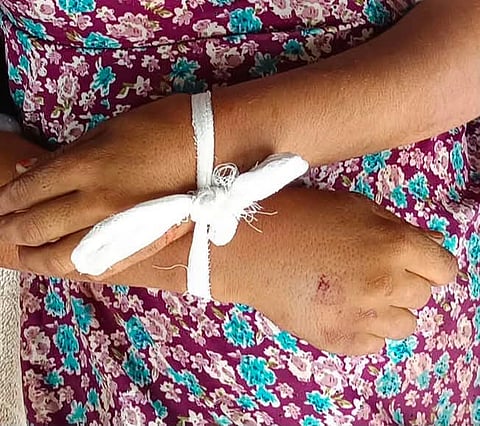
Thirteen-year-old Razia Bano was allegedly raped and subsequently died on 20 August 2026 in Chatroo, Kishtwar (J&K), after undergoing an abortion of a seven-month-old pregnancy. She belonged to the Gujjar and Bakarwal community, whose members have historically served as domestic workers, labourers, and pastoral workers across the Chenab region and the Kashmir Valley not merely because of poverty, but because of a deeply entrenched social perception that they are born to serve dominant social groups. The expression “Gujjar kott ya Gujjar koor gasay” (“We need a Gujjar boy or a Gujjar girl”) captures the normalisation of this relationship of servitude.
Razia was reportedly employed as a domestic worker by Khalid Hussain, who was also her neighbour and teacher at the school where she studied in the 8th grade. She carried for seven months the pregnancy resulting from the sexual assault. She ultimately died beneath the weight of a stigmatised identity ‘Gujjar’ while her financially and socially vulnerable father was allegedly pressured into compromising and settling through the dominant social apparatus. The tyranny of the local social hierarchy the ‘Kechari milieu’ is said to have terrified her father from the moment the pregnancy became apparent. He was reportedly terrified that either settle the matter or face consequences.
Political cum social intervention of influential and dominant figures, reportedly, including former sarpanch Haji Ghulam Qadir, raises an even more disturbing question about the manner in which social power can transform justice into a bargain. It was, in effect, a negotiation between the powerful and the vulnerable, as though a butcher were bargaining with a shepherd over the price of a life. After the matter remained unsettled, Razia returned to her father's home, where she remained for approximately seven months. During this period, a neighbour, Mohd Iqbal, was allegedly, paid to assume responsibility for the pregnancy and was settled with a certain amount of money. On the 19th-20th august, however, Razia was moved randomly and secretly to Kishtwar hospital. Hospital staff were persuaded that Mohd Iqbal was her husband. An abortion was subsequently carried out without informing her father.
Tribal activist Talib Hussain has claimed that this plan was designed to conceal the identity of the biological father and potentially manipulate subsequent DNA evidence by exchanging or disposing of the foetus through hospital personnel. These allegations, if established through an impartial investigation, would indicate an attempt not merely to terminate a pregnancy but to destroy potential evidence of sexual violence. When the initial reports and allegations are read together, the case raises a disturbing similarity with the 2018 rape and murder of the minor tribal girl Asifa in Kathua, Jammu and Kashmir. That is how social power, political influence, and the vulnerability of a tribal minor intersect.
This is not necessarily an isolated event. Rather, it must be examined within a larger pattern of social stratification and institutional neglect. Consider the case of Suraya Begum of Kalaroos, Kupwara, on 17 January 2019. When she was nine months pregnant, she was reportedly carried on a charpoy through heavy snow to Lal Ded Hospital in Srinagar because the local roads were impassable. At Lal Ded, however, she was allegedly not admitted overnight. Her family repeatedly requested that she be allowed to remain in the hospital, explaining that they had travelled from a distant, snowbound area. They were reportedly refused and told to leave, with the alleged remarks “Gujjar happat” (“You Gujjars are bears”) and “Amis chu fakh yiwan, yim chi Gujjar” (“They smell foul; they are Gujjars”). At approximately 8:30 p.m., Suraya reportedly went into severe labour and delivered a baby girl by the roadside. The newborn died shortly afterwards. Srinagar’s temperature that night was reportedly around −0.7°C.
And how can we ignore Noor Jahan, a 45-year-old woman who was reportedly gang-raped on 4 May 2025 at Nishat, Srinagar? Neither civil society appeared to express comparable outrage, nor did the case receive significant national-media attention. Her case once again exposes the hierarchy of public empathy: whose suffering becomes a national outrage and whose suffering disappears into silence. The tragic death of Razim Akhter on 23 December 2024 at GMC Rajouri, and the fatal delay in medical care reportedly suffered by Naseem Akhter on 18 February 2021 at District Hospital Poonch, are among the recorded cases, yet they should not be dismissed as isolated medical anomalies. They point instead towards a deeper crisis in healthcare infrastructure and access in the border districts, where marginalised and nomadic communities can face disproportionate barriers to timely medical care. While Gujjar and Bakarwal communities traverse harsh terrains to sustain an important pastoral economy, the state apparatus too often appears incapable of guaranteeing them equal access to healthcare and, ultimately, equal protection of the right to life.
In the Chenab region and, to some extent, in the Kashmir Valley, Gujjars and Bakarwals are often reduced, in the dominant social imagination, to a labouring and servile population. Their social position is frequently determined by dominant groups rather than by their own agency. Justice, therefore, becomes selective, and so does outrage. If “Gujjar” itself can function as a social slur, and if individuals can be judged through expressions such as “Gujjar khaslat” (“Gujjar traits” or “Gujjar habits”), then the problem is no longer merely individual prejudice. It is a structure of social perception.
Generations of Gujjars and Bakarwals have grown up within conditions of poverty, exclusion, geographical isolation, and social stratification. In such a setting, a child can be socially assigned a position even before birth. The prevailing hierarchy can determine not merely where that child will live, but what kind of work, dignity, and social status society expects that child to possess. If a community is historically imagined as born to serve, how can one expect society at large to respond to violence against its members with the same moral urgency accorded to those belonging to socially privileged groups?
The deeper problem, therefore, is that crime, criminality, and the administration of social justice cannot be completely separated from the social structure in which they occur. As Hunter S. Thompson put it, “In a close society where everybody’s guilty, the only crime is getting caught. In the world of thieves, the only final sin is stupidity.”
According to local media reporter Asif Iqbal Naik, there was allegedly no anaesthesia technician available during Razia’s abortion procedure and, consequently, she may not have been properly anaesthetised. Her initial medical reports, according to him, reportedly support this possibility. Asif also stated that, when he spoke to a woman who performed Razia’s final rites, she described injuries to Razia’s private parts that appeared to have been inflicted unprofessionally. If these facts are independently verified, the absence of qualified medical personnel and the manner in which the procedure was conducted could become crucial elements in determining the circumstances of her death. Otherwise, Razia might have survived. The irony is devastating. Article 21 of the Constitution guarantees the right to life and personal liberty to every person, yet social prejudice can determine whose life receives its full protection in practice.
Had Razia survived, the seven-month-long history of alleged sexual violence, pregnancy, and subsequent attempts at settlement might not have come to light. Was her death also the culmination of a collective effort to prevent the truth from becoming public? The real tragedy is not merely that one individual allegedly committed sexual violence. It is that a wider social environment which has normalised, concealed, negotiated, and ultimately enabled the consequences of that violence because the victim belonged to a socially marginalised community. This is the brutality of identity-based dehumanisation.
When a society in general has an expression such as “Agar toi wechew janglas manz aike anndhh saruf (snake) bai Gujjur, Gujjur gase marun, saruf gasai travun”—“If you ever encounter a Gujjar and a snake at the same time, kill the Gujjar and leave the snake”—it becomes necessary to ask what happens when such prejudices enter institutions. How does one expect a doctor, teacher, administrator, political leader, or police officer to respond with ordinary human compassion if the social environment has already taught them to see a particular identity as inferior? It is like expecting a butcher to show compassion towards the goat standing before him. The problem, however, is not the individual butcher alone; it is the social system that has taught him to see the goat merely as an object for slaughter.
Razia may have been beaten, threatened, frightened, humiliated, and psychologically broken during those seven months. She may have cried out to the sky, while the social apparatus around her remained unmoved. And when, in the name of abortion, she allegedly underwent a procedure that ultimately ended her life, her screams may have disappeared into the trenches of the identity assigned to her. Perhaps her greatest tragedy was not simply that she was allegedly raped. It was that her suffering could be negotiated because she was Gujjar. Her identity became the very condition through which her vulnerability was interpreted.
Her screams have yet to shake a society sufficiently to demand a comprehensive and impartial investigation. She may have hoped that her suffering would not disappear into the trench of identity but rather become a beginning where no other Razia would be ruined, bargained over, and ultimately sacrificed beneath the accumulated weight of social stigma. The identity that isolated her from the social mainstream was not created by her. The stigma attached to it was inherited from generations before her.
Gujjar and Bakarwal marginalisation cannot simply be explained through a supposed cultural fear of modernity or by attributing their deprivation to ignorance. Many of them have remained rooted in the pristine valleys and higher altitudes of the Himalayas, but they have simultaneously been left miles behind the rapidly changing capitalist, technological, educational, and globalised world. It was and remains the responsibility of socially privileged sections of society to bring such communities into confidence, to create meaningful access to modern education, and to make them feel that they too belong to the wider socio-economic and political order.
When that process fails, the responsibility becomes even more urgent for an educated and conscious class emerging from within the marginalised community itself. For example, in twentieth-century Kashmir, Sheikh Muhammad Abdullah became associated, in a different historical context, with the mobilisation of people who had experienced generations of deprivation and political exclusion.
Razia must have been asking why the social mobility achieved by a section of the Gujjar and Bakarwal elite has not percolated into a sustained transformation of the conditions of the overwhelmingly deprived majority. The Gujjar and Bakarwal question deserves to be viewed through a similar lens: the relationship between an emerging community elite and an overwhelmingly deprived majority. A considerable socio-economic distance has emerged between sections of the Gujjar elite and the ordinary people whose identity has provided much of the basis for their political and institutional representation. Some politically and economically prosperous members of the community have built political careers and public faces around their tribal belonging. Yet examples of their sustained efforts to mobilise, educate, organise, and unite the most deprived sections of their own community remain comparatively rare.
Razia’s death should not be reduced to another isolated crime report. It should force us to confront the deeper structures that determine whose suffering becomes visible, whose testimony is believed, whose death produces outrage, and whose identity makes suffering easier to ignore.
- The author is a research scholar in the Department of History at Aligarh Muslim University (AMU).
Disclaimer: The views and opinions expressed in this article are those of the author alone. The Mooknayak does not necessarily endorse them and bears no responsibility for the content.
You can also join our WhatsApp group to get premium and selected news of The Mooknayak on WhatsApp. Click here to join the WhatsApp group.
'The Mooknayak' practices democratic journalism. It is a media platform committed to the Constitution, democracy, and social justice. If you also want 'The Mooknayak' to always raise the voices of the marginalized and show the pain of the voiceless, please subscribe.
PLEASE SUBSCRIBE US