Discussion
Jantar Mantar Protest: FIRs Against Students Quashed; Is Relief Enough?
The Supreme Court’s intervention protects the right to protest, but also places a larger responsibility on the Union Government


— ✍️ Dundra Kumara Swamy
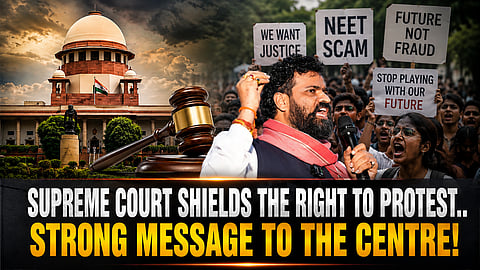
What should a student carry into adulthood—a book, a degree and hope for the future, or the burden of a criminal case for having raised questions about an examination system? This is the larger question that arises from the Supreme Court’s decision to quash the FIRs relating to protests over the NEET-UG controversy. The order is not merely about closing a set of criminal cases. It brings into focus the delicate relationship between the right to peaceful protest, the State’s power to maintain public order, the proportional use of criminal law and, above all, the responsibility of the government to maintain public confidence in a national examination system.
The Supreme Court invoked its extraordinary jurisdiction under Article 142 of the Constitution to bring the proceedings relating to the protests between July 20 and 25 to an end. The significance of the order lies not in creating a general exemption from criminal law, but in recognising that participation in a peaceful protest should not, by itself, become a permanent impediment to a young person’s future. At the same time, the Court did not treat the right to protest as an unfettered licence. Violence, destruction of public property and serious physical offences cannot be placed on the same footing as peaceful dissent. The distinction is important: constitutional freedoms deserve protection, but they operate within a constitutional framework of responsibility.
The qualification concerning 2,873 persons reinforces this principle. At the instance of the Delhi Police, the Court permitted the possibility of fresh FIRs where investigation establishes involvement in serious offences such as causing physical harm or damaging property, particularly in cases involving serious criminal antecedents. The Court, therefore, did not place every protester in the same category. It sought to distinguish between legitimate democratic dissent and conduct that attracts criminal responsibility. Such differentiation is essential to the rule of law. Neither blanket criminalisation of protest nor blanket immunity for unlawful conduct can constitute a sound democratic principle.
The more uncomfortable question, however, concerns the consequences of an FIR for a young student. A criminal case may affect educational opportunities, employment prospects, higher studies and social standing even before a court determines guilt. The eventual closure of a case may provide legal relief, but it cannot always erase the anxiety, disruption and uncertainty that preceded it. This is why the State must exercise criminal law with restraint and proportionality. At the same time, where there is credible evidence of violence or deliberate destruction, accountability must follow. Protection of rights and accountability for offences are not competing principles; they are complementary requirements of a constitutional democracy.
The judgment also carries a larger message for the Union Government. When questions arise over the integrity of a national examination, the first response of the State should be transparency, explanation and institutional correction—not an instinctive reliance on criminal proceedings against those who raise concerns. NEET is not an ordinary examination. For students and families, it represents years of preparation, considerable financial expenditure and intense personal expectation. Any erosion of confidence in its conduct therefore has consequences far beyond the examination hall. A government’s authority is strengthened not by silencing questions, but by answering them convincingly.
That places a substantial responsibility on the examination authorities and the government. Examination security, protection of question papers, transparent investigation of complaints, timely action against those found responsible and an accessible grievance-redress mechanism are not administrative luxuries. They are essential to preserving institutional credibility. If every major examination controversy follows the same cycle—students protest, criminal cases are registered and the judiciary is eventually asked to intervene—the problem is no longer confined to law and order. It becomes a question of governance and public trust. The objective must be to prevent such crises rather than repeatedly resolve their consequences.
The issue of compensation to families who have lost students in circumstances connected with the examination controversy adds a deeply human dimension to the matter. Financial assistance can provide some measure of support, but it cannot compensate a family for the loss of a child. Any compensation framework must therefore be accompanied by institutional accountability and preventive reform. The objective should be to ensure that students and their families are not left to bear the consequences of systemic failures. A credible examination system requires not merely an examination to be conducted, but a public assurance that its integrity will be protected at every stage.
The Supreme Court’s intervention should also be understood correctly by student movements. The right to question the government and to organise peaceful demonstrations is an essential component of democratic life. But that right carries responsibilities. Protest must remain peaceful, and legitimate dissent should not become a justification for violence or destruction. Equally, the State must resist the temptation to treat dissent itself as disorder. A democracy is tested not when citizens agree with the government, but when they disagree with it. The constitutional answer to dissent cannot routinely be the criminal law; it must first be dialogue, transparency and accountability.
Ultimately, the Court has provided legal relief, but it has not—and cannot—close the larger question confronting the government. Why should students have to approach the judiciary before their anxieties are adequately addressed? Can public confidence in national examinations be restored merely by closing FIRs? And, when the next controversy arises, will the State respond first with answers or with cases? The Supreme Court may have brought these proceedings to a close, but the deeper file remains open—the file of public trust. Closing that file will require more than a judicial order. It will require a government willing to listen, explain, correct and accept responsibility.
- The author is a High Court advocate, National President BC Dal and Chairman of National BC Reservation Struggle Coordination JAC.
You can also join our WhatsApp group to get premium and selected news of The Mooknayak on WhatsApp. Click here to join the WhatsApp group.
'The Mooknayak' practices democratic journalism. It is a media platform committed to the Constitution, democracy, and social justice. If you also want 'The Mooknayak' to always raise the voices of the marginalized and show the pain of the voiceless, please subscribe.
PLEASE SUBSCRIBE US