Discussion
India's Stark Inequality: How Maharashtra's Economic Policies Exclude Marginalized OBCs
How are caste, fiscal policy, and inequality deeply entrenched in India's wealthiest state?

Structural neglect regarding Denotified and Nomadic Tribes is a critical issue. Since its inception, the politics of single-caste hegemony has prevailed in Maharashtra. The impact of this is evident in the realm of systemic justice. Due to their large population, advanced social status, political consciousness, and institutional strength within the private and cooperative sectors, the Maratha community maintains a firm grip on Maharashtra's politics. Even the politics of Lok Sabha and Legislative Assembly constituencies reserved specifically for Dalits and Adivasis are often conducted under the leadership of Maratha politicians.
Consequently, any state government tends to respond to agitations by the Maratha community as if they were instances of social unrest. This dynamic, driven by pressure-group politics, leads to the implementation of policies centered around a single caste, while policies aimed at social justice remain merely on paper.
Although financial provisions for OBC communities are frequently announced, the actual implementation often prioritizes schemes benefiting the Maratha community. The Annasaheb Patil Economic Development Corporation was established specifically to foster the socio-economic development of the Maratha community. Under this initiative, the state government launched a loan scheme in 2017 to assist young men and women from the Maratha community in establishing their own enterprises. Over the past decade, a total of ₹12,500 crore in funds has been disbursed for this purpose.
In September 2025, State Minister Chhagan Bhujbal exposed the discriminatory nature of fund allocation by presenting specific statistical data. Despite the OBC population constituting 54 percent of the total, their respective economic development corporations have received a mere ₹2,500 crore over the last 25 years. In stark contrast, during the single year of 2025 alone, the 'SARTHI' institute dedicated to the Maratha community received ₹750 crore in funding, whereas the Maharashtra State Other Backward Classes Finance and Development Corporation received a meager ₹7 crore.
Between 2010 and 2025, the Annasaheb Patil Economic Development Corporation, which works towards the social development of the Maratha community, received a total of ₹1,063 crore in funding. In this context, the beneficiary class is the Maratha-Kunbi community, which constitutes only 11–13% of Maharashtra's population. On the other hand, the Other Backward Classes (OBC) Finance and Development Corporation received a total funding of merely ₹398 crore over the entire period from 2015 to 2025. The list of beneficiary classes under this corporation is extensive, comprising the OBC, VJ, NT, and SBC groups — communities that together account for 58–60% of Maharashtra's population.
The financial discrimination against OBCs becomes even more evident when examining the financial provisions announced by the then Finance Minister, Ajit Pawar, during the Monsoon Session of July 2025.
An expenditure of ₹33,232 crore was incurred for the 'Mukhyamantri Majhi Ladki Bahin' scheme from July 2024 to March 2025. A proposal for a total expenditure of ₹36,000 crore for this scheme for the year 2025–26 has been presented, as informed to the Maharashtra Legislative Assembly by the then Finance Minister, Ajit Pawar.
However, at that time, the economic demands of the Denotified Tribes (Vimukta Jatis) and Nomadic Tribes communities were completely ignored. 'Mahajyoti' — an organization dedicated to educational schemes for OBC communities — had requested funds amounting to ₹730 crore from the state government for the development of infrastructure. In this regard, the concerned officials had written to the government in May 2025 seeking a budgetary allocation. However, the government sanctioned only ₹203 crore, while completely disregarding the demand for ₹526.55 crore requested for training and financial assistance.
In stark contrast, the very same government, in 2023, made available 26 acres of land across various cities in Maharashtra for the infrastructure development of the SARTHI institute. Furthermore, it sanctioned a fund of ₹1,360 crore specifically for this infrastructure development.
Additionally, the state government has formulated a comprehensive plan worth ₹25,500 crore for the Kumbh Mela scheduled to be held in Nashik in 2027. Under this initiative, facilities for the Kumbh Mela are to be developed in three phases spanning the years 2024, 2025, and 2026, through the Urban Development, Public Works, and Tourism Departments. To this end, the government approved works worth ₹5,100 crore last year. Furthermore, the 2026 budget has sanctioned various development projects totaling ₹22,181 crore.
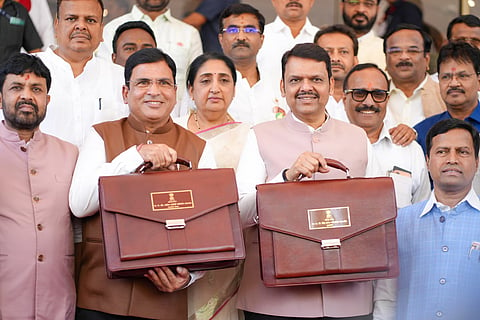
In March, Maharashtra's Chief Minister and Finance Minister, Devendra Fadnavis, presented the state budget for the year 2026-27. While presenting the budget totaling ₹7,69,467 crore, allocations of ₹23,150 crore for Scheduled Castes (SC) and ₹21,723 crore for Scheduled Tribes (ST) were provisioned.
This funding is disbursed under the SCSP (Scheduled Caste Sub Plan) and TSP (Tribal Sub Plan) frameworks and is utilized for education, healthcare, infrastructure, and various welfare schemes. However, a mere ₹4,300 crore was announced for welfare schemes and initiatives dedicated to OBC communities. The OBC community, which constitutes nearly 40 percent of Maharashtra's population, received, in effect, no special financial allocation beyond approximately one percent. The current government has thus perpetuated a tradition of unequal and unjust economic policies that has persisted since the very inception of the state of Maharashtra.
In its budget, the state government has allocated a fund of ₹4,300 crore for the social and educational development of the OBC community. However, the various schemes intended for the OBC community required a minimum of ₹30,000 crore. OBC leader Laxman Hake remarked that the state government has provided only half of the funds actually required.
Although financial provisions for OBC communities are frequently announced, the actual implementation often prioritizes schemes benefiting the Maratha community.
The category of 'Other Backward Classes' (OBC) in Maharashtra encompasses more than 350 diverse castes. Of these, the groups classified as 'Denotified and Nomadic Tribes' number over 40. Each of these groups possesses its own distinct cultural, linguistic, and occupational traditions. Although a segment of this community has, to some extent, settled in both rural and urban areas, politically, the community has not yet become as organized as it ideally should be. Furthermore, a caste-based census would enable this community to recognize its collective strength — a realization that would prove immensely beneficial for its social and political upliftment.
The reason for this is that the politics of forming 'pressure groups' constitutes a crucial stage for this community. The socially fragmented nature of the OBC communities itself poses an obstacle to the process of building a cohesive political force. Consequently, these communities have not yet been able to develop the capacity to influence the policy-making process at the national level.
At the national level, the lack of accurate statistical data regarding these communities serves as a major impediment to initiating discussions and formulating policy decisions concerning them. Once accurate demographic statistics regarding OBC communities become available, the process of economic planning will become significantly smoother. Moreover, this data will also help clarify the extent to which individuals belonging to Denotified Tribes have been deprived of various welfare schemes.
You can also join our WhatsApp group to get premium and selected news of The Mooknayak on WhatsApp. Click here to join the WhatsApp group.
'The Mooknayak' practices democratic journalism. It is a media platform committed to the Constitution, democracy, and social justice. If you also want 'The Mooknayak' to always raise the voices of the marginalized and show the pain of the voiceless, please subscribe.
PLEASE SUBSCRIBE US