— ✍️ Prakash Priyadarshi
The police crackdown on peaceful protesters at Jantar Mantar on 20 July 2026 left the country shaken. Students were dragged away, women were allegedly assaulted, and a group of young people had already gone on indefinite hunger strike images that forced an uncomfortable question about what the Indian state now owes its citizens. But reading Jantar Mantar as simply a protest against the NEET exam misses the point entirely. It is the newest instalment in a much older story: the recurring moment when ordinary Indians walk out of their homes, campuses and villages to demand the one thing every constitutional democracy is supposed to guarantee and that is accountability.
The Gen Z mobilisation, symbolised by the Cockroach Janata Party and the sit-in at Jantar Mantar, has to be read inside the long continuum of India’s grassroots struggles from the freedom movement, through JP’s 1975 “Total Revolution,” the RTI movement, the anti-corruption protests, the anti-CAA demonstrations, and the farmers’ agitation. Indian democracy, the piece argues, has never renewed itself only inside Parliament; it renews itself on the street. Ram Manohar Lohia’s line is invoked as a kind of thesis statement: “जब सड़कें सूनी हो जाती हैं, तो संसद आवारा हो जाती है” (when the streets fall silent, Parliament loses its way). What’s unfolding at Jantar Mantar hunger strikes, barricades, young people refusing to back down despite intimidation is framed not as an isolated grievance but as a historical reflex: Indians have always taken to the streets against corruption and injustice because voting alone was never meant to be the whole of democracy.
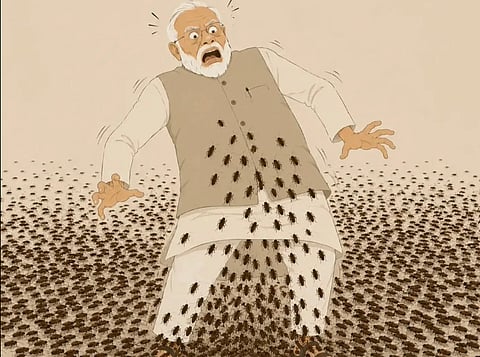
There’s a striking passage on language and reclamation. This places Gen Z’s adoption of the word “cockroach” alongside older histories of stigmatised communities turning insults into identity Dalits reclaiming words once used to abuse them, workers reclaiming the language of labour, feminist movements reclaiming words meant to silence women. What was meant to humiliate being called a cockroach or a parasite became, in this telling, a badge of resistance. The epicentre of this argument is a photograph: Abhijeet Deepke, founder of the Cockroach Janata Party, standing with supporters in solidarity with Sonam Wangchuk and three students on indefinite hunger strike Neha Bora (JNU), Aameen Amtoj (Ambedkar University Delhi), and Manish Kumar (University of Allahabad). All four, the piece notes, had visibly lost weight after days of fasting through Delhi’s scorching heat and also bearing the brunt of BJP led- Fascist government’s brutality.
The comparison that anchors historically is to the India Against Corruption movement at Ramlila Maidan in 2011–12 the last time, I argue, that India saw a mass mobilisation carrying this same democratic charge. Despite the violence surrounding Jantar Mantar, I think this is a very beautiful and hopeful moment as a resistance because it shows that demos of India’s democracy are alive and democracy survives not only through elections but through citizens willing to occupy public space when institutions doesn’t respond properly. Here Lohia’s line becomes very relevant that जब सड़कें सूनी हो जाती हैं, तो संसद आवारा हो जाती है". Now in order to reclaim our “Original Position” that is our Vision and promises of Republic, the demos/people of this country has to come down onto the roads and streets, the way Gandhiji, Bhagat Singh, Ashfaqulla Khan, Nehru, Ambedkar and many sung and unsung heroes of our freedom struggle envisages and imagined the original position of the Republic of India built on justice, liberty, equality, secularism and fraternity, and casts today’s protest as a defence of exactly that founding vision, not a threat to it.
Here I would like to situates India’s current political situation within a wider regional pattern. It points to Nepal’s democratic mobilisations, Sri Lanka’s Aragalaya, and Bangladesh’s student-led uprisings as evidence that across South Asia, Gen Z has become a indomitable political force one that treats the street as the last resort when institutions won’t respond to legitimate grievances. It looks much similar that the Gen Z and the Cockroach Janata Party at Jantar Mantar refusing to accept unemployment, exam scams, institutional decay and a shrinking democratic space, at a moment when public conversation is dominated by religion, caste, temples and symbolic nationalism instead of jobs, schools and justice. Their demands are constitutional at their core an accountable governance, equitable education, dignified work, equal justice.
To interpret this movement merely through the lens of the NEET controversy is to misunderstand history. Much like the greased cartridges of 1857 or France's fiscal crisis of 1787, NEET became only the immediate trigger for grievances that had accumulated over years of institutional neglect. The erosion of public education, healthcare, employment security, and public trust has produced a deeper democratic crisis. Jantar Mantar is therefore not the beginning of this unrest but the visible expression of Indian Gen Z and general demos demanding the accountability from the government.
Here I am providing the data to show exactly what had been “quietly dismantled” before NEET ever became the trigger and this is where it leans hardest on data.
On education: citing figures presented in the Lok Sabha by Minister of State Jayant Chaudhary, the article reports that close to 93,000 government schools shut down between 2014–15 and 2023–24 roughly 25 schools a day. Over the same period, government-school enrolment fell by 2.26 crore students, even as private schools grew from 2.88 lakh to 3.39 lakh a visible shift from public provision to market-led schooling. Uttar Pradesh and Madhya Pradesh alone accounted for about 40,000 school mergers, reshaping access to neighbourhood schools especially for rural, Dalit, Adivasi and economically marginalised children. The consequence shows up in dropout numbers too 3.5% at the upper-primary level and 11.5% at the secondary stage. For the author, these aren’t just administrative statistics; they represent the quiet withdrawal of a constitutional promise that education is a public good and a route to social mobility.
On health: the National Health Policy of 2017 called for public health spending to reach 2.5% of GDP, with the Centre contributing roughly 1%. The Union Budget for 2026–27 puts the Centre’s health allocation at just 0.27% of GDP a figure that has stayed under 0.3% for five years running. Even the modest bump seen during Covid has reversed; adjusted for inflation, the 2026–27 health allocation is actually 1.3% lower than what was spent in 2020–21, with central spending as a share of GDP sliding from 0.37% then to 0.27% now. The essay reads this as more than a budget cut a retreat from one of the state’s most basic welfare obligations, made worse by the fact that it comes after a pandemic that should have taught the opposite lesson.
On employment: drawing on the India Employment Report 2024 (jointly produced by the ILO and the Institute for Human Development), the piece notes that nearly 83% of India’s unemployed are young people, while almost 90% of the total workforce remains in informal employment low wages, no security, minimal protection. Regular employment improved modestly until 2018 but has since reversed course, giving way to more contract work and less job security. The author frames the demand for employment among India’s youth not as an economic wish-list item but as a democratic claim proof that the country hasn’t managed to convert its demographic dividend into dignified livelihoods.
On land and forests: the essay turns to the Forest Rights Act (FRA) of 2006, meant to correct the historic dispossession of Adivasi and forest-dependent communities, and argues its implementation tells a story of promise undercut by practice. Between July and September 2014 alone, 33 of 41 development proposals were cleared, diverting over 7,000 hectares of forestland, largely for private investment while the National Board for Wildlife saw its pool of independent experts shrink and decision-making concentrate in a small standing committee. As of 30 April 2026, only 47.1% of FRA claims had resulted in recognised land titles, with 52.9% rejected or still pending. The author reads this through a Marxian lens as a form of “primitive accumulation” dispossession achieved not through open coercion but through bureaucratic delay and administrative exclusion, clearing the way for capital-intensive development at the expense of forest-dependent communities.
On law and justice: the piece points to two cases as evidence of uneven accountability the Lakhimpur Kheri violence of October 2021, where four protesting farmers and a journalist were killed, and the Pune Porsche crash of May 2024, where a minor accused of killing two young professionals was initially granted lenient bail conditions that triggered public outrage. Against that backdrop, the essay argues, being compared to “cockroaches” and “parasites” landed differently for many young Indians as one more sign of a system that treats some lives as more accountable to the law than others.
Bringing these threads together, I reiterates the 1857 comparison: the NEET leak didn’t manufacture this anger, it simply lit a fuse that had been sitting there for years. Students beaten at Jantar Mantar, farmers who camped at Delhi’s borders, informal workers, Adivasi communities still waiting on their forest rights, and children who’ve lost their neighbourhood schools are, in the essay’s framing, all making the same underlying demand a state that is actually answerable and accountable to the people it governs.
Despite the violence and the physical toll on the hunger strikers, I think this is one of the most beautiful and hopeful moments where the courage of a generation standing against Hindutva and fascistic forces. The fasting undertaken by Sonam Wangchuk, Neha Bora, Aameen Amtoj and Manish Kumar, and the solidarity shown by Abhijeet Deepke and other Gen Z supporters, is presented not as despair but as democratic conviction a reminder that when institutions stop answering, peaceful resistance remains citizenship’s highest expression. I see the legacy of JP Narayan’s movement during the Emergency and to the farmers’ agitation in which, it states, 700 farmers died before the farm laws were eventually repealed as well as the scattered local struggles against displacement, caste violence, and ecological harm.
A couplet from Wasim Barelvi captures the mood the author wants to leave the reader with: “उसूलों पे जहाँ आँच आये टकराना ज़रूरी है, जो ज़िन्दा हों तो फिर ज़िन्दा नज़र आना ज़रूरी है” — when your principles are under threat, you must stand and fight; if you are truly alive, you must be seen to be alive. I see, These words are exactly fitting to the Gen Z that they stood up for themselves and for this country. Rather than accept “cockroach” and “parasite” as insults, the, Gen Z turned them into symbols of dignity and mobilized and extended it into a protest about one exam into a demand for accountable government, fair education, secure work and constitutional protection. Much like the anti-CAA movement or the farmers’ protest before it, Jantar Mantar is offered as proof that India’s democratic energy still lives on its streets, not only inside Parliament.
I borrow Slavoj Žižek’s distinction between Ptolemaic and Copernican responses to crisis where the Ptolemaic response patches a failing system with small adjustments to preserve its appearance; the Copernican response asks what structure keeps producing the crisis in the first place, and changes that. For more than a decade, in my opinion, Indian governance has stayed firmly Ptolemaic such as treating deep structural problems (unemployment, unequal education, ecological decline, agrarian distress, social polarisation) with welfare schemes and subsidies rather than addressing what actually causes them. As those problems deepen, the argument goes, elections and parliamentary debate alone start to feel insufficient to a generation whose daily reality hasn’t actually changed.
That widening gap between constitutional promise and lived experience, what I argue, something that has pushed Gen Z onto the streets not to request for a bigger welfare cheque, but a rejection of a development model they see as having lost its moral legitimacy. What they want is a republic where justice, equality, dignity, secularism and accountability aren’t rhetorical decoration but the actual basis of how the country is governed. For Gen Z specifically, Jantar Mantar is framed as symbolising exactly this Copernican demand not only the removal of one minister or one leaked paper, but a rejection of democracy reduced to ritual, in favour of real economic equality and social justice over systems that keep reproducing the precarious situation in the name of caste, communal, and structural exclusion.
If one looks carefully at this government trajectory then one can find that this Hindutva-Vadi and Fascist government, which manufactures enemies out of Muslims, Dalits, Adivasis and the poor of every faith because a working class united across caste and religion is more frightening to it than any external threat. Divisive politics, I argue is not accidental but strategic what Gramsci told “manufactured consent” wearing the costume of religion and caste so the poor fight each other instead of looking upward at the oligarchs above them. Crony capitalism, caste hierarchy and Hindutva are described as three faces of one arrangement where Marx’s warning about capital consuming labour, made literal in coal blocks and forests where Adivasi families and Dalit laborers become what Agamben called homo sacer: bare life, stripped of standing, whose land can be seized and whose death draws no real inquiry. The seven hundred farmer deaths at Delhi’s borders become an instance of what Achille Mbembe called necropolitics. Ram Rajya, has become the Master Signifier which is a sublime object of ideological weapon for the present government which made us to ignore the precarious situation across all spheres of our life. It is nothing but a fantasy screen concealing a hollowed out state.
But the good thing is that the Gen Z has understood the sublime object and Fascistic character of the government. And now the mask is off, the "Cockroaches are no longer believing in Ptolemic patches rather they are seeking Copernican treatment means fundamental change, the substantial change replacing top-down welfare with rights claimed from below, redefining development beyond GDP to justice, dignity, and ownership. The state must cease merely managing capitalism's contradictions and instead transform the unequal social relations that reproduce poverty, exclusion, and dependence.
Jai Hind.
- The author is associated with the Centre for the Informal Sector and Labour Studies, School of Social Sciences (SSS1) JNU, New Delhi.
You can also join our WhatsApp group to get premium and selected news of The Mooknayak on WhatsApp. Click here to join the WhatsApp group.
'The Mooknayak' practices democratic journalism. It is a media platform committed to the Constitution, democracy, and social justice. If you also want 'The Mooknayak' to always raise the voices of the marginalized and show the pain of the voiceless, please support us.
Please Contribute