— ✍️ Jayant S. Ramteke
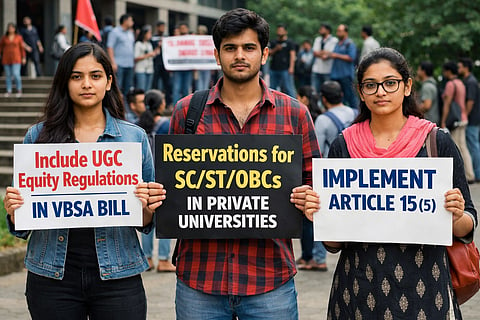
Following the Supreme Court’s decision to stay the implementation of the UGC Equity Regulations 2026, protests have erupted across several parts of northern India, led primarily by SC/ST/OBC student groups and social justice organisations. These demonstrations view the court’s move as a rollback of essential safeguards intended to curb caste-based discrimination in higher education institutions.
Major protests have taken place in Delhi, Varanasi, Lucknow and Bhopal. In Delhi, students from the University of Delhi’s North Campus marched in large numbers demanding the immediate reinstatement of the UGC Equity Regulations and the enactment of a statutory “Rohith Act” to ensure enforceable protection against caste discrimination. The protests were organised mainly by student bodies such as the All India Students’ Association (AISA) and were supported by faculty members and civil rights activists.
At Banaras Hindu University in Varanasi, SC/ST/OBC student groups organised marches and sit-ins under broad unity platforms, demanding the establishment of Equal Opportunity Centres and Equity Committees with genuine representation of marginalised communities. Protesters highlighted persistent discrimination in academic evaluation, hostel life and faculty conduct.
In Lucknow, student organisations including the Birsa Ambedkar Phule Students’ Association (BAPSA) led marches from Lucknow University to Parivartan Chowk, focusing on the absence of reserved-category faculty appointments and the urgent need to restore the UGC Equity Regulations. Senior activists and former public officials joined the protests, giving them wider political visibility.
In Bhopal, the Bhim Army and the Azad Samaj Party organised joint demonstrations, framing the issue as one of constitutional justice and social equality. These groups warned that the stay on the regulations weakens institutional accountability and emboldens caste-based discrimination on campuses.
The core demands of the protesters include the immediate reinstatement and implementation of the UGC Equity Regulations 2026, the creation of functional Equal Opportunity Centres and Equity Committees in all universities, transparent and time-bound grievance redressal mechanisms, and the passage of a stronger legal framework such as the proposed Rohith Act. Protesters emphasise that the regulations are not about expanding reservations but about ensuring dignity, safety and fairness for marginalised students.
The protests are being led primarily by student organisations such as AISA and BAPSA, along with SC/ST/OBC student unions, civil rights groups and social justice movements such as the Bhim Army and Azad Samaj Party. These groups argue that the stay order protects institutional privilege rather than student rights.
Yet despite their moral force, the present movement remains politically limited. It is reactive rather than transformative. Its central demand is the reinstatement and implementation of the UGC Equity Regulations. This demand is necessary, but dangerously insufficient. A movement that confines itself to restoring what has been stayed risks becoming an emotional response rather than a political force. It risks fighting yesterday’s battle while tomorrow’s legal architecture is being constructed without its participation.
History reminds us that rights are not secured through defensive pleading. They are secured through structural confrontation
The UGC Equity Regulations derive their legal authority from the UGC Act of 1956. But the proposed Viksit Bharat Shiksha Adhishthan (VBSA) Bill seeks to repeal the UGC Act altogether and replace it with a new regulatory framework. Once the VBSA Act becomes law, the UGC will legally cease to exist. With it, every regulation framed under the UGC Act—including the Equity Regulations—will automatically lapse unless explicitly incorporated into the new statute.
This is the central danger that current protests overlook. Even if the Supreme Court lifts the stay tomorrow and the regulations are implemented, they may survive only temporarily before disappearing with the UGC Act. The movement may celebrate a victory that quietly expires within months. That is not justice. It is illusion.
Therefore, the political demand cannot stop at “Bring back UGC Equity Regulations.” It must become sharper and legally precise: the Equity Regulations must be written into the VBSA Bill as binding statutory law. Anything less is temporary relief. Anything less is surrender disguised as success.
Rohith Vemula did not die because there was no helpline. He died because institutions exercised power without accountability. Payal Tadvi did not die because there was no committee. She died because elite academic spaces remained socially closed. Darshan Solanki did not die because of procedural failure. He died because caste was rendered invisible under the false language of meritocracy.
The protests must also confront a deeper question: what kind of law is the VBSA Bill?
Education lies in the Concurrent List of the Constitution, meaning both the Centre and the States share responsibility for higher education. The VBSA Bill upsets this balance by concentrating policy-making authority in a single central body and weakening the role of states.
For marginalised communities, this is not a technical constitutional issue. Several state governments have historically implemented progressive policies on reservations, scholarships and access to education. Excessive centralisation risks erasing these regional safeguards and replacing them with uniform policies driven by political ideology rather than social justice.
Federalism is not merely an administrative arrangement. It is a protection against monopoly of power. The VBSA Bill threatens that protection.
Even more dangerous than regulatory centralisation is financial centralisation. Under the VBSA Bill, the power to distribute grants will lie with the Department of Education under the Union government, not with an autonomous regulatory authority. This creates a system in which funding becomes a political weapon.
Universities aligned with the ruling establishment may be rewarded, while those that question or resist may be punished through budget cuts. This is not conjecture; it is a familiar pattern wherever political control replaces institutional autonomy. Over time, reduced public funding will force universities to rely on self-financed courses and higher tuition fees. Public universities will slowly become private institutions in disguise.
Education will shift from being a public good to a market commodity. This transformation will devastate SC/ST/OBC students, who overwhelmingly depend on public universities for affordable education. What caste exclusion once did socially, fee exclusion will now do economically.
The most glaring silence in the current protests concerns Article 15(5) of the Constitution. Introduced through the 93rd Constitutional Amendment in 2005, this provision empowers the State to provide reservations for SC/ST/OBC communities in private aided and unaided educational institutions, excluding minority institutions.
Nearly twenty years later, this mandate remains largely unimplemented.
India today has more than 500 private universities—about 40 percent of all universities in the country. These institutions dominate engineering, management, medical and professional education and have become the principal recruitment grounds for private industry. Yet SC/ST/OBC representation in these institutions remains abysmally low.
This means new corporate jobs systematically bypass marginalised communities. This is not accidental. It is the structural reproduction of caste inequality through the market.
The Constitution promised representation. The market has delivered exclusion. And the political class has protected this exclusion through prolonged inaction.
There is a deeper contradiction in the present protest strategy. The UGC Equity Regulations address discrimination after students enter institutions. Article 15(5) addresses discrimination at the point of entry. Without reservations in private universities, equity becomes cosmetic.
A campus cannot be inclusive if marginalised communities are numerically invisible. Protection without participation produces symbolic justice, not structural change. Helplines cannot replace seats. Committees cannot replace admissions. Regulation without representation offers moral comfort, not social transformation.
This moment demands not just louder protests but a deeper political shift. The movement must graduate from spontaneous resistance to a coherent political programme rooted in constitutional vision.
First, it must insist that the UGC Equity Regulations 2026 are not treated as temporary executive guidelines but are incorporated directly into the VBSA Act as binding statutory law. Without this, any restoration of the regulations will remain fragile and reversible.
Second, it must challenge the architecture of the VBSA Bill itself, which centralises power and places financial control over universities in the hands of the Union government. This is not a technical issue; it is a democratic one. A university system governed by fear of funding cuts cannot nurture critical thinking or social justice.
Third, and most urgently, the movement must place at its centre the long-ignored constitutional mandate of Article 15(5): reservations for SC/ST/OBC communities in private aided and unaided educational institutions. Equity within campuses cannot substitute for justice at the gates of admission.
These three demands are not separate struggles. They form a single constitutional battle grounded in Articles 14, 15 and 21—the principles of equality, non-discrimination and dignity. What is at stake is not one regulation or one bill, but the moral direction of higher education itself.
A movement that limits itself to restoring the UGC Equity Regulations will remain defensive and temporary. A movement that demands their inclusion in the VBSA Act, resists political control over funding, and enforces Article 15(5) will become transformative and historic. This is the difference between protest and political programme. This is the difference between reaction and resistance.
Rohith Vemula did not die because there was no helpline. He died because institutions exercised power without accountability. Payal Tadvi did not die because there was no committee. She died because elite academic spaces remained socially closed. Darshan Solanki did not die because of procedural failure. He died because caste was rendered invisible under the false language of meritocracy.
To honour these lives with temporary regulations is to misunderstand their meaning. Their deaths were not administrative accidents; they were structural indictments of India’s higher education system. Their memory demands more than sympathy and more than reversible guidelines. It demands a transformation of the very architecture of power, access and accountability in universities.
This struggle is not about one regulation or one court order. It is about who controls higher education in India and for whose benefit. It is about whether universities will serve democracy or hierarchy, inclusion or exclusion, dignity or dominance.
If the protests remain confined to restoration, they will remain temporary. But if they evolve into a movement that demands statutory equity in the VBSA Act, resists political control over funding, and enforces Article 15(5) in private universities, they can reshape the future of Indian higher education.
The choice before the movement is historic. It can remain a reaction to a judicial setback, or it can become a resistance that defines a new political programme for education. It can remain news, or it can become history. Only when emotional reactions are transformed into movement for constitutional rights, and protest into programme, will Rohith, Payal and Darshan be honoured not with words, but with justice.
-Alumnus of IIT Bombay and IIM Calcutta, Jayant S Ramteke is an educationist and founder & CEO of Meritorium Knowledge Academy
You can also join our WhatsApp group to get premium and selected news of The Mooknayak on WhatsApp. Click here to join the WhatsApp group.